
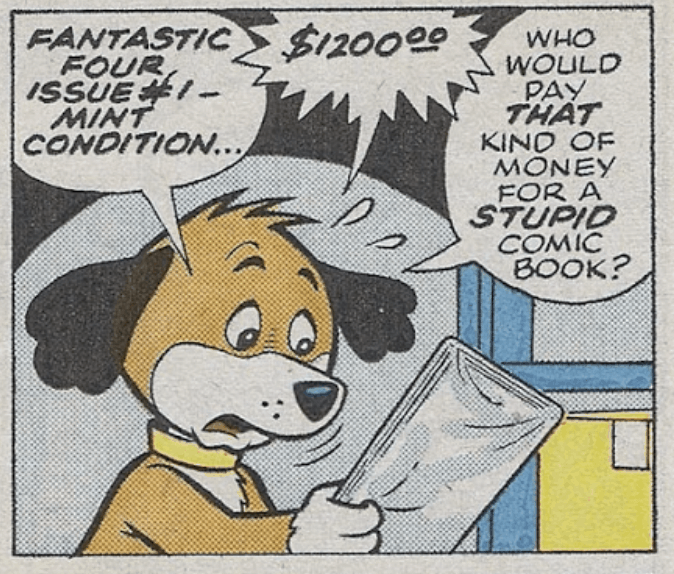
One thing I really like about The Walking Dead is that they never refer to zombie media; they instead act as if the phenomenon is wholly new. That’s an approach I’d love to see more of. The opposite is so weird in books like Kick-Ass where they are constantly reading comics. I’m reading a Stephen King book now where one of the characters is saying that The Shining isn’t a good movie.
Sure, the self-referentiality is weird, but what bugs me more is the common trope of “This story is real, unlike all these other stories I’m gonna name now”. Not into it. Like, a Marvel hero and someone in the comic says “Oh, like Batman from the comics?” and they reply “But unlike him I’m real” and I’m like… you guys are on the same level, quit it with this faux-Calvino nonsense, you’re only devaluing yourself by calling attention to the frame, the page, the ink.
I was looking for a TV tropes page for all this annoying genre awarenes, but they instead have a page called Genre Blindness where they disparage the approach that TWD so successfully took and that I prefer. That’s really backwards. (Also, using “blind” as a synonym for “unaware” is messed up.)
Listen, I don’t care if Batman comics or Spider-Man comics exist in your superhero book, but you don’t have to mention it or harp on it. It immediately breaks the spell when you start talking about how you’re so much realer than than all the other stories in your genre.
It was an interesting trope when it first appeared. It was great in Scream but it’s so overdone now. One early appearance I remember is in Watchmen, where the original Nite Owl is inspired by comics, but his own appearance then causes superhero comics to fall out of favor completely. But by now, it just feels dumb.
It only worked the first time, give it up.
Now I see that there is a Genre Savvy page! (So that’s what I should’ve named this page.) And it’s one of the most extolling, least-critical pages on the entire page (especially compared to theirnpage on Genre Blindness). Tropes aren’t bad across the board, they’re building blocks of shared experience, but some tropes are pretty bad and this Genre Savvy one, I’m pretty tired of, when they make reference to specific works.
Jens wrote in, saying that visual references and homages and callbacks are great. I agree, I love it, but what I don’t like is when the characters are talking about the genre in order to make their own story sound more “real” and it often has the opposite effect.
Like, a self-rescuing princess is fine, I have several examples in mind, and of other times people deliberately subvert tropes. That’s great.
But if those princesses then go “This isn’t Super Mario Bros, which is just a video game” (and this new princess is also just in a video game) then not cool. It’s the whole “this book is more real than this other specific existing book”, “this movie is more real than this other specific movie” that doesn’t work anymore.
I guess this goes back to Don Quixote except not really because it’s in a different genre. This works great for comedy, I love Gwenpool, for example (which is arguably the reverse of this trope, since she is using her genre savviness to invoke verfremdung rather than verisimilitude). It just in “oh this story is the only one that’s real life!” where it backfires.
Dangit, I wanted to write an essay about this so I checked to see if I already had! (As you can see above because I’m just adding these new thought onto it at the end.)
I wanted to talk a little about how the Question inspired Rorchach but then read a comic about himself. I wanted to write that Secret Identity by Kurt Busiek is actually really good. And also Gwenpool is amazing. I also reread all of Kick-Ass and Hitgirl and got really into it (I didn’t get to Big Game yet).
I still don’t like the trope—I think it’s disrespectful to the other hero comics to be all like “okay those other comics they’re all made up but this one is for real real”.
These thoughts today were prompted by me reading Batman #408 through #416 (and I might keep going for a few more issues after that, too). Where the post-Crisis, car-thief version of Jason Todd is first introduced. I thought it would’ve been really fun if Dick in #416 would’ve been all like “You fired me as Robin citing the reason that it’s too risky to have a nineteen year old sidekick and then you replace me with a way younger kid in the same issue” and throws Batman #408 in his face. #416 is explicitly stated to take place eighteen months later so it’d’ve been fun to have Batman then say “Some version of this convo is probably going to into #416 because we’ve had a time skip”.
That was just a daydream. Instead in the comic Dick is reacting to what he’s read in Gotham City newspapers.
I’m not talking about “we know we are comics characters” like She-Hulk and Deadpool and Gwenpool (although those are both really fun), I’m more trying to do the Watson and Holmes thing where the characters are “real”, it’s just that the writing about them is also diegetic.
I vaguely remember seeing something like this in Fantastic Four or Spider-Man where it’s alluded to that in the 616, there exists comics about these heroes. (The polar opposite of Watchmen where there was one real super hero comic book—Action Comics #1—but the real-life superhero fad yucked everyone’s yum about that so pirate comics took over instead.) It’s left super vague what’s actually in in those comics and how it works.
It made me wanna read comics where the characters in the comics are aware of the way their actions have been depicted in previous issues. On a time gap to account for editing, publishing etc. Like The Thing comes in angrily waving an issue of Fantastic Four at Human Torch being all like “dangit, issue such-and-such shows you making fun of me behind my back! Did you really do that or did the author add that?” “Yeah, I did. I’m really sorry.” Again, they aren’t reacting to comics panels or speech balloons or saying that they are fictional characters—they’re just real people living real lives but with awareness that they’re being reported upon in comics form.
After all, that level of constant surveillance is the horrific reality we all live in in this collective 1984 called The Internet.