Lately I’ve been using the +”%y-%V” date format a lot and I
wanted a weekday format to optionally append to that (although most of the time the weekly granularity is enough) and landed on
MTWRFSU for odd weeks and mtfwrsu for even weeks. I found online that
some schools and hospitals use that system for scheduling. It’s good
to have biweekly because then I don’t have to dedicate an entire page
every week for my todo lists. That reminded me of the Arvelie
calendar.
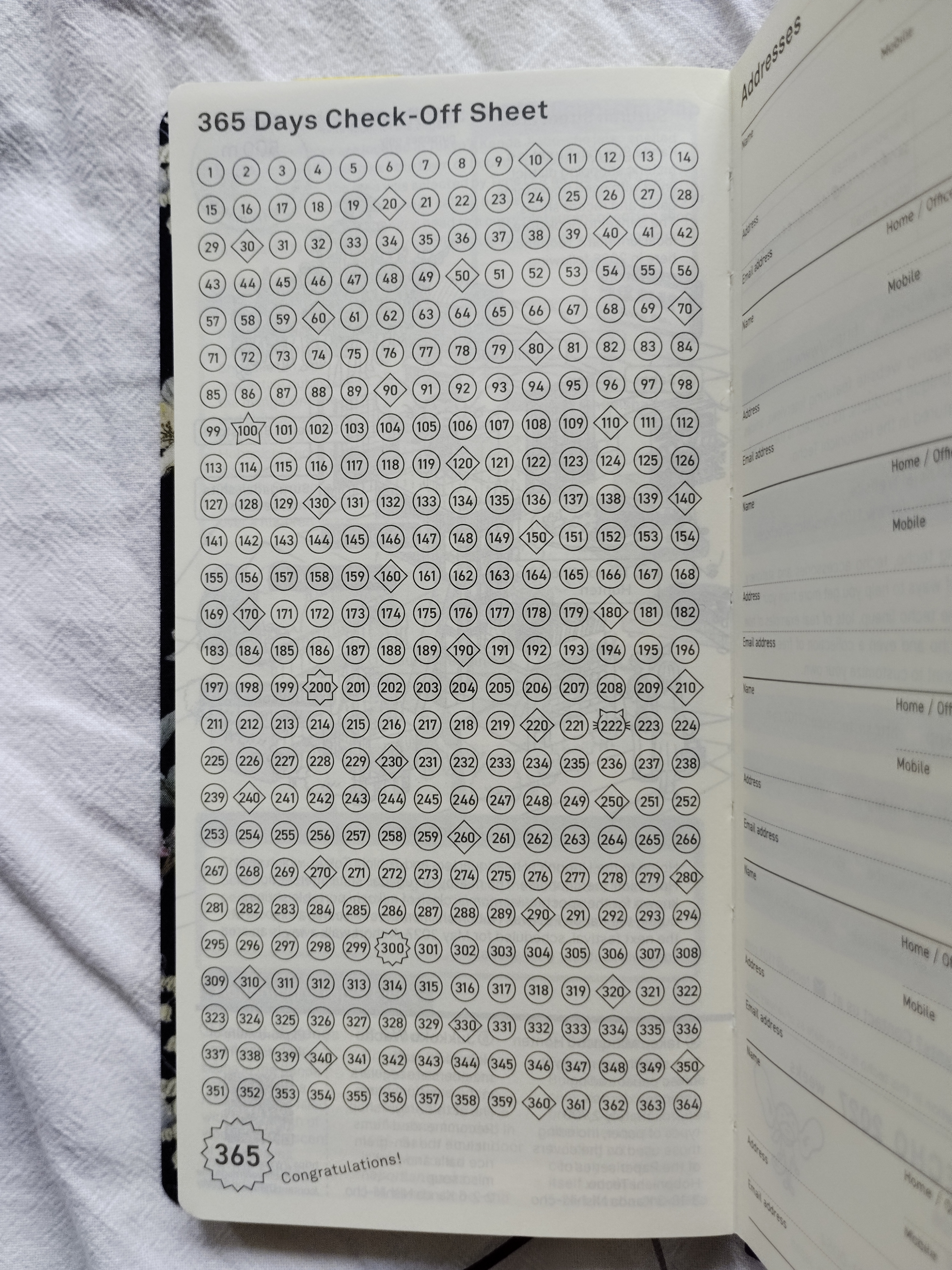
So in the back of a Techō Weeks there’s this “365 Days Check-Off
Sheet” that always look like this (even on leap years, which is
a bit awkward):
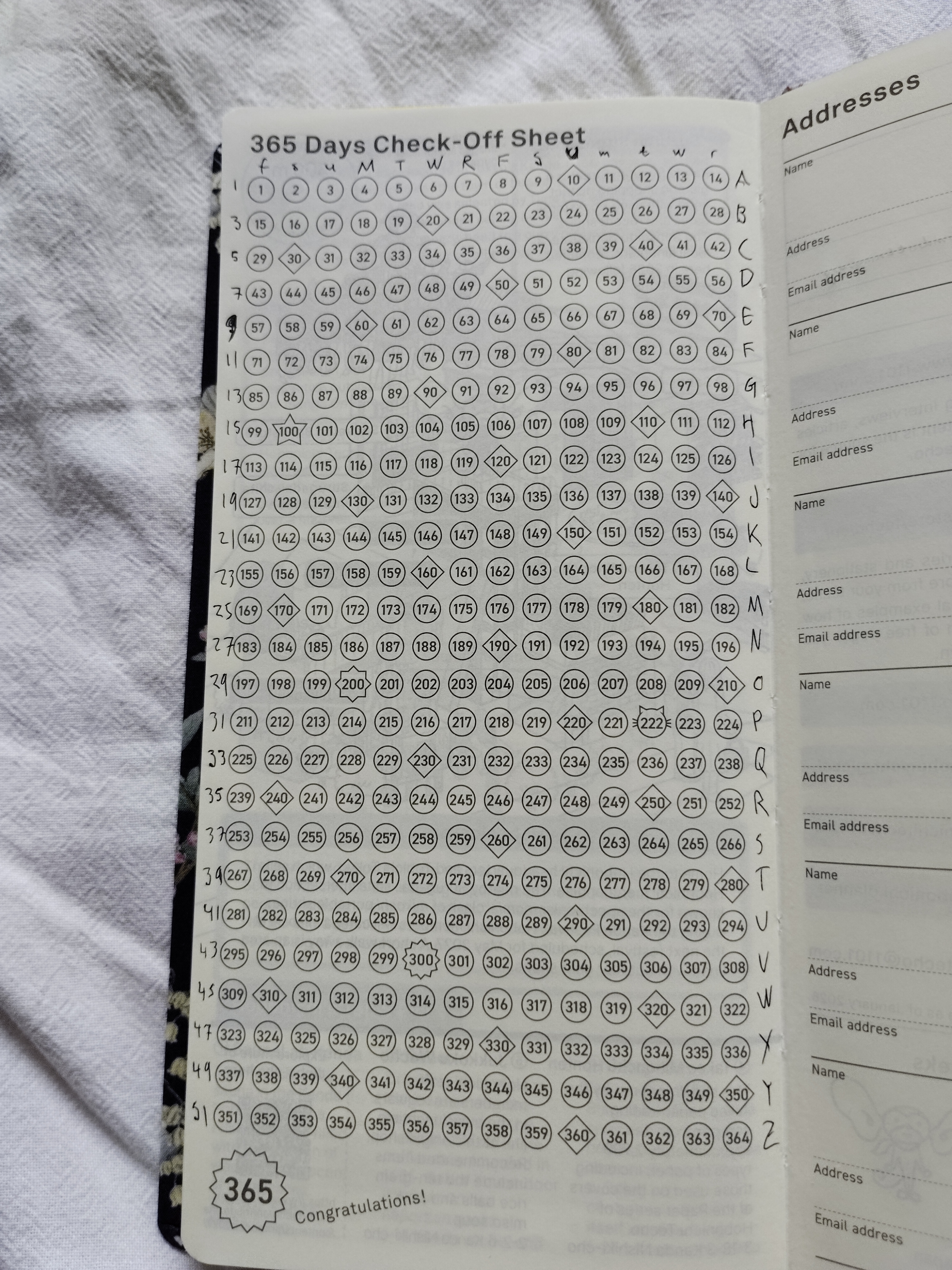
You can use it as an Arvelie calendar converter by adding some
letters down one margin and the week numbers down the other.
I went with uppercase MTWRFSU for odd weeks and lowercase mtwrfsu of
even weeks. Then I used the ISO week number that corresponds to the
entire week being fully contained on that line. So for 2026 that means
fields are labeled “RFSUmtwrfsuMTW” across and the weeks are numbered
going 2, 4, 6, 8 etc down. The “ABCD etc” vertical lettering is the
same every year since the Arvelie calendar doesn’t change year over
year, but the weekday label and week number does change. (I
looked it up with the help of the monthly spreads at the start of the
book. For example in 2027 the first Monday in week 1 starts with
January fourth. In 2026, the first full week is week 2 which starts
with a lowercase m on January fifth.) For 2027, the fields are
labeled “fsuMTWRFSUmtwr” across and the week numbers down go 1, 3, 5
etc. Like this:
How to find Arvelie date from Gregorian
Looking in the calendar on the monthly or weekly spreads you can find
your week and the day of that week and that way find your day of the
year in the grid. (Bonus if you also wanted to find out the day
of the year, like I’m writing this day 268 of 2026
apparently.) Then you can find the Arvelie month letter on
that row and to get the date you just count the offsets on the day on
that row. (The first row already has 1 through 14 printed but
remember that Arevelie is 0–13 so subtract one if you’re looking up
there.)
For example let’s say we’re gonna convert April 1st 2027. That is
Thursday week 13, an odd week so uppercase T. So find the number
crossreferencing T and 13, it’s 91. That number row has G and is the
sixth offset from the left so it’s Arvelie G06. Or let’s take an
even-week date like April fifth. Looking at the date in the monthly or
weekly spreads we see that that is Monday week 14. It’s the nearest
lowercase m following week 13 so it’s 95. That is Arvelie date
G10. (I don’t really use the 91 number or the 95 number, the
position of the number is all that matters, I just noted those here in
case you’re following along.)
How to find Gregorian date from Arvelie
Find the row corresponding to the Arvelie month, find the weekday and
week number by looking at the other letterals corresponding to that
number. Then look that day up in the monthly or weekly spreads. For
example Arevlie day J11 in the Gregorian year 2027 is 138, and that is
the lower case t on the 19 line so it’s Tuesday week 20, which the
monthly or weekly spread tells us is the merry merry month of May
18th. Again the number 138 isn’t used in the calculation, it’s
just my way to “point to” the right box for anyone following along at
home.
You can still use it as a check-off sheet
But every day becomes mapped to one particular date instead of any 365
days starting on any day, so that’s the trade-off here. You lose some
flexibility but gain being able to look up what day particular number
belongs to and you can find day of year and, by looking at the
alphabet rows, you can find the Arvelie grid.
This doesn’t have to be part of “setting up a new Techō”; since all
the info you need to do it is in the book (it’s a calendar, after all)
you can do it whenever you want to, for fun, just as long as you
brought a pen.
2026-09-25T12:46:05+02:00Idiomdrottningsandra.snan@idiomdrottning.orghttps://idiomdrottning.org/counting-the-reals<div xmlns="http://www.w3.org/1999/xhtml"><a href="https://idiomdrottning.org/counting-the-reals">Counting the Reals</a></div>
If we have a sequence of prime numbers, we can add in non-prime
natural numbers “in between” in a way that preserves the ordering by
making the newly inserted numbers be the products their neighbors.
We have 2 3 5 7 and we want to put a new number in between 3 and 5?
That’s gonna be 15 since 3×5 is 15.
Like if we have the numbers 2 3 5 45 and 15, we know that the leaf
order needs to be 2 3 45 15 5.
Why? Because first we take our primes; in this case 2 3 5.
Then we can insert the lower products where they fit, like 15 has to go between 3 and 5.
Then 45 has to go between 3 and 15. Our order can be reconstructed no
matter how jumbled the numbers are.
Or if we have 2 3 6 12 72, we know that their leaf order needs to be 2
12 72 6 3, same method. Factoring the numbers and seeing where they
go.
So to tell the story, on the planet Mars there’s a guy with two sacks.
One he fills with values: all the reals he can discover or come up
with, the other with keys: one natural number for each real in the
order he discovered them. He claims that this is a 1:1 mapping.
Someone tries to “find a new real” by diagonalising, he just puts that
on top of his value sack and adds N+1 on his key stack and calls that
a day. This “Martian Method” is not new to mathematics and if it
proved or disproved anything about the countability of reals that
would’ve been known by now.
Now over on planet Venus there’s me and I’m doing a way more
cumbersome method. First of, I seeded my value bag with the thousand
most popular and coolest reals, and sorted them in number order. I
gave the lowest the key 3, the second lowest the key 5, the third
lowest the key 7 and so on. Reserving the primes 2 for
lower-than-lowest and 7297 for higher than highest. From then on, as I
set out on my real gathering journey, no more primes for keys. Each
new real will be sorted in along the number line (so π goes between 3
and 4) and the key will be a non-prime generated by multiplying the
neighboring element’s keys.
So far, so bad. I have a lot of the same mathematically theoretical
drawbacks as the Martian Method of adding reals one by one.
I mean if a generator function for all reals (just as naturals have
“prev+1’) had been found, that would’ve been headline news since it’s
been proven that that can’t exist. Don’t worry, that’s not what this
is.
This is still pretty cool I think, because now here’s the one benefit
I have:
Let’s say there’s a hurricane one day across the solar system so that
all four of our bags are jumbled. All four bags used separate fonts
for the numbers in them (like, I used Helvetica for my natural indices
and Times for my reals, and on Mars they used Verdana for the natural
indices and Comic Sans for their reals) so there’s no worry at of what
number goes in which bag. Even so, the Martian guy is SOL at this
point. He can’t reconstruct his mapping.
I can easily. I just sort all my reals according to the number line
(so 3.5 goes after π but before 4 and so on) and I can figure out the
proper ordering of my keys also. I reset the primes to the order they
started in and then their products go in between them. I find a 35 I
know it needs to go between 5 and 7. I find a 175 I know it goes
between 5 and 35, that’s the only place it can go. Then I lay the two
arrays next to each other and I have my 1:1 mapping back.
That’s it. That’s what was new and cool in this paper. No more, no
less. Still no ordered generator for the reals.
If we’re adding the reals in a sane and orderly fashion, this does not
work. Like, let’s say we first add all reals that are also naturals.
Then we add all halves. Then we add all quarters. Then we add all
eights. Then we add all sixteenths and so on fractally. That’s no good
because that fractal will bloom out and “use up” all keys before we
even get to things like thirds and fifths, let alone pi and e.
This can only work if we add all possible reals willy nilly, in an
undefined order, sorting them after we add them. So if we add 8
after 7 and 9, it goes between them because seven eight nine.
Instead seeding with a thousand popular reals and the 1002 lowest
primes, I could also have started with an empty bag of reals and just
the primes 2 and 3, that works just as well. The first real I find
gets key 6, the second real I find gets either 12 or 18, the third
real I find gets either 24, 72, 108, or 54. And so on. That’s the
elegantest way to do it.
Since the primes don’t need to be in natural order, just in an order I
can get back later post-hurricane, I also could’ve started with the
ordered infinite set that’s all possible primes five or higher from
here to eternity, setting aside 2 and 3 to use for boundary factors
later, and map that infinite set of primes to my value sack of reals
which is seeded with all possible algebraics, mapped 1:1 to those
prime keys. Then I just need to go hunting for all possible
transcendentals. And yes, there are infinitely many of them but that’s
fine, I have an infinite amount of keys since I can just keep on
multiply the neighbors. In between 2 and 3 go 6. In between 2 and 6
go 12. In between 2 and 12 go 24. And there’s no other place the 24
could go.
Follow-up
Carl writes in, saying:
Thinking about your primes thing. I think that it has a similar
structure to the rationals, right? Just as you can take any pair of
rationals and find another rational between them, so can you take
any pair of naturals and find a natural that goes between them in
your ordering.
Generating the Reals
I can’t write a generator if the sequence has more than one infinite
loop and I also need to be able to refactor the infinite loop to go on
the outside of all other loops or I’d get unreachable code. Like,
generating infinite squares with a do while true loop is easy.
Generating infinite rectangles trickier but possible with zigzagging
like 1x1, 1x2, 2x1, 1x3, 2x3, 3x3, 3x1, 3x2 and so on.
That’s why generating all finite binary strings is super easy, barely
an inconvenience. But generating all infinite strings not so much
since that would require two nested infinite loops which creates
unreachable code.
Don’t shoot the messenger here:
I’m not promoting metric,
I’m not advocating for metric,
I’m not saying metric is OK.
I just wanted to help those who are subjected to metric.
You can and should use a conversion app for when it really matters
but this is just a rough guide for those who want some basics.
Distances
A meter is around a yard, more or less, so ten foot is around
three meters. A meter was originally defined as one ten-thousandth of
the distance between the equator to the pole, so 1/40000 of the
Earth’s circumference. With the garbled measuring powers they had back
then, that is not saying much.
Each kilometer is a thousand meters.
Five kilometers is around three miles,
and ten kilometers is around six miles. Going the other way,
ten miles is a little over sixteen kilometers, which means that five miles is eight kilometers.
Going small, this is so dumb but we have both centimeters
(one-hundredth of a meter) and millimeters (one-thousandth of a meter)
and yes, confusion between those two have messed up many a project.
Two inches are approximately five cm which is also fifty mm.
Sizes
100 mm is 10 cm which is 1 decimeter which is a tenth of a meter. A
cube of that is a liter. A liter is more-or-less a quart, a fourth
of gallon or two pints.
A cube of one centimeter is one milliliter (yes, this is dumb). Milli
means one thousandth while kilo means thousand. A hundred milliliters
is a deciliter, which is what we use instead of cups; it’s a li’l less
than half a cup, two cups is almost five dl.
Weights
Now this is the good part: one liter of water weighs
one kilogram, which is a little over two pounds,
or a stone is a little more than six kilograms. So you can just double
a kilogram weight to get an approximation of the pound weight. Why
“kilogram” is the main unit and not a gram (a thousand grams are one
kilogram) I’ve never understood. That’s just how it is.
But a good thing for all y’all gem lovers out there is that a carat
is actually a metric-based unit
already—five carats are exactly one gram.
Areas
These aren’t exactly day-to-day for me so I had to look it up. A
hectare is an area that’s a 100 meters by a hundred meters. (Or
50 by 200 or any other weird shape just as long as it’s that
size.) Usually imperial units are a bit bigger like two cups
is five dl, two inches is five cm but with hectare, it’s two hectare
is close to five acres. I’ll try to remember that by thinking that
“hectare” has more letters than “acre” just like “inch” has more
letters than “cm” and “cups” has more letters than “dl”.
For things like apartment sizes it’s a li’l easier; use an app when it
really matter down to the exact digit but just to get an overview, 100
square feet is a little more than nine square meters, so just lop off
the last digit. When someone says “Oh I manage to live so
minimalistically at 400 square feet” I can immediately know their
place is way bigger than mine using the lop-off shortcut (“400
becomes 40”; it’s actually 37.16 which is close enough).
Temperatures
Temperature… While there is a formula, it’s convoluted (multiply ˚C by
nine, divide by five, then add 32, or the other way: subtract 32 from
˚F, then multiply by five, divide by nine) it’s probably best to just
memorize some key values.
Ice is 0˚ C, steam is 100˚ C, water is liquid in between.
C is actually good for cooking for that reason.
0˚ C is 32˚ F, 37.78˚ C is 100˚ F, 100˚ C is 212˚ F. (Since
20✕9+32 = 212. All Celsius values that are cleanly divisible by five
come out as integer Fahrenheit values.) Fahrenhet is good for
weather. 0 is really cold outside and 100 is really hot outside.
Celsius is cranked up to be about literally boiling things on the
stove or in the lab, and it’s off by thirty.
So an increase by one degree ˚C is approximately 2˚ F; if it gets
ten degrees hotter in ˚C that’s around it getting twenty degrees
hotter in ˚F! Eighteen to be exact! The problem is that F has a 32
degree head start so
for a super rough conversion from C to F: double and add thirty.
Learning a system
Conversion is no good if you wanna learn a system. For example, D&D
uses imperial and my players came from metric so I was always
discouraging converting to metric or refering to metric, instead
always pointing to references like “oh, it’s around a foot” and
holding up my hands approx a foot apart, or “ten by ten foot is like
this room” or “OK, I’m five foot seven so on me the water would go up
to here” or “it weighs like four swords”. To start thinking in the
other system directly as soon as possible. I know that might sound
like a mistake akin to “whole language instruction” but I think
this is a different case.
And if you just need a one-off, there are apps for that. If
you’re a translator of fiction, remember to round so your characters
are saying reasonable things. No one says “OMG we’re going over 160.93
mph!”. If you’re an engineer, of course never round and instead be super
precise.
Rough conversion guides like this page is for the middle ground. When
you’re subjected to metric more than a one-off but less than actually
having to learn it, this page is for you.🎁
It’s for those who are metric-curious but not invested. Who still want
to hate it but want to know a little bit about what they’re hating.
PS
Metric is also the name of a super good Canadian band that I really
love! Waves is my favorite song of theirs among many many
fantastic gems. But I can pretend that the band name means “a metric
to measure by” as opposed to “the metric system”.
2024-08-25T07:58:41+02:00Idiomdrottningsandra.snan@idiomdrottning.orghttps://idiomdrottning.org/unit-of-selection<div xmlns="http://www.w3.org/1999/xhtml"><a href="https://idiomdrottning.org/unit-of-selection">Unit of Selection</a></div>
It’s Stephen Jay Gould’s “Caring Groups and Selfish Genes”! 🥁
Group selection
The world of objects can be ordered into a hierarchy of ascending
levels, box within box. […] Life, too, operates at many levels,
and each has its role in the evolutionary process. Consider three
major levels: genes, organisms, and species.
That’s indeed a useful model, but in the end it’s just a model, one
that, in this particular question might lead us far astray from the
truth, as I’ll try to argue.
Mutation is the ultimate
source of variation, and genes are the unit of variation. Individual
organisms are the units of selection. But individuals do not evolve—they
can only grow, reproduce, and die. Evolutionary change occurs in groups
of interacting organisms; species are the unit of evolution. In short,
as philosopher David Hull writes, genes mutate, individuals are
selected, and species evolve.
So the question I wanna look at here is what the unit of selection is,
if it’s only on the individual organism level or if something else is
going on.
The identification of individuals as the unit of selection is a central
theme in Darwin’s thought. Darwin contended that the exquisite balance
of nature had no “higher” cause. Evolution does not recognize the “good
of the ecosystem” or even the “good of the species.” Any harmony or
stability is only an indirect result of individuals relentlessly
pursuing their own self-interest—in modern parlance, getting more of
their genes into future generations by greater reproductive success.
Yes, it’s good to maintain awareness of a lack of teleological “intention”
around a lot of stuff that the creepy crawlies on this blue li’l
marble are up to. It’s an emergent system. I just wanna go one step
farther and note that unlike Conway’s “Game of Life” model, the
rules of our system can themselves change. We don’t have to live in a
Galt’s Gulch of cruelty and robbery.
Individuals are the unit of selection; the “struggle for existence” is a
matter among individuals.
Huh?! Three seconds ago we were saying it’s not teleological. A bee
isn’t gonna start belting out “I will survive!”
You correctly pointed out that evolution does not recognize the “good
of the ecosystem” or even the “good of the species”, but it doesn’t
consider the “good of the individual” either.
Instead, evolutionary processes effect pressures on all kinds of
units. People, animals, herds, hives, cities, corporations, clubs,
tribes, bands, families, nations… There are also evolutionary
processes on memes! Religions, editors, operating systems, game
rule sets, political platforms, resource distribution protocols…
Evolution, probably better known as throwing spaghetti at the wall and
seeing what’s best at sticking around and then recursing on that,
isn’t limited to just “each animal for themselves”. Evolutionary
processes are everywhere in complex iterative systems, not limited to
just one level.
Nations, cities, clubs, corporations are all examples of evolutionary
processes on a group level. Successful group concepts will not only
thrive, they’ll be copied. If we aren’t aware of these emergent
consequences of our protocols, we will get wrecked.
Scottish biologist V.C. Wynne-Edwards raised orthodox hackles
fifteen years ago by arguing that groups, not individuals, are units
of selection, at least for the evolution of social behavior.
Yes, it’s correct to observe that evolutionary processes effect changes on groups.
Some of the specific mechanics proposed by Wynne-Edwards (like
epideictic displays to manage group density) ended up not being
proven.
But remember, it’s not teleological. Just like most bees or algae
don’t go “Hmm, what shall I do to survive today?”, neither do most
hives. They don’t summon everyone for a big speech going “Listen up
gang! We’re getting a li’l too dense over here, so fewer babies next
spring”. That’s a straw reading of group selection pressures.
Siblings, on average, share half their genes. If you die to save
three sibs, you pass on 150 percent of yourself through their
reproduction. Again, you have acted for your own evolutionary
benefit, if not for your corporeal continuity. Kin selection is a
form of Darwinian individual selection. […] Most evolutionists
would now admit that group selection can occur in certain special
situations (species made of many very discrete, socially cohesive
groups in direct competition with each other). But they regard such
situations as uncommon if only because discrete groups are often kin
groups, leading to a preference for kin selection as an explanation
for altruism within the group.
While that would explain racism, it’s wrong because it, again, overly
ascribes intent to these li’l dandelions and fishes. Instead, reframing the
evolutionary process as a mutually recursive eval/apply loop of
iteration-via-survival, survival-via-iteration of pressures it becomes
clearer to see that it works on all kinds of groups whose behaviors
can evolve. That would explain not only racism but also sexism,
nationalism, classism, ageism, all kind of dumb bullying.
Group selection is a real thing. It’s also why gay. Gay behavior has
emerged in many species even though it’d make an orthodox darwinist
panic; it would seem incomprehensible on an individual-survival-level.
But a queer eye can be a vital thing for a society. Through a group
selection perspective, it makes total sense. A diverse group has
complementary strengths.
Now, as Gould himself points out in a previous essay (called
Shades of Lamarck), we humans can hack this.
There’s also memetic evolution. Our books, our ideologies, our git
repos, our games and our laws—in short, our protocols.
If we wanna fix things and end racism and nationalism and corrupt
corporate overreach, step one is to stay aware of how this stuff
works.
This is also why climate change is such an incredible mindbomb to try
to address. We’re set up to make most of our decisions on some
sorta Dunbar tribe scale, but now we’ve got to work together since
planets are the units of selection here. Planets that can get its shit
together and not burn themselves will survive longer than those who
do. (That’s maybe not an evolutionary process in the strictest
sense since there’s no iterative copying of planetary setups, at least
not yet. We’re not living in a rimward Orion Arm galactic empire or a
Bostrom sim multiverse, as at least as far as we know. So it’s not a
full eval/apply loop, just a survivability eval part, but… Uh, let’s
not mess this planet up, please!)
For some reason we managed to do it in the seventies and eighties with
the energy crisis and freons, but since this affects every consumer,
corporation, and politician, not just OPEC or a small handful of
corporations in the refrigerator and hairspray business, there’s a
lot more squabble. We’ve got to rise above, sooner rather than later.
My selfish gene it fills my spleen
The second half of Gould’s essay is better, arguing against Dawkin’s
expression of Maynard Smith’s horrible “selfish gene” idea. Let me use
language as an analogy to show how wack that idea is:
One of the things that make human language so cool compared to the
language of many other animals like monkeys or fish is that it’s
multilevel.
There are monkeys where one type of scream means “danger, snake!” and
another means “danger, eagle!”
We humans go one step further since we have put our screams (our
“phonemes”) together into words, whether the combinations and their
order matters. “Eek” means something different than “key”, “wish”
something different than “shiv”, “canal” something different than
“Lacan”. “Forty-six” something different than “Sixty-four”.
Dogs can understand that level of human speech just fine. They are
much better at it than most human kids are. They can understand “go in
the other room and get the blue ball” way better than most human li’l
rugrats can.
However, we’ve cranked it up a notch since we’ve then put our words
together in combinations where their order matters.
“Before you get the red ball, get the blue ball” mean something
different than “get the red ball before you get the blue ball” even
though it has the same words, just in a different order. Even
though the phrases “red ball” and “blue ball” are in the same order,
things like the placement of “before” flips the meaning entirely.
Most dogs can’t understand that at all while most human kids understand it just fine. This is called “syntax”—the order of words mattering. Once you take syntax into account, that’s where humans are a li’l special.
And then of course that can be recursed upon further. Watching Memento in the chronological cut is a different experience than watching it the way it was originally released.
There’s evolutionary pressures on ideas, on slogans, on books, on political platforms. The evolutionary pressure on individual letters is way lower by comparison. Yeah, yeah, I might slightly favor words with my favorite letters like “s” and get a li’l turned off by the guttural IPA [χ] sound of Loch and Bach, but not to the extent that I’m throwing out an entire idea because of that. But, then again, “why not both?” Evolutionary pressures happen on all kinds of levels. To the extent that selfish gene idea tries to reduce it to only or even primarily genes, that’s wack.
I get the idea was to promote kin selection, to be like “OK here’s why
we help each other; it’s because our genes recognize themselves in
other people, not literally because genes don’t have eyes, but various
processes have emerged that rewards and affords such help”, but on the
surface level it still feels like an artifact of the
hyper-individualist era. Forget Galt’s Gulch, it’s not even enough
with “every man is an island”, now my left arm is trying to stage a
coup against my right foot!
2024-07-02T13:22:56+02:00Idiomdrottningsandra.snan@idiomdrottning.orghttps://idiomdrottning.org/prime-one<div xmlns="http://www.w3.org/1999/xhtml"><a href="https://idiomdrottning.org/prime-one">One among primes</a></div>
My mathematical training taught me that the good reason for 1 not being considered prime is the fundamental theorem of arithmetic, which states that every number can be written as a product of primes in exactly one way.
When I was young I thought that 1 was prime. The guy who explained that it wasn’t just said “they just decided that it’s not prime, a lot of stuff works out better that way”. A good, succint “a wizard did it” explanation that satisified me (after all, it had worked out for i, j, k and so on, I didn’t trip out over the name “imaginary” and it pretty immediately turned out to be useful) and over the years I found that it was true, that a lot of things really did work out better.
But reading Lamb’s essay, I see that a wizard really did do it, i.e. that it really was something that the math community actually decided rather than calculated out.
Take a polyhedral projection, like octahedral or icosahedral (or even more faces, the more faces the better, it doesn’t have to be a platonic solid).
Unfold. You now have something that looks like the Dymaxion or Butterfly.
But rotate the continents so they look like they’re placed in traditional world maps. Careful: do not cut every li’l face, just cut out the continents, as big pieces as possible, and rotate them and place them.
Add water! It’s not a sea map, it’s fine if oceans are distorted, it’s a land map! Add more sea! Make some sea distances smaller and some larger, just add endless distortion out at sea.
Basically take a rectangle, fill it with water, cut out the continents
from a Dymaxion style map (making few big cuts rather than many small
cuts), place them in that water guided by some other projection.
So the map still looks rectangular and “normal” except it doesn’t have Mercator’s follies.
That’s the world map poster I’d want. I don’t want it to look like an orange peel but I want the projection properties of an orange peel map. I’ve wanted this since 1988 when I first saw the Goode homolosine, which isn’t a polyhedral projection but it’s what inspired the idea: “why not just place this on a backdrop of sea so it looks normal!?”
(And then do the opposite for a separate map that is a sea map at the expense of land accuracy.)
This sort of map, like all polyhedral projection maps, is pretty useless for actually measuring things on. It’s just nice to look at and we get to see places in their real sizes (as long as they’re land places and not oceans). The Thissots indicatrix is awesome on this one.♥︎
A few years ago the build the earth project for Minecraft had a
similar idea calling it “Modified Airocean”. Very awesome! I haven’t
found images but judging from the text description, it sounds right:
This map projection provides an extremely low amount of distortion
of both shapes and sizes on land, at the cost of heavily distorting
the oceans. Unlike the Dymaxion, Modified Airocean is not intended
to be unfolded into a 3D object like an icosahedron, and has its
continents placed such that it looks somewhat similar to an
equirectangular projection.
But I wanna see big poster maps based on this! I can’t even find any
dinky li’l low-rez JPEGs of what they had, let alone a huge wall map.
My folks used to have a big canvas world map (from Ikea I think) but
it looked so distorted since it was Mercator. That was only the second
biggest problem; the biggest issue was that it used Copperplate
Gothic.
2024-01-20T19:54:16+01:00Idiomdrottningsandra.snan@idiomdrottning.orghttps://idiomdrottning.org/block-universe<div xmlns="http://www.w3.org/1999/xhtml"><a href="https://idiomdrottning.org/block-universe">The block universe and you</a></div>
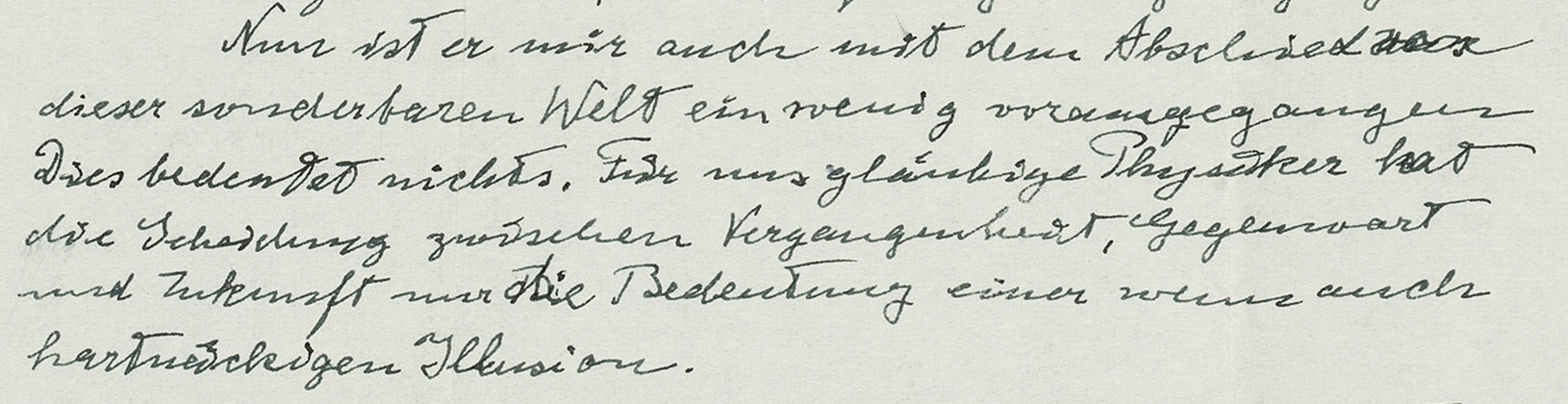
When Einstein’s best friend Michele died, Einstein wrote a letter to
Michele’s widow saying:
This doesn’t mean anything.
He wasn’t just trying to be a math nerd version of Liza Radley or
a German philosopher’s wrong-headed remix of Hassan-i-Sabbah.
Einstein expressed belief in eternalism, probably better known as the
“block universe”.
The block universe is the idea that past present future is all in one
big old four-dimensional “block”. You know how a doll’s house can be
set up as a static three-dimensional diorama? You can look at the
living room, the bedrooms, the kitchen… fun fun fun.♥︎ And then
imagine you added a pause/play/forward/rewind button set so you could
look at the living room before and after the glass table was
shattered, or the bedroom before and after grandpa drinks the
posset, you could go back and forth through it.
In fact, instead of making it “rewind buttons”, just build the entire
doll’s house four-dimensionally directly into space-time so that all
points of time are there at once. Everytime existing at the same time
with no difference between the past or the future.
Such is the world of the block universe.
It’s a worldview that came about because it helps makes the math
around some weird things like how time passes differently for
astronauts and such. Not that simple math is always right or that
Occam’s razor is always particularly accurate in its ruthless carving
of reality, and I’m no mathematician and even Einstein’s relativity
equations were wrong about rotations of the outer edges of galaxies so
who knows whether or not the block universe is a real thing or not but
for the sake of this li’l essay, let’s pretend it is.
Now, the whole doll’s house is an analogy since for most of us, our
own view of time is moment-by-moment like Bodhidharma intended, at
least without a few spoonfuls of Strawberry Fields.
The comfy life under the marmalade skies
The block universe is comforting in some ways, as Einstein noted; the
past is no less valuable than the future. As I’m aging I find the
green leaves of hope in the tree inside my heart one by one turn into
red leaves of memory. Not as many as I would’ve hoped, and many leaves
just wither or fall of and never come to pass, but some. And some that
I never even dreamed of.
In the block universe, Nabokov’s “brief crack of light between two
eternities of darkness” can be an ever-shining drop of gold.
The Amber Prison
The block universe is also an horrifying idea in some ways.
For us with messed-up pasts facing the grim darkness of the far future
there can be great comfort in the present. Take my past, my future,
fine, but now is mine. Things that happened in the past, happened in
your mind. Lead kindly light. Et cetera.
The block universe keeping the past alive in amber is not entirely a good thing.
The future is similarly frozen.
In Lovecraft’s stories, where the universe is a twisted nightmare
brought forth by an unruly, unthinking Azathoth, one of the chief
horrors in that nightmare is spacetime itself, probably better known
as Yog-Sothoth. The inescapable uncaring cosmos. All matter and all
processes wrapped up in a bow.
From the “What the Hell” family’s relation to “Free Will”
Don’t worry, there are still tensions and forces and processes in the
block universe. There can still be a bookshelf between that olive
green dictionary and the floor. Direct spatial relationships, and
direct temporal relationships like how a dance party can be preceded
by sending out invitations, or a shattered glass preceded by a fall.
We’re condemned to choose.
What we call “free will” is our precious, invaluable interface to
these processes. We are non-teleologically put on this God’s
blue-marbled green li’l Earth completely interlaced with these
processes, like all animals are and all matter is.
Do not squander that. No matter how absurd the li’l Azathoth windfish
garbage nightmare we’ve been thrust into, we have a responsibility
to make the best of what-is-perceived-to-be-our-choices.
How to love when you’re already dead
It’s harder to change a situation if you can’t even make yourself
realize it’s true.
When you’re still in “this can’t be real” mode it’s easy to get
tripped up, to panic, lash out, lockup, compartmentalize, block out,
push away, ignore, repress, freak out, make excuses.
Once you can see that it can be real, no matter how bad it is, you
can calmly do your best to try to fix or mitigate things.
The comforting aspects of “block universe”, or of its complement, the
“moment-by-moment” universe, can make us less attached to our wishful
thinking about the future and more clear-headed to try to solve
things.
Living in the world fully is pretty hard, and not getting attached to
the dust of the world is not easy either; doing both at the same time
is way harder but that is the challenge we have to rise to.
It seems to me that the ban on “thinking machines” in Dune isn’t just
a ban on the extreme cases of super clever and emotional Pinocchio
AGI.
It’s a mandate for human oversight and judgment. There is a lot of
tech and automation that has existed throughout the past decade that
doesn’t fulfill that mandate. Scripts are fun but we’ve got to check
the work.
The risk isn’t primarily “Skynet” or “Reign of Steel” or “Matrix”.
It’s that we leave ourselves vulnerable to other humans who can wield
their machines more effectively and wield our machines against us.
We’re already seeing this with inventions like Facebook and
television. So many people have made themselves dependent on machines
and algorithms out of their own control.
The recommendation engines of YouTube, Facebook, Twitter, TikTok and
similar sites have lured people into fascism. It’s no wonder! Fascism
and algorithmic popularity are both fueled by the same thing:
Conformity and binding the outgroup.
If we start obeying machines, that means obeying the owners of those
machines. And I trust them about as far as I can throw Manhattan.
2023-11-22T13:39:44+01:00Idiomdrottningsandra.snan@idiomdrottning.orghttps://idiomdrottning.org/gaps2<div xmlns="http://www.w3.org/1999/xhtml"><a href="https://idiomdrottning.org/gaps2">The God of the Gaps is coming from inside the house</a></div>
I’ve long thought it was sus that the “New Atheist” writers were so
eager to criticize the beliefs of the Foreign Other to a much greater
extent than their own cultures.
The core of the New Atheist argument is that beliefs in non-proven
supernatural entities should not unduly influence human behavior,
society, and policy without a strong basis in evidence.
They come across as not overly fond of arguments like Spinoza that
want to combine appreciation for the natural world with the gratitude
attitude, or like Kierkegaard who saw the world as ultimately an
unknowable absurdity of crawlies and forces but put up an “I Want To
Believe” poster in his office regardless.
Criticizing Spinoza and Kierkegaard is fair game! Science is about
things we know and society should be based on what we do know.
And yet…
Scientists place their faith in supernatural things all the time!
The New Atheists hate the God of the gaps but don’t raise concern
against strings, selectrons, dark matter and other modern day
“angels”.
String theory isn’t falsifiable since the mathematical equations are
so mutable. The strings are like Russell’s Teapot, swirling around in
space and can’t be disproven since you can’t look everywhere at once.
Don’t get me wrong! I love that these theories were put forth and that
they’ve had so much care & thought behind them. The only way forward
for science is to come up with new wild ideas and then test them.
Occam’s Razor is just a guideline, not literal fact.
However, belief in some of these or “teapots” have been impactful on
people’s lives even though they ended up not being there once we were
able to look. People have staked their careers and dreams on these
li’l angels when they were still “supernatural”, which they ultimately
turned out to be.
They say the original sinners never felt a drop of pain until that
second in the garden, then they felt it each and every day. So draw
back your bows, you hunters who have never felt that flame! All the
absolute beginners are safe in the shade for today.
2023-09-25T10:58:29+02:00Idiomdrottningsandra.snan@idiomdrottning.orghttps://idiomdrottning.org/physics-vs-crime<div xmlns="http://www.w3.org/1999/xhtml"><a href="https://idiomdrottning.org/physics-vs-crime">Physics vs Crime</a></div>
Captain MW
Assistant: “Captain, we don’t know until we’ve done dusting tests whether the culprit is the neighbor coming through the window, or the butler coming from the hall.”
Captain MW: “OMG! This is a remarkable paradox! The culprit is the neighbor and the butler at the same time!”
Assistant: “Not really… but until the prints come back, we won’t know which it is; until then we can rule out people who weren’t even in town that day. So there’s still a lot of progress we can make on the case with what we’ve got so far, we can sta–”
Captain MW: “You’re saying that those prints will collapse the wave function! Impossible! But don’t worry, Captain Many Worlds to the rescue! It’s clear that we are living in a field of overlapping simultaneous worlds and in one world the neighbor is a cruel and disgusting killer, and in the other the butler is a callous and brutal murderer. Both worlds obviously equally true! These people disgust me, assistant, they truly disgust me!”
Assistant: “Uh, no, it’s one world, it’s just that we haven’t done the tests yet, once we–”
Captain MW: “Truly a superposition of murder, assistant. Yes, yes. We’ve got two murderers on our hands. And I am a hero in every world!”
Doctor SAAAD
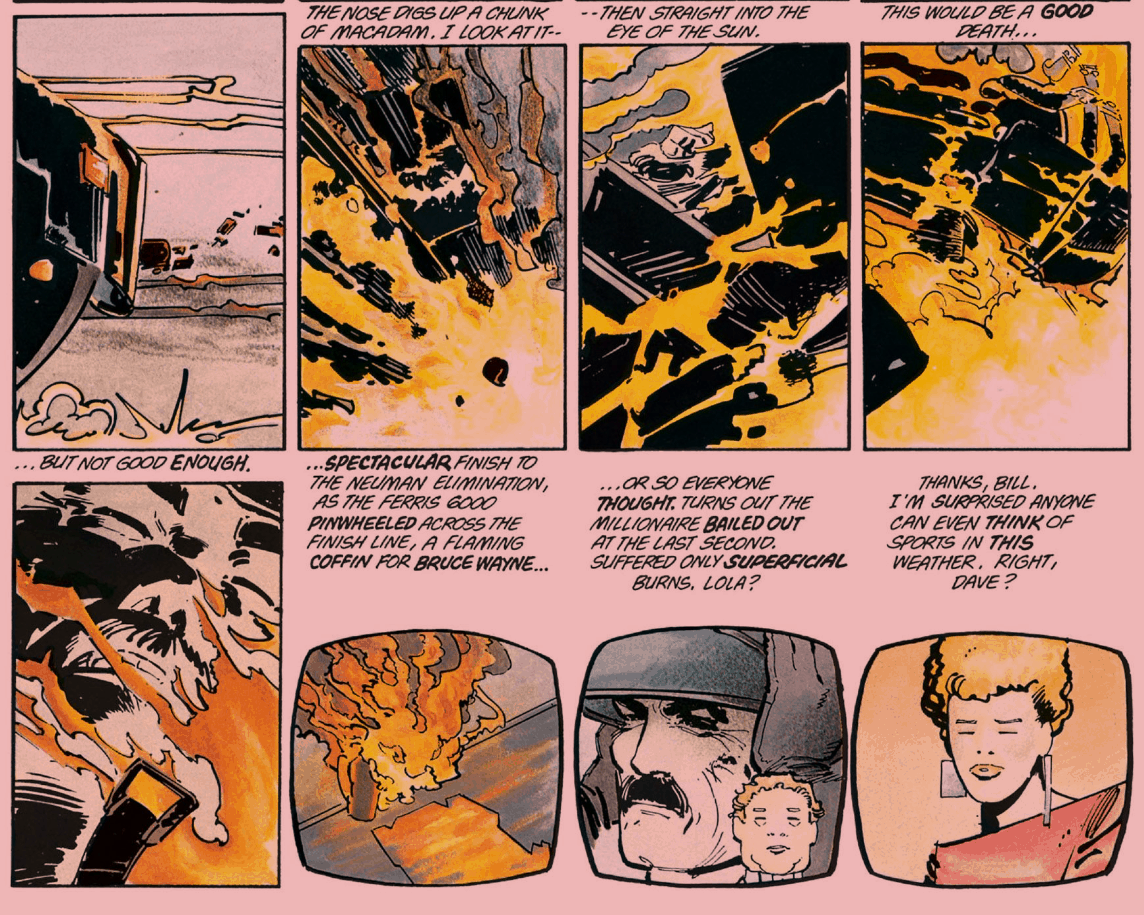
Assistant: “Doctor, as you’re aware we’ve known for sure for quite a while that the lawless vigilantes known as The Dynamic Duo are in fact millionaires Dick Grayson and Bruce Wayne in disguise.”
Doctor SAAAD: “Yes! One as the dastardly Boy Wonder ‘Robin’, and the other as the devious Dark Knight Detective, ‘Batman’, but whom of them is Grayson and whom is Wayne?”
Assistant: “Correct, doctor! And good news! We’ve finally manage to apprehend one of them, ‘Robin’, in Coast City, while the other, ‘Batman’, is known to be in Metropolis right now. And after unmasking ‘Robin’, we now know that he is Dick Grayson!”
Doctor SAAAD: “Very good work! Congratulate your team! Now, that leaves us with only one question left. Who is ‘Batman’? We’ve got apprehend him.”
Assistant: “What do you mean, doctor? He is obviously Wayne. Since ‘Robin’ turned out to be Grayson.”
Doctor SAAAD: “I don’t think you understand, assistant. ‘Robin’ was apprehended in Coast City. ‘Batman’ is confirmed to be in Metropolis. That is a distance of almost 2800 miles.”
Assistant: “Right, but we caught one in the pair. So that means that we know–”
Doctor SAAAD: “That we know nothing about whether Grayson or Wayne is ‘Batman’. We can not clear Grayson’s name from the accusations of being ‘Batman’ until ‘Batman’ is apprehended.”
Assistant: “But Grayson has been apprehended here in Coast City.”
Doctor SAAAD: Are you trying to propose that there is some sort of Spooky Action At A Distance, that our actions in Coast City can have any bearing whatsoever on what goes in in Metropolis? Assistant, you disgust me with your superstitions!”
Professor DM
Assistant: “Ballistics report came back, professor. But maybe you need to reconsider your formulas when considering shots at this extreme distance. The results came back inconclusive. As if the victim was running faster than he could have.”
Professor DM: “Reconsider formu…?! Poppycock, assistant! Clearly there’s a much easier explanation at hand: the entire crime scene and everyone present must’ve been entirely covered by gooey rhizomatic strands of Dark Matter!”
Assistant: “We, uh, we can’t see any such thing, professor.”
Professor DM: “Surely it must be a type of material that photons don’t interact with but bullets do! If we can find the supplier of this Dark Matter, we are sure to be hot on the heels of our shooter!
2023-01-22T22:41:22+01:00Idiomdrottningsandra.snan@idiomdrottning.orghttps://idiomdrottning.org/beat-time<div xmlns="http://www.w3.org/1999/xhtml"><a href="https://idiomdrottning.org/beat-time">When a watch company promoted the revolutionary calendar</a></div>
This attempt at a timezone-less Internet time might’ve succeeded if they had been a li’l bit better at openwashing. It was too blatantly their corporate thing, with the day starting not based on anything astronomical but on Swiss standard time (i.e. where the sun is gonna be over Greenwich an hour later). To promote their own factory.
If they had tied it to 刻 time notches or to the revolutionary calendar, but emphasized the new timezoneless nature of “beats”, we coulda had something great. The original pitch that this wasn’t meant to replace normal time but just used as a separate tool to coordinate stuff online was good. Maybe we’d have moved over entirely after a while. And they woulda been first to market, which would’ve been even more appealing if it had been (or looked like) more of an “open standard”.
The fact that they also illegally planned to broadcast over ham bands was also a pretty bad nail in the coffin, along with the hypermedialized and dorky overuse of @ and dot prefixes.
As many 180˚s and life-changing, opinion mind blows as I’ve experienced in my life as an old, this isn’t one of them because I had the exact same take then: really liked it and felt it was a missed opportunity squandered by the same two criticism I have now: The UTC+1 thing is dumb (it’s not that big of a deal—and great for Swedes) and it’s too blatantly corporate and the “.beat” (dot beat) unit name is embarrassing. I was a teenager, more critical and less gullible than I am now. We all saw that it was just a dorky watch ad campaign, quickly abandoned by its own makers.
Meanwhile, here we are in a mess of timezones and DST and I have to say “it starts in three hours” instead of being able to list a specific time. Or specific day, even, since current clock system needs a date line which wouldn’t be necessary with decimal time. (On the other hand, it would mean that having both systems in parallel would be difficult west of the date line and east of whatever point becomes the “new Greenwich”.)
The fact that it didn’t map up to normal minutes & hours was kind of an advantage because it helped disambiguate those time stamps from normal timestamps. @500 didn’t look like 12:00.
I wish the amount of seconds in a day would’ve matched the old system so that a second is still a second. It takes five “beats” to make an integer amount of seconds: 432 seconds.
But maybe we can work with that. Or 864 seconds for ten beats or 86.4 seconds for one beat. So we have a timekeeping system based on beats and seconds.
Okay so here’s my proposal
First of all, it’s not called “Biel” Mean Time any more because we
don’t want to promote Swatch. It’s the Basic Mediterranean Time. A
geographical feature not ruled by a single polity. Or, Boring Meridian
Time if you want to go even neutraler. Still compatible with the old
beats; it’s just a name change not a spec change. Which sucks for
people near the dateline. That was an advantage of UTC over BMT; it
placed the dateline in a less populated area, which becomes extra
important in a no-timezones system. But all in the name of compatible
with the original beats.
Second of all, there are two display modes. First is the traditional
beats view (a.k.a. mode 1) that still looks like @255, an at sign
and the number of beats since midnight BMT. The same beats you know
and love, no need to upgrade any old clocks, no need to trot out
xkcd://927, it still works.
Then mode 2 is the decabeats view which shows the current decabeat and
the number of seconds since that decabeat began. One decabeat,
abbreviated 刻 is ten beats which is 864 seconds. So @255 is
25#432 (no @ sign, separated by a # character). That example means
it’s 432 seconds since @250. Good for cooking and sports and for
conversion between traditional time keeping and decabeats, since each
h:m:s timestamp has an integer 刻#s equivalent and vice versa. Unlike
traditional beats which can’t represent exactly 12:06 for example, nor
can traditional h:m:s represent @11 without resorting to tenths of a
second.
Watches can combine both modes and that looks like this: 25.5#432.
They must not only show mode 2. If they can only show one mode, it
needs to be mode 1 or the combined mode. The .5 and the #432 are
redundant. Also they don’t tick up at the exact same time; only at
.5#432 and .0#0, twice per decabeat, creating a nice li’l
syncopation. Don’t just have 25#432 if there’s no way of showing
that last digit.
Mode one is still gonna be the main mode! It’s better to say 30 beats
than 3 decabeats!
What’s the point…
…of “decimal” time instead of base 60 time if you’re gonna have a base
864 number, isn’t that going from the ashes into the frying pan? The
point is if we want to ditch time zones, one good way to do that is
alongside a radically different time representation. And the optional
seconds view make things more backwards compatible and is good when we
need finer granularity. And coarser granularity: one decabeat is just
under a a quarter of an hour and ergo four of them almost make an
hour. (Although 41 beats is even closer.)
BMT either mode is a concise time-zone–independent representation that
your attendees then can convert to their own local time in HH:MM:SS
using apps or whatever. If that’s the only use for BMT, even if no-one
actually tries to look at a BMT clock, that’s still valuable to me.
It’s this format 255:000, that’s the equivalent of what in BMT mode
2 would be 25#432. One thousand pulses in Neralie time is one
beat, and 625 pulses is 54 seconds. Their Neralie system preceded my
proposal by many years. I just didn’t know about it. It’s good that
they chose NNN:NNN with a colon infix because then there’s no
confusion with BMT mode 2 which uses a # infix nor with BMT mode 1
which uses the @ prefix.
So if there’s an event announced in BMT you can use your Neralie watch
to attend it! Especially since BMT mode 1 is the main mode. @255 in
BMT mode 1 is easy to understand for a Neralie user.
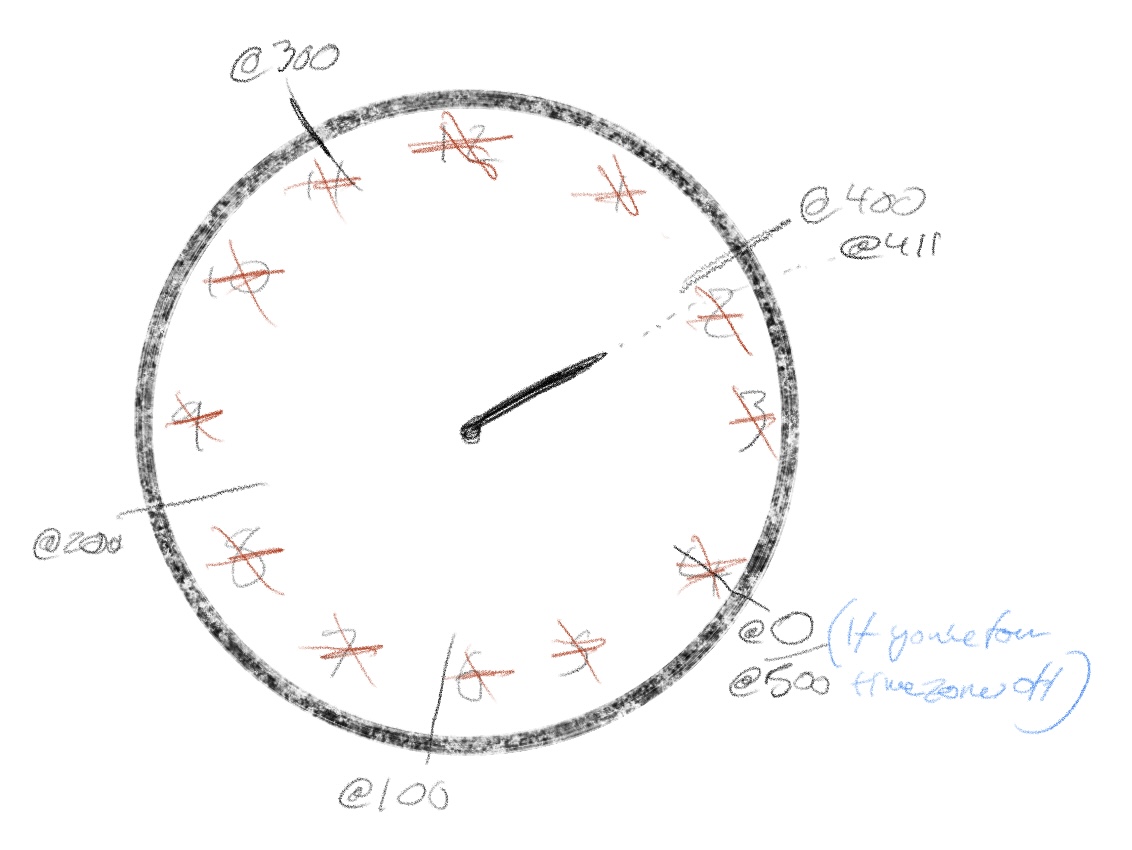
Old clocks
Any old analog watch already works with BMT: just look at the small
hand (the hours hand) and know that one revolution is 500 beats.
And if the small hand has moved 12 “minutes” (2⅖ hours) that’s one
hundred beats. Each “minute” (each fifth of an hour) that the short
hand moves is 8⅓ beats. And six “minutes” on the short hand (1⅕ hours)
is 50 beats and three “minutes” is 25 beats.
So only looking at the small watch hand it’s easy to
see the beats go by.
The long hand (the minute hand) isn’t as useful but there’s a
beautiful correspondence of sorts: each 12 minutes the long hand
(the minute hand) moves is also 8⅓ beats.
So dividing the watch circle into fifths, each fifth being twelve
“minutes”, has two purposes; it takes the short hand a hundred beats
to move that distance and the long hand, it takes 8⅓ beats; the same
time it takes the short hand to move 1 “minute”. A beat is very
roughly one and a half minutes and more precisely it’s 1.44 minutes.
Warning: thanks to “time zones”, this division of the revolution into
fifths doesn’t start at midnight/noon most places of the world. Only
in the Boring Meridian it does that. So you might have to look at your
watch sideways and imagine a new starting point for the short hand.
The seconds hand is great if your watch has one but then you’re in
decabeat territory a.k.a. BMT mode 2! Good for precise timings like
cooking, sports, speedrunning. Just count seconds normally. Each tick
is one second, each rotation is 60 seconds, two rotations is 120
seconds, three is 180 seconds etc and your goal is 864 seconds which
is one decabeat and 14⅖ rotations.
An example
So let’s say you’re waiting for an event that starts at say @911 and
all you have is your mom’s old analog watch. You can first learn to
see whether you’re in the right half of the day or if you have to wait
until the second revolution. The short hand does two revolutions in
one day. Then okay you know it’s in the second revolution and it’s 411
beats into it so you know the short hand needs to have passed at least
four fifths of the way around. @911 means the short hand should be
past the 49th “minute”.
The unhelpful and confusing long hand doesn’t do much but can at least
keep you company as you know the short hand will tick up one “minute”
(8⅓ beats) each time the long hand moves a fifth around (12 minutes).
In other words
In old-school hh:mm time, a “step” for the short hand is a twelfth of
the way around, five “minutes”, and indicates one hour, and a full
rotiation of the long hand. Each of those five “minutes” is five
minutes on the long hand, 7⅕ beats.
In BMT, a “step” for the short hand is a fifth of the way around,
twelve “minutes”, and indicates 100 beats (and 2⅖ rotations of the
long hand). Each of those twelve “minutes” is twelve minutes on the
long hand, 8⅓ beats.
So their mental model is: long goes one rotation = short goes one
click which is five “minutes”. This is an hour to them.
To us in the BMT world, long goes one fifth = short clicks one
“minute”, and after twelve such clicks we’ve had hundred beats.
You can see how the old-school clock had it backwards; a twelfth for
five where we have a fifth for twelve.
Old watches and mode 2
Oh this is great, the long hand is the useful one in mode 2 because
roughly one quarter rotation (14⅖ minutes) is a decabeat! And then a
second is a second is a second. Yeah, yeah, calling 14⅖ minutes a
quarter is a li’l loosy-goosy but if you want precision, mode 2 is
still your friend since every mode 2 time has an integer scaled
mapping to hh:mm:ss! We want old tech to be useful in the solarpunk
world.♥︎
2022-12-19T15:51:08+01:00Idiomdrottningsandra.snan@idiomdrottning.orghttps://idiomdrottning.org/longtermism<div xmlns="http://www.w3.org/1999/xhtml"><a href="https://idiomdrottning.org/longtermism">Here we are in the future</a></div>
Hearing from “longtermists” and their detractors is exhausting in that
“stuck in the middle with you” way. Both are wrong.
It’s really frustrating how the detractors undervalue future lives.
What if people would’ve gone all Ligotti and Zapffe in the 19th
century and annihilated 100% of human life? Not into it. Please
don’t mistake this for some anti-Roe “every sperm is sacred” nonsense;
can’t we just have a dream of a world where there are humans in say
5000 years from now? That’s literally what might be at stake with some
of these short-term existential threats.
The second problem of the detractors is how they mishear “the death of
millions is bad and complete extinction is even worse” as “the death
of millions is a super vital part of our evil plan”. That’d be messed
up, yeah. If that was an intentional goal. Which it’s not. The idea is
to try to save people.
I’m sometimes scared that the longtermists do undervalue present life.
Jenny in the space ship a million years from now is not worth more
than Jenny in the meadow today. And, maybe I’m weird about time,
but I don’t wanna undervalue past lives either. Future events are not
more real or valuable than past events. Maybe the present is a li’l
bit better than both, but it has a drawback of already having become a
few seconds ago, probably better known as “the past”.
An even bigger problem with these self-proclaimed longtermists is how
they suck. It’s like the world’s worst people. Exploiting workers
while living in luxury, making climate-endangering mistakes like
Musk’s foray into proof-of-work crypto, and chumming with racists like
Coulter and Trump like Peter Thiel does. Trump, who ended up hiring
climate denier Rex Tillerson for secretary of state, is who Thiel
selected to lead us into the long term future. That sucks.
2022-10-30T12:38:12+01:00Idiomdrottningsandra.snan@idiomdrottning.orghttps://idiomdrottning.org/fusion<div xmlns="http://www.w3.org/1999/xhtml"><a href="https://idiomdrottning.org/fusion">Fusion vs the doomsday clock</a></div>
Will fusion save us? If SPARC or ITER are on the right track, then no
way. Their timelines are way too slow. Earth will be toast😭
If, on the other hand, something like Zap or Helion with their
pie-in-the-sky, Hail Mary approaches are correct then that’d be
awesome. That’s not super likely and we definitively have to work on
other approaches to end fossils and not put all our hopes on one or
both of these wild ideas, but it’s nice to have like an additional
tiny li’l source of hope.
It’s like if you’re on the battlefields of Rohan or Gondor but you’ve
got Frodo and Sam inching towards Mount Doom (or Luke Skywalker in the
trench if you prefer the space edition). That doesn’t mean you should
just hang back and think everything’s fixed (because you don’t know
for sure that they’ll make it), but that doesn’t mean you should give
up either (because you don’t know for sure that they’ll fail).
That goes for a lot of other supposedly world-saving tech, too.
There are two common ways we humans mess up when there’s this kind of
tech, anything from wild energy storage plans to wave hydro to MSR
a.k.a. LFTR. We go “Oh, OK, guess I don’t have to do anything, then!”
We give up on other plans because we’re so sure that the Hail Mary plan will…
work and fix everything no matter what we do
fail and it’s no use trying anything
Both are mistakes. Let’s keep trying to fix the climate crisis and end fossils.♥︎
2022-10-21T11:25:00+02:00Idiomdrottningsandra.snan@idiomdrottning.orghttps://idiomdrottning.org/a-god-for-ants<div xmlns="http://www.w3.org/1999/xhtml"><a href="https://idiomdrottning.org/a-god-for-ants">A God for Ants</a></div>
There’s no reason to diminish and shrink down God to a particular
image or icon, to this one-week, one-planet, static, unyielding
picture frame, when our own senses and hearts and minds show us aeons
and galaxies and this unfolding, learning, teaching, listening
resounding symphony.
To be able to reason about things, our human brains are set up like
God intended, we use three things: symbols, referents, and reference.
A symbol, also known as a sign, is a word, gesture, picture, name or similar.
A referent is the thing in-and-of-itself.
And reference is the relationship between the two.
Regardless of whether or not you wanna reason for or against the
existence of dogs, butterflies, roads, next Friday, or the lost moon
Chrysalis, you’d be using some kind of reference to do so.
Since language is fragmented (Gen 11:1–9),
sometimes words can mean different or even opposite things.
For example, I might say that a scientist has a problem to solve and
mean that they have a mystery they would like to try unravel or learn
more about. This is confusing since “problem” also sometimes means a
crisis or trouble like a ship with a leak, but that’s not what I mean
in this context.
And it’s important to realize that there’s no way around this. That’s
just how it is and that won’t change. Here on the pre-eschatonic Earth,
there’s never gonna be a “corporal Carrot”–universe where every word
has precisely one meaning and is always used in exactly that one
meaning.A reference to an overly literal-minded fictional character, by Terry Pratchett.
Luckily, most people use the Gricean maxim of quality when they talk,
meaning that they are trying their best to say relevant things
concisely, most of the time.
So even if you wanna say “I currently believe that Chrysalis never
existed”, you’d be using a reference (such as the name “Chrysalis”) to
do so. Now, again thanks to the Gricean maxim of quality, we don’t
need to do this about every Russell-teapot out there. We don’t need to
try to think of every variation of every non-existing thing and name it.
Chrysalis received this attention since a lot of people believe it
existed and they were talking about it.
One of the reasons they believe that, and don’t shoot the messenger on
this, is that the rings have similar composition as one of Saturn’s
other moons, Iapetus, and they mathed out that if a Iapetus-like moon
got smashed, something similar to Saturn’s rings would probably
happen.
No-one knows for sure but that’s why, even though science meant “to
know” in Latin, science really is just a big “hmm, maybe like this?
Let’s put it here for now” sorta like when you’re doing the first pass
of sorting the pieces out of a jigsaw puzzle box. Sometimes it really
does feel like pieces fit together perfectly, while other times it’s
more tentative or even flat-out wrong.
The same goes for our relationship with God. The book is full of
examples of how we go astray, either on a personal level or with
humanity as a whole. Young Earth creationism is only one of many
ways to tentatively sort the jigsaw pieces. It’s part of protestant
hermeneutics which arose in modern times (16th century) in an
ever-more curious and science-minded world.
It is a truth universally acknowledged that as an art, technique, or
philosophy evolves, there are always gonna be fans of a particular
stage or era. “I like baroque music”, “I like 80s thrash metal”, “I
like sock-hop”. These nostalgic fans are not necessarily wrong: things
evolve in many-branched trees, of thought and counter-thought, of
steps in the wrong direction or in the right. It’s good to be able to
go back to what worked from what doesn’t work. You might have to think
of how you got started sitting in your little room.
At the same time, something that starts as a “hey guys, can we maybe
try to think kind of differently about this stuff?” so often freezes
and itself becomes a means of killing new thought.
Jesus, for example, praised both serpents and doves in Matthew 10:16.
If God created everything, where can I put my feet that’s not holy?
We’d need to, with every word we write, credit the Highest. For
example, that previous sentence should read “We’d need to, with every
word our God-given ability to write lets us write, credit the
Highest”, and this sentence itself should start “For example, that
previous sentence that God let me write…”, but, just like the Gricean
maxim of quantity predicts, we can omit some things once we know that
the person we’re speaking to already know them.
It’s all the same re-gifted sixpence but it’s also all pretty darn
special. Jesus praising those animals are like if you were to praise
your own toe, but, you know, sometimes you wanna do that. You find
this li’l part of reality, like how a butterfly flies out of a pupa,
and it makes you wanna go jouez haut-bois, résonnez musettes! Psalm
104:25! Every li’l sparrow and bug and butterfly and grain-of-sand is
accounted for, as is every moonshard across the night’s canvas.
2022-09-21T11:13:28+02:00Idiomdrottningsandra.snan@idiomdrottning.orghttps://idiomdrottning.org/genre-vs-literature<div xmlns="http://www.w3.org/1999/xhtml"><a href="https://idiomdrottning.org/genre-vs-literature">Genre vs Literature</a></div>
I can agree with the sentiment
that there are two kinds of fiction stories:
Those that try to write within an existing framework or collection of tropes, like a whodunnit or a bug-eyed-monster story or a ghost story, or within a mashup of two or more such frameworks.
There are a lot of beloved-by-me stories in that first category, like Snow Crash on the heels of the Sprawl Trilogy, or From A Buick 8 in the tradition of Chambers or Bierce, but I can still see why people sometimes wanna make this division as some sort of litmus test or indicator when they look for Great Literature—not a perfect test by any means because there are both false positives and false negatives, but still somewhat useful as one kind of data point.
Where they lose me, though, and what I can’t get behind, is when they take the presence of anything supernatural, fantastic, otherworldly, technological, speculative—in short, anything fantastic—as a reason to dismiss a book as “genre”.
Then they lose their collective proverbials and awe at the sight of Marquez and his “magical realism”.
I feel like that’s sort of a onion-in-the-varnish, surface-level take on “genre” vs Literature. Yes, yes, I do understand wanting to put the fifth Tarzan book or the twentieth licensed Star Wars book on a shelf separate from your Cora Sandel or your Hermann Hesse, but if the definition of “genre” is “not in Kansas anymore”, you’re missing out on a lot of absolute mindbending classics like Kallocain or Aniara.
In Defense of the Shared Universe
I’ve often compared The X-Men to La Comédie humaine as another multi-volume masterpiece. During the latter half of the 20th century, and more so now, we’ve seen the return of “shared universe” storytelling. Shared universes are nothing new: the Thousand and One Nights, the Greek heroes and pantheon, the land of castles and princesses of fairy tales. This kind of shared universe storytelling fell out of vogue in the age of copyright, auteurism, individualism that signified the 1800s but now here we are and we can dream together again♥︎
N = the number of civilizations in our galaxy with which communication might be possible (i.e. which are on our current past light cone);
and
R∗ = the average rate of star formation in our Galaxy fp = the fraction of those stars that have planets ne = the average number of planets that can potentially support life per star that has planets fl = the fraction of planets that could support life that actually develop life at some point fi = the fraction of planets with life that actually go on to develop intelligent life (civilizations) fc = the fraction of civilizations that develop a technology that releases detectable signs of their existence into space L = the length of time for which such civilizations release detectable signals into space
In the Drake equation, I’m a bit of an ET-naysayer, I had really underestimated R. The Milky Way is a li’l bit bigger than I thought.
I feel like fl, fi, fc might well be reasonably high but that ne might be overestimated. The Earth really is precious. ♥︎
Anthropic bias is a 🐝.
My thinking is that fl, fi, fc have evolution on their side which ne doesn’t really. It “just” has stochastics and selection, which the genetic algorithm has other stuff going for it too (talking about sex).
L, I’m not so sure of. Maybe if the ETs can dodge space-capitalism.
As dovish as I am, like how I condemn sending weapons to warzones, I still agree with sanctions, divestments, pulling products from markets etc. No-one is mandated to trade with an organization or nation who is killing them.
Like, Mon Cala stopped selling ships to the Empire after Alderaan and I don’t blame them. There are many innocent farmers on empire-controlled planets who could’ve used those ships—even for life-saving purposes, but, it’s reasonable of Mon Cala to halt their sales. I’ll defend that decision.
They sent weapons and cruisers to the Alliance to Restore the Republic, weapons that ended up killing people, and I’m not as onboard with that decision, but I see it as a separate issue.
Arguing that Mon Cala would’ve been morally mandated to trade with the Empire is something I can’t get behind at all.
2022-04-23T18:29:48+02:00Idiomdrottningsandra.snan@idiomdrottning.orghttps://idiomdrottning.org/milu<div xmlns="http://www.w3.org/1999/xhtml"><a href="https://idiomdrottning.org/milu">When my diary mentioned 密率</a></div>
One year ago
TIL that Gregory (and then Euler) used 6.28… for their circle constant and that Euler only later switched to using 3.14…
Of course 密率 was found 1500 years before Euler was even born, and that’s in favor of the 3.14 camp, but still. It’s not obvious what the best circle constant should be.
Space aliens probably know how to play go at least to an extent that they would recognize the New Zeeland style rules. Square tesselation, cell-filling, liberty counting is something I could see them inventing.
But would they react to 3.14 is the question? Maybe they’d be like “huh…? only half a turn? do they mean to signal a 180°!? a grave insult!”
Obv today in modern day Earth we can use both. π is pretty well established as half a turn and τ can represent a full turn. When π is convenient, use it, and when a full turn is convenient, use it.
One week ago
I am suddenly obsessed with the reciprocal of τ, probably better known as one radian. Tripping the 密率 dream, one radian is 113/710 of a circle and one circle is 710/113 of a radian. Kinda.
Get on outta here with that 3.14 stuff. If trig was based around “diametrians” (reciprocals of π) then maybe. The angle subtended from the center of a circle which intercepts an arc equal in length to the diameter of the circle. Maybe the math nerds should’ve thought of that. Then there’d be π diametrians in a circle instead of this waxing gibbous nonsense.
Today
I am so obsessed with 密率, an irreducible fraction with a 112 period (in decimal). Maxing out its denominator, which is 113, a prime.
I’m in love with this number. I don’t even care about the circle divided by r squared anymore, schmancendental. I’ve found my Buddha on the road and I don’t wanna pull the trigger.
It’s still a mystery to math dorks why there’s a huge honking 292 smack dab in the fraction expansion of pi. A001203 in the OEIS. I’m dangerously close to getting into some woo mystic religion nonsense just to honor and celebrate this wonderful number (密率, that is, not 292).
I wonder if there are any circles in nature that use 密率. Any bubbles or flower stalks or tree-rings where God cut some corners (Matthew 10:29) and finally made some rational decisions for once ♥︎🙏
Later today
I have been wondering—if pi was secretly 密率 all along, could the circle have been squared? Turns out that yes, it could have, and Ramanujan did it in 1913! That is absolutely baller! Er, I mean, approximately baller!
21 months later
Some might think 密率 a.k.a. 355/113 isn’t so special. But here is why:
It’s easy to get approximations of pi that are smaller, like 3/1 or
16/5 or 22/7 but going to 355/113 suddenly gets almost three orders of
magnitude closer.
And then that’s as close as it gets for a long time. The next one up
is 52163/16604, a much clumsier number, four more digits only to gain
less than 0.000001 of accuracy, hardly worth even using an
approximation at that point, and what’s worse, it’s not even that
special because the next one up is just around the corner,
52518/16717, and so it goes, there’s a whole bunch in the
50000-something series. 355/113 really does stand out.
Whenever there are people who doubt the things the rest of us
know—when they doubt the moon landing, vaccine efficacy, the curvature
of the Earth—I’m like “Okay, a curious and skeptical nature can be
good”. As soul-crushing as it can be to have some gaslighting fuck go
like “well, actually, sexism doesn’t exist”… some people are just
inherently curious and wanna know “how” and “why” about everything and
learn everything for themselves and that’s not all bad. Wanting to
honestly learn how things really work can be great.
Those same people then three seconds later turn around and ruin it
with stating an unwavering belief in some world-wrecking scam like
ivermectin or Q or oligarch state propaganda or large scale factory
animal ag or proof-of-work cryptocurrency. The three second skeptic
whose only reason for doubting the truth is how it contradicts with
the lie they’re devoted to.
These last few years of bleach-drinkers and Qultists have really
eroded some of the (much-needed) good-faith criticism of the
fundamental flaws of a market-driven approach to pharmaceutics. It’s
heartbreaking.