<?xml version="1.0" encoding="UTF-8"?>
<?xml-stylesheet type="text/css" href="https://idiomdrottning.org/feed.css"?>
<feed xmlns="http://www.w3.org/2005/Atom">
  <title>Idiomdrottning</title>
  <subtitle type="xhtml"><div xmlns="http://www.w3.org/1999/xhtml">
    <p>The most unruly and least considered, most shameful among various Idiomdrottning components and libraries can be found here.</p>
    <p>To contact me, <a href="mailto:sandra.snan@idiomdrottning.org">send mail to sandra.snan@idiomdrottning.org</a></p>
    </div>
  </subtitle>
  <link rel="self" href="https://idiomdrottning.org/blog"/>
  <updated>2026-10-09T13:25:38+02:00</updated>
  <id>https://idiomdrottning.org/blog</id>
  <entry>
    <link rel="self" href="https://idiomdrottning.org/culpa"/>
    <id>https://idiomdrottning.org/culpa</id>
    <title type="xhtml"><div xmlns="http://www.w3.org/1999/xhtml"><a href="https://idiomdrottning.org/culpa">How I killed the Earth</a></div></title>
    <content type="xhtml">
      <div xmlns="http://www.w3.org/1999/xhtml">
				<div>


<p>I have done three out of four things right with climate. I eat only plants. I do not drive. I do not fly. Three for four. My failure that torments me every day is that I have not been able to convince all of my friends and fam. That is my failure. I just never figured out how.</p>

<p>I read Skeptical Science. They read delayist web pages like Omni or DN. And some of them voted for delayist politics.</p>

<p>Many of my friends and fam fly <strong>more</strong> than the average.<small> (Some don’t and that’s no thanks to me but I appreciate it all the same. ♥︎)</small> And when I talk to them it’s clear that they aren’t making this decision informedly. They don’t know how urgent and how big the question is.</p>

<p>So that’s all on me I guess. I didn’t exlain it clearly and credibly enough. They think I’m a hysteric exaggerator. If I had been saner or well-adjusteder or healthier instead of crazy-aunt-madwoman-in-the-attic I had been more credible and they woulda listened. But I wasn’t so they didn’t.</p>

<p>And I knew how bad it was. It’s not their fault because they didn’t know but it is my fault because I did. Everytime they go on a recreational airplane trip I might as well be fueling up that jet because I knew and I let them. I tried pleading and begging them not to but because I’m such a no-count loser they can’t hear it. They just hear it as crazy talk.</p>

<aside>I don’t know why they still want me as their friend or fam since they can’t trust me on this. “Oh she’s great and the way she is saying that the Earth is warmer than in 125000 thousand years and that airplane aerosols trap heat and that ruminants are disproportionately emissive even beyond trophic inefficiency that’s all fine.” I mean what the heck! Either I’m right, or I’m lying, or I’m crazy. They wouldn’t be friends with a liar and if they thought I were right they’d hark, so they obviously have me sorted as crazy.</aside>

				</div>
				<div>
		<p><a href="/blog/texts">Texts</a> • <a href="/blog/psychology">Psychology</a></p>
				</div>
      </div>
    </content>
    <updated>2026-10-08T17:31:42+02:00</updated>
    <link href="https://idiomdrottning.org/culpa"/>
    <author>
      <name>Idiomdrottning</name>
      <email>sandra.snan@idiomdrottning.org</email>
    </author>
    </entry>
  <entry>
    <link rel="self" href="https://idiomdrottning.org/rules-not-rulings"/>
    <id>https://idiomdrottning.org/rules-not-rulings</id>
    <title type="xhtml"><div xmlns="http://www.w3.org/1999/xhtml"><a href="https://idiomdrottning.org/rules-not-rulings">Rules, not rulings</a></div></title>
    <content type="xhtml">
      <div xmlns="http://www.w3.org/1999/xhtml">
				<div>


<p>The <cite>Quick Primer for Old School Gaming</cite> was a huge
influence on me when I first started playing blorbily but looking at
the 2024 edition of that primer now I can see how far we’ve drifted
apart.</p>

<p>Sure, someone overhearing our tables wouldn’t hear a difference. The
“moose head example” would sound the same. Players describe how they
are looking for treasures and traps rather than rolling for it.</p>

<aside>(I saw someone on Reddit saying at most actual
tables the players wouldn’t look behind the moose head and be like
“another boring room, let’s leave” leave the GM would impatiently
blurt out “you think there’s something weird about the moose head”. I
don’t do that. What they don’t find, they don’t find. Sometimes
they’ll come back a dozen sessions later and find it, or another party
will if I run for multiple players West Marches style. DMs, you’ve got
to keep the secrets secret! <a href="/dm-secret-knowledge" title="Secret-keeping is the DM's most important job">That’s your one job!</a>)</aside>

<p>I call that style of play “diegetic mechanics” and for me it
definitively came from the old school primer. It’s so awesome. I
definitely handle as much of the game as I can that way.</p>

<p>But the difference is the “improvisational” part. “Rulings, not
rules.” The primer has an example of a DM deciding on the fly that a
particular rogue has a 1d6 chance of finding traps<small> (in addition
to pouring water and knocking with poles I guess)</small>.</p>

<p>That isn’t my jam. If there is something behind the moose head it’s
because it’s written down. Not because “oh the players are messing
around with a moose head, I want to reward that and making up a secret
compartment behind it”. Playing that way would not be blorb.</p>

<p>When I say “rules, not rulings”, <a href="/new-dm-advice" title="New DM advice">new DMs</a>, please do not be
scared!</p>

<p>By all means, start small and with a simple ruleset! I want new DMs to
take up the shield and go for it and not be overwhelmed by having to
read a thousand books! But when you make a “ruling”, write it down and
make it a rule instead.<small> You can polish and revise it between
sessions if you want and consult your players too, knowing it’s
<a href="https://en.wiktionary.org/wiki/what%27s_sauce_for_the_goose_is_sauce_for_the_gander#English" title="what's sauce for the goose is sauce for the gander - Wiktionary, the free dictionary">goose&amp;gander</a> and things you let them do, monsters might be able
to do too.</small></p>

<p>Creating new mechanics and new rules is an amazing way to keep a blorb
alive, a blorb that’s bigger than what you could manually track or
create. We made the <a href="/looking_for_stuff_outdoors" title="[D&amp;D] Looking for Stuff Outdoors">“looking for stuff outdoors”</a> rules when it
became impossible to in detail prep every single flower in every
single square foot. But when doing so, I want to be guided by the
<a href="/blorb-principles" title="Blorb Principles">blorb principles</a>. <strong>No fair picking paper <em>after</em> seeing them
choose rock</strong>, and no tier three truths if I have a tier two truth and
no tier two truths if I have a tier one truth.</p>


				</div>
				<div>
		<p><a href="/blog/texts">Texts</a> • <a href="/blog/rpg">Rpg</a></p>
				</div>
      </div>
    </content>
    <updated>2026-10-07T12:29:02+02:00</updated>
    <link href="https://idiomdrottning.org/rules-not-rulings"/>
    <author>
      <name>Idiomdrottning</name>
      <email>sandra.snan@idiomdrottning.org</email>
    </author>
    </entry>
  <entry>
    <link rel="self" href="https://idiomdrottning.org/15-7=8"/>
    <id>https://idiomdrottning.org/15-7=8</id>
    <title type="xhtml"><div xmlns="http://www.w3.org/1999/xhtml"><a href="https://idiomdrottning.org/15-7=8">How to quickly subtract seven from fifteen</a></div></title>
    <content type="xhtml">
      <div xmlns="http://www.w3.org/1999/xhtml">
				<div>


<p>Yeah, yeah, you can do it normally and just figure out that fifteen
minus seven is eight. But you can also take the tens-complement to
seven (which is three) and add that to the last digit which is five
and that makes eight. It works for all single-digit numbers subtracted
from a number 10–19. When you’re subtracting from an even bigger
number, it’s not great<small> (subtract ten rather than just lop off
the first digit. So 123 minus 7 is absolutely not 6, it’s
116)</small>.</p>

<p>Maybe this is just a me-problem it’s just my weird brain (because I
was out of school in second grade and missed out on subtraction
drills) but I hate subtraction. <a href="/algebra-easier-than-subtraction" title="When algebra is easier than subtraction">It’s easier if I convert it to 7+X =
15</a>, my brain right away returns with “eight” when seeing 7+X = 15
whereas when it sees 15 - 7 it returns with grumbling and rusty
creaking and paaainful struggle of “okay first subtract the fives so
we have two below ten that is eight” or I dunno what the heck it’s
doing back there but it’s not fun for it (🧠) to do. But if I’m gonna
juggle the numbers to turn it to 7+X = 15 anyway I might as well
juggle them to be 3+5 instead because that’s even easier.</p>

<h2 class="qm" id="why-do-i-need-a-trick-to-subtract-numbers-in-this-range">Why do I need a trick to subtract numbers in this range?</h2>

<p><a href="/dice-math" title="The misguided idea to do math to numbers rolled on dice">I’ve talked about this before</a> but in D&amp;D you often have to
add the same static number over and over again to freshly rolled
numbers off a twenty-sided die and then compare it to another static
number. Let’s say you’re fighting a giant crab with AC 15 and you have
a dinky li’l weapon that lets you attack with +7 on your twenty sided
die rolls. You roll a 15. You add seven. That is 22. You hit. Then you
roll six. You add seven. That is 13. You missed. Then you roll seven.
You add seven. That is 14. You missed.</p>

<p>Compared to if you could just know that all rolls eight or higher are
hits; you roll 15, that’s a hit. You roll six, that’s a miss. You roll
seven, that’s another miss. <strong>That’s three additions you didn’t even
have to make.</strong> That means the math is undeniably easier. There’s a
whole step that’s elided!</p>

<p>Even if it’s just on a single roll I do like it when all the math is
pre-figured and the roll <em>immediately</em> tells you the hit. You are
fighting an AC 13 skeleton with that +7 attack.</p>

<dl>
  <dt>Scenario one</dt>
  <dd>You roll. The die hits the table. It’s a six. You add six to seven.
You see that you hit.</dd>
  <dt>Scenario two</dt>
  <dd>You subtract seven from 13 so you know you need six or higher. You
roll. The die hits the table. It’s a six!! Hooray! Immediate cheers
and satisfaction! The hit is as immediate as the thunk of the dice
stopping on the table.</dd>
</dl>

<p>In the early years of game design where fiddly li’l things like dice
protocols were all we cared about partly because systems weren’t open
source back then so everyone had to reinvent the wheel and partly
because we hadn’t looked up to see the larger structural issues around
prep and role GM/player role separation, this was call “fortune at the
end”. Some hated it because they want to keep on fiddling with the
dice for all time so it doesn’t see so random what’s happening. You
might have rolled the six but then you add your skill of seven
<em>afterwards</em> so that it’s your own skill that pushed it over the
edge.<small> (And the Fortune-at-the-end haters love it even more when
there’s a resource like the compost in Three Sisters or the aspects in
Fate that lets you actually change the results.)</small> But I love
fortune at the end and am always advocating for it. First place your
bets, find your footing, notch your bow, lift your sword, and <em>then</em>
let it fall.</p>

<h2 id="house-rules-no-more">House rules no more</h2>

<p>Over the years I’ve <a href="/tens-complement" title="The “Tens-Complement” system">tried encapsulating this in house rules</a>. Back
in 2014 for that first few months of D&amp;D I made a box of SRD monsters
on A7-sized cards where their attack values were pre-calculated to be
tens complement so a skeleton’s +4 scimitar was listed as 6 and I had
noted all the player character’s AC minus ten. So if ten skeletons
attacked a character I could just look at that character’s noted
number, add six, and grab ten 20s and roll them and quickly pick up
the hits. That was all on the DM side and the players didn’t have to
worry, for them it was the good old 3e system working as per ushe.
This was only for a few years before we introduced “<a href="/oh-injury" title="Oh, Injury!">defense
rolls</a>” and those were normal D20+adds.</p>

<p>For our last campaign this spring I tried <a href="/tens-complement#update-the-roll-extremes-system" title="The “Tens-Complement” system">pushing the Suldokar’s
Wake-style rules</a> on them
instead. As in, if you have a +7 sword attack vs an AC 15 crab, you
hit on 7 or lower <em>or</em> 15 or higher. Exact same amount of hits and
misses<small> (out of the twenty sides, there are thirteen hits and
seven misses)</small> but it’s not the exact same specific ordinal
<em>numbers</em> that hit. I.e. a natural 13 is a hit with D20+adds but a
miss in the “roll extremes” system. That was mega confusing to the
players and they hated it.</p>

<p>So I’m gonna bring back D20 + adds. Vanilla
same-​as-​every-​other-​5e-​table D20 system. I know, I know, the players
have pledged in the past to subtract before they start rolling but
they never do. <a href="/subjective-time" title="Subjective time">Subjective time</a> is one part of this, but maybe
there is some other appeal for them in adding after the roll and I’m
the outlier. Whatever. That’s fine. I guess the main takeaway here for
me is to let the players do their job whatever way they want to do it,
and <a href="/say-the-dc" title="Say the DC">their job is to hit or miss</a>. I don’t want to micromanage
that. <a href="/dm-want" title="DMs don't know what players want">DMs don’t know what players want</a>.</p>


				</div>
				<div>
		<p><a href="/blog/texts">Texts</a> • <a href="/blog/rpg">Rpg</a></p>
				</div>
      </div>
    </content>
    <updated>2026-10-03T10:31:43+02:00</updated>
    <link href="https://idiomdrottning.org/15-7=8"/>
    <author>
      <name>Idiomdrottning</name>
      <email>sandra.snan@idiomdrottning.org</email>
    </author>
    </entry>
  <entry>
    <link rel="self" href="https://idiomdrottning.org/dm-want"/>
    <id>https://idiomdrottning.org/dm-want</id>
    <title type="xhtml"><div xmlns="http://www.w3.org/1999/xhtml"><a href="https://idiomdrottning.org/dm-want">DMs don’t know what players want</a></div></title>
    <content type="xhtml">
      <div xmlns="http://www.w3.org/1999/xhtml">
				<div>


<p>There’s generally this theme I hear whenever I talk to other DMs
online or in person, and I get frustrated with my fellow DMs for not
understanding this: the kinds of games DMs love are not the same
players love. Not every DM, but some forever DMs are all about super
minimal games and they really love constraining the players and taking
options away from them. My players <em>love</em> crunch and options.
Classes to pick from and build out and test. I hate that and prefer
way more open-ended and creative games like Fate or OSR where there’s
only a few options that you can flavor as you wish. I love the blank
canvas, they want the menu of options. DMs love minimal games because
there’s less rules for them to have to remember and fiddle with and
adjudicate and they can just <a href="/rules-light-prep-heavy" title="Rules-light, prep-heavy">concentrate on the prep</a>. But
there are many things that bring a player to the table. For some the
game system in and of itself is the appeal. Getting to <em>pick</em> some
actual abilities with actual crunch and tangible in-game effects is
like Christmas for them.</p>

<p>A mindset I don’t have to share in order to understand and try to
provide for. My own brain was messed up by the <a href="/chasm-width" title="The Chasm Width Problem">chasm width
problem</a> early on so I could never <em>really</em> care about these
player abilities knowing that the DMs were likely holding the finger
on the scale the entire time.<small> (As in, <a href="/atomic-encounters#the-flagging-dilemma" title="Atomic Encounters">what good is a +2 to
picking locks</a> when the DM could just make all locks be two
harder.)</small> But then the <a href="/blorb-principles" title="Blorb Principles">blorb principles</a> solved the chasm
width problem so now all of this crunch is actually real and there’s
something pretty nifty about that.</p>


				</div>
				<div>
		<p><a href="/blog/texts">Texts</a> • <a href="/blog/rpg">Rpg</a></p>
				</div>
      </div>
    </content>
    <updated>2026-10-03T10:18:24+02:00</updated>
    <link href="https://idiomdrottning.org/dm-want"/>
    <author>
      <name>Idiomdrottning</name>
      <email>sandra.snan@idiomdrottning.org</email>
    </author>
    </entry>
  <entry>
    <link rel="self" href="https://idiomdrottning.org/cubelet-95"/>
    <id>https://idiomdrottning.org/cubelet-95</id>
    <title type="xhtml"><div xmlns="http://www.w3.org/1999/xhtml"><a href="https://idiomdrottning.org/cubelet-95">The 95-card Cubelet</a></div></title>
    <content type="xhtml">
      <div xmlns="http://www.w3.org/1999/xhtml">
				<div>


<aside>A cubelet is a <a href="/same-deck-magic" title="Same-deck formats solve it all">shared deck</a> for Magic where
you can play any card facedown as a land.</aside>

<p>Sometimes the advice for cubelets is to <a href="https://www.reddit.com/r/mtgcube/comments/1fwh559/advice_for_cubelet_builders_and_players/" title="Advice for Cubelet builders and players on Reddit">stick to three or four
archetypes</a> but here’s a template for a full ten-<a href="https://mtg.wiki/page/Archetype#Draft_archetype" title="Archetype - Magic: The Gathering Wiki">archetype</a>
cubelet.</p>

<p>Put in twenty “mega-glue” cards that are each good in exactly four
archetypes each (for example five per color and the card should be
good in all four archetypes of that color and not good for other
archetypes).</p>

<p>Then for each of the 45 possible pairs-of-two-archetypes, put in one
card that’s only good for either of those two archetypes and bad in
the eight other archetypes.</p>

<p>Then finally for each archetype put in three cards (maybe signpost
uncommons) that are only good in that particular archetype.</p>

<p>That makes it so every archetype gets 20 cards<small> (three that only
it wants, nine that one other archetype wants, and eight that four
other archetypes want)</small>. We’ve figuratively fit 200 cards in a
95 card deck.</p>

<aside>You can get to 100 by putting in one more
mega-glue card per color. I have deckboxes that fit 295 unsleeved
cards making them perfect for three of these if I stick to 98 or
lower, hence 95.</aside>

<p>Now here’s the trick. You get to scry 1 three times before you draw
your card for the turn.<small> (It’s scry 1 thrice instead of scry 3
so you can’t know what your opponent is gonna draw. But to speed it up
you can place the cards on top of each other as you reject them and
then place the deck on top of them instead of strictly putting each
new rejected card under the previous one.)</small> That means there’s
a 61% chance of drawing a card relevant to any one architecture you
want (and much, much higher if you’re building a board that combines
two or more archetypes).</p>

<p>Now, since in a normal cubelet you have plentiful access to five-color
lands, you can’t just rely on color to gatekeep it so that each
“mega-glue” cards are “only” useful in exactly four of the ten
archetypes. Maybe you could if you changed the land rule but otherwise
you’ll just have to be very careful selecting the mega-glue cards.</p>

<h2 id="entering-half-baked-territory">Entering half-baked territory</h2>

<p>I had some ideas for how to change that land rule. First I was
thinking that maybe a white card becomes a Dimir land and a Selesnya
card becomes a Grixis land or I dunno. Cards can make the mana they
aren’t (five-color lands make colorless mana and colorless cards make
any of the five colors). I thought it was gonna look ugly to leave the
cards face up so first I thought maybe I’ll just discreetly scribble
on the color wheel on the back of cards to indicate what the lands
are. But then I didn’t wanna do that. Even if the cubelet is built out
of draft chaff, in the apocalypse when there are no more card printers
these cards are gonna matter to someone. So how about this? Each land
also has the <a href="https://scryfall.com/card/pls/140/meteor-crater" title="Meteor Crater">Meteor Crater</a> ability, i.e. they can make colors
you already have in play. That way you don’t need to peek as often
underneath to remember what colors your lands have.</p>

<p>Or, maybe they <em>are</em> five-color lands but you can only have so-and-so
many permanent colors in play and maybe some limit on non-permanent
spells. (The following is a li’l too overwrought to be a refined final
rule but just to think out loud: you can have permanents of up to two
colors in play and cast instants/sorceries of up to three colors per
turn but they count against each other so if you already do have two
permanentcolors in play you can cast instants of those colors and up
to one extra color per turn.) That way if your Rakdos board gets wiped
you can switch gears and try to build up with Selesnya or Gruul.
Season to taste (i.e. maybe allow the arcs or wedges in an arc or
wedge set).</p>


				</div>
				<div>
		<p><a href="/blog/texts">Texts</a> • <a href="/blog/mtg">Mtg</a></p>
				</div>
      </div>
    </content>
    <updated>2026-10-01T13:54:07+02:00</updated>
    <link href="https://idiomdrottning.org/cubelet-95"/>
    <author>
      <name>Idiomdrottning</name>
      <email>sandra.snan@idiomdrottning.org</email>
    </author>
    </entry>
  <entry>
    <link rel="self" href="https://idiomdrottning.org/reading-about-productivity"/>
    <id>https://idiomdrottning.org/reading-about-productivity</id>
    <title type="xhtml"><div xmlns="http://www.w3.org/1999/xhtml"><a href="https://idiomdrottning.org/reading-about-productivity">Reading about productivity</a></div></title>
    <content type="xhtml">
      <div xmlns="http://www.w3.org/1999/xhtml">
				<div>


<p>For me GTD was lifesaving. More than once actually. I would be dead if
I hadn’t found it. When I was getting into GTD, one of the things I
liked to read for entertainment was productivity blogs. I realized
that reading them wasn’t “doing” anything, it was just reading. I
didn’t find it any less worthwhile and any more procrastinatey than
reading comics or watching <cite>Breaking Bad</cite>. It was just
clean good fun, with the added bonus that (rarely) there was the
occasional actual good tip that I still use and rely on to this day
that significantly increases my ease and quality of life. Every day is
such a struggle and without those tips to make it a li’l easier it’d
be way harder.</p>

<p>I saw that 43folders.com’s domain name was gone and the site was down.
I just wanted to say thanks. It was a site I loved.</p>

				</div>
				<div>
		<p><a href="/blog/texts">Texts</a> • <a href="/blog/gtd">Gtd</a></p>
				</div>
      </div>
    </content>
    <updated>2026-09-27T12:07:14+02:00</updated>
    <link href="https://idiomdrottning.org/reading-about-productivity"/>
    <author>
      <name>Idiomdrottning</name>
      <email>sandra.snan@idiomdrottning.org</email>
    </author>
    </entry>
  <entry>
    <link rel="self" href="https://idiomdrottning.org/longhand"/>
    <id>https://idiomdrottning.org/longhand</id>
    <title type="xhtml"><div xmlns="http://www.w3.org/1999/xhtml"><a href="https://idiomdrottning.org/longhand">The Handwriting Bottleneck</a></div></title>
    <content type="xhtml">
      <div xmlns="http://www.w3.org/1999/xhtml">
				<div>


<p>I just realized that I’ve been pretty reckless and unempathetic as I
advocate for handwriting and paper. I have “stenography privilege”
since I can write shorthand. That’s as fast as typing. Most people’s
longhand is like ten times slower than a good typist. It’s not fair or
practical to just tell them to go paper-based. Maybe you can go paper
for one day just to <a href="/gtd-basics" title="GTD basics">get an overview of the workflow</a> and then
bring it back to digital if you want.</p>

<p>I do use cursive longhand in the <a href="/meta-grimoire" title="The Meta-Grimoire">meta-grimoire</a> but that’s just when
creating new topics. Most of the time all I’m adding is reference
numbers.</p>


				</div>
				<div>
		<p><a href="/blog/texts">Texts</a> • <a href="/blog/gtd">Gtd</a></p>
				</div>
      </div>
    </content>
    <updated>2026-09-27T11:48:28+02:00</updated>
    <link href="https://idiomdrottning.org/longhand"/>
    <author>
      <name>Idiomdrottning</name>
      <email>sandra.snan@idiomdrottning.org</email>
    </author>
    </entry>
  <entry>
    <link rel="self" href="https://idiomdrottning.org/arvelie"/>
    <id>https://idiomdrottning.org/arvelie</id>
    <title type="xhtml"><div xmlns="http://www.w3.org/1999/xhtml"><a href="https://idiomdrottning.org/arvelie">Hobonichi × Arvelie</a></div></title>
    <content type="xhtml">
      <div xmlns="http://www.w3.org/1999/xhtml">
				<div>


<p>Lately <a href="/meta-grimoire" title="The Meta-Grimoire">I’ve been using the +”%y-%V” date format a lot</a> and I
wanted a weekday format to optionally append to that<small> (although most of the time the weekly granularity is enough)</small> and landed on
MTWRFSU for odd weeks and mtfwrsu for even weeks. I found online that
some schools and hospitals use that system for scheduling. It’s good
to have biweekly because then I don’t have to dedicate an entire page
every week for my todo lists. That reminded me of the <a href="https://wiki.xxiivv.com/site/arvelie.html" title="XXIIVV — arvelie">Arvelie
calendar</a>.</p>

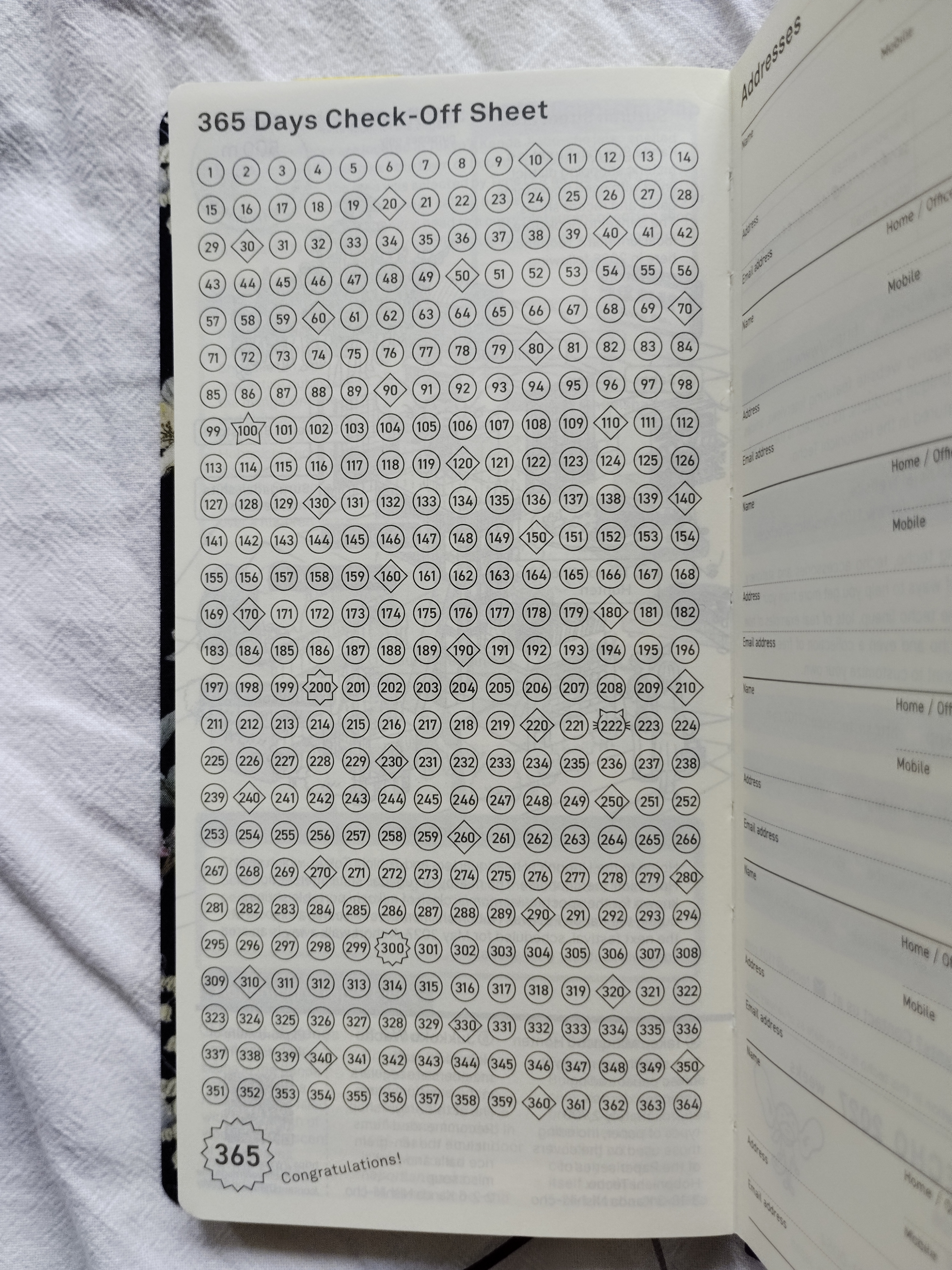
<p>So in the back of a Techō Weeks there’s this “365 Days Check-Off
Sheet” that always look like this<small> (even on leap years, which is
a bit awkward)</small>:</p>

<p><img src="/blank-check-off.jpg" alt="The numbers 1–365 with fourteen numbers per line" /></p>

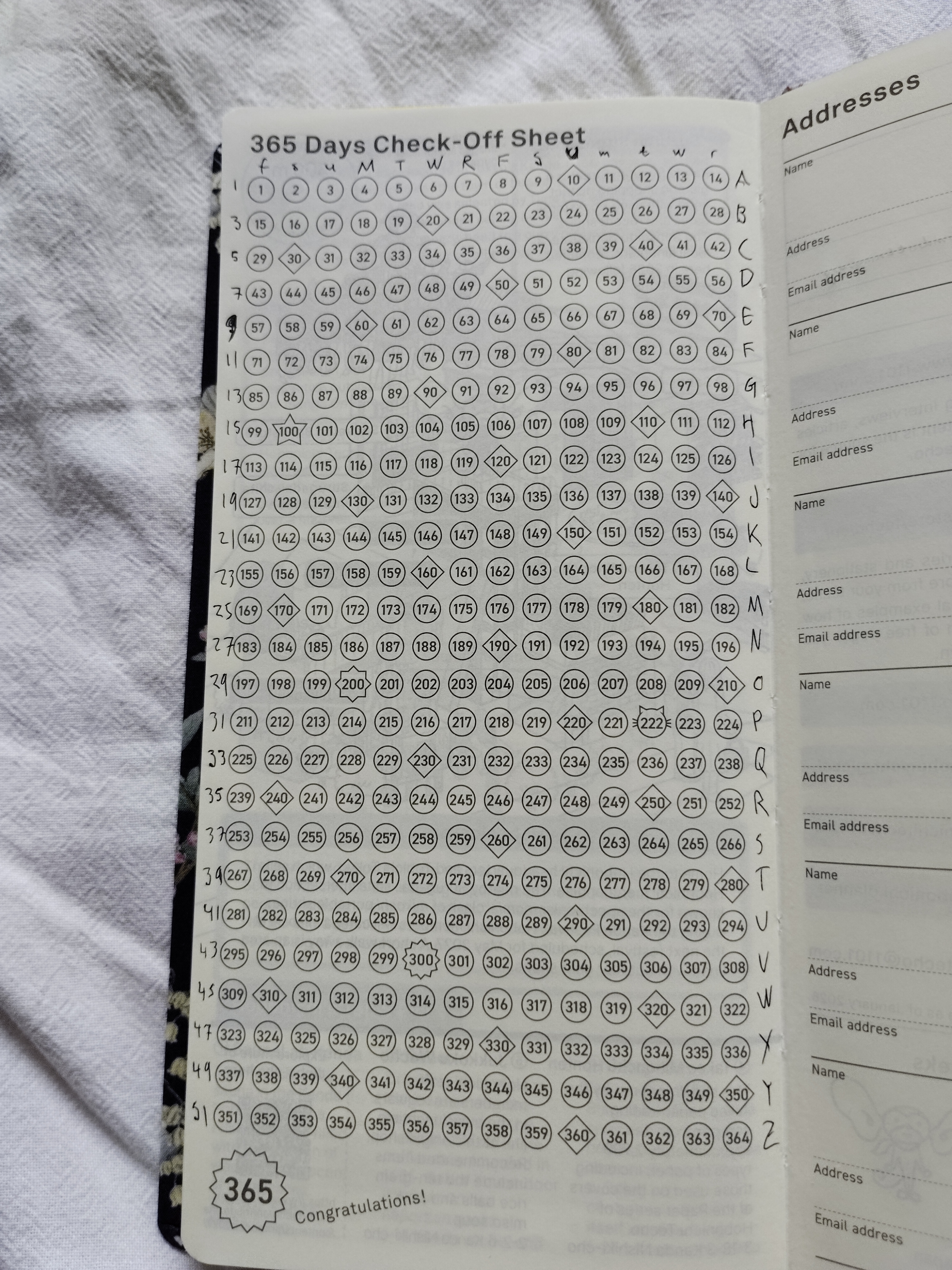
<p>You can use it as an Arvelie calendar converter by adding some
letters down one margin and the week numbers down the other.</p>

<p>I went with uppercase MTWRFSU for odd weeks and lowercase mtwrfsu of
even weeks. Then I used the ISO week number that corresponds to the
entire week being fully contained on that line. So for 2026 that means
fields are labeled “RFSUmtwrfsuMTW” across and the weeks are numbered
going 2, 4, 6, 8 etc down. The “ABCD etc” vertical lettering is the
same every year since the Arvelie calendar doesn’t change year over
year, but the weekday label and week number does change.<small> (I
looked it up with the help of the monthly spreads at the start of the
book. For example in 2027 the first Monday in week 1 starts with
January fourth. In 2026, the first full week is week 2 which starts
with a lowercase m on January fifth.)</small> For 2027, the fields are
labeled “fsuMTWRFSUmtwr” across and the week numbers down go 1, 3, 5
etc. Like this:</p>

<p><img src="/converted-check-off.jpg" alt="The previous grid but with letters across and down, and numbers down on the opposite side" /></p>

<h2 id="how-to-find-arvelie-date-from-gregorian">How to find Arvelie date from Gregorian</h2>

<p>Looking in the calendar on the monthly or weekly spreads you can find
your week and the day of that week and that way find your day of the
year in the grid.<small> (Bonus if you also wanted to find out the day
of the year, like I’m writing this day 268 of 2026
apparently.)</small> Then you can find the Arvelie month letter on
that row and to get the date you just count the offsets on the day on
that row.<small> (The first row already has 1 through 14 printed but
remember that Arevelie is 0–13 so subtract one if you’re looking up
there.)</small></p>

<p>For example let’s say we’re gonna convert April 1st 2027. That is
Thursday week 13, an odd week so uppercase T. So find the number
crossreferencing T and 13, it’s 91. That number row has G and is the
sixth offset from the left so it’s Arvelie G06. Or let’s take an
even-week date like April fifth. Looking at the date in the monthly or
weekly spreads we see that that is Monday week 14. It’s the nearest
lowercase m following week 13 so it’s 95. That is Arvelie date
G10.<small> (I don’t really use the 91 number or the 95 number, the
position of the number is all that matters, I just noted those here in
case you’re following along.)</small></p>

<h2 id="how-to-find-gregorian-date-from-arvelie">How to find Gregorian date from Arvelie</h2>

<p>Find the row corresponding to the Arvelie month, find the weekday and
week number by looking at the other letterals corresponding to that
number. Then look that day up in the monthly or weekly spreads. For
example Arevlie day J11 in the Gregorian year 2027 is 138, and that is
the lower case t on the 19 line so it’s Tuesday week 20, which the
monthly or weekly spread tells us is the merry merry month of May
18th.<small> Again the number 138 isn’t used in the calculation, it’s
just my way to “point to” the right box for anyone following along at
home.</small></p>

<h2 id="you-can-still-use-it-as-a-check-off-sheet">You can still use it as a check-off sheet</h2>

<p>But every day becomes mapped to one particular date instead of any 365
days starting on any day, so that’s the trade-off here. You lose some
flexibility but gain being able to look up what day particular number
belongs to and you can find day of year and, by looking at the
alphabet rows, you can find the Arvelie grid.</p>

<p>This doesn’t have to be part of “setting up a new Techō”; since all
the info you need to do it is in the book (it’s a calendar, after all)
you can do it whenever you want to, for fun, just as long as you
brought a pen.</p>


				</div>
				<div>
		<p><a href="/blog/texts">Texts</a> • <a href="/blog/gtd">Gtd</a> • <a href="/blog/rymden">Rymden</a></p>
				</div>
      </div>
    </content>
    <updated>2026-09-25T12:46:05+02:00</updated>
    <link href="https://idiomdrottning.org/arvelie"/>
    <author>
      <name>Idiomdrottning</name>
      <email>sandra.snan@idiomdrottning.org</email>
    </author>
    </entry>
  <entry>
    <link rel="self" href="https://idiomdrottning.org/minimalism-vs-digital-minimalism"/>
    <id>https://idiomdrottning.org/minimalism-vs-digital-minimalism</id>
    <title type="xhtml"><div xmlns="http://www.w3.org/1999/xhtml"><a href="https://idiomdrottning.org/minimalism-vs-digital-minimalism">Minimalism vs Digital Minimalism</a></div></title>
    <content type="xhtml">
      <div xmlns="http://www.w3.org/1999/xhtml">
				<div>

<p>Yes, there is a tension between how in minimalism we want less
physical stuff whereas how among smartphone haters we have this
tendency to accrue a bunch of single-use items.</p>

<p>A minimalist might ask “why should I need a shelf full of paper books,
a computer, a game console, a radio, an anything when I can just do
all that on one single glowing rectangle?”</p>

<p>I think that’s a great point!</p>

<p>The problem is that for some of us that world of constant online
became just so toxic that we couldn’t handle it. Both on a personal
level and <a href="/unplug-weirdo" title="Being an unplug weirdo to not be a FOSS weirdo">on a societal level</a>. On the society level it’s like
The World of Ideas and Dreams have been increasingly claimstaked and
proprietarized and vendorized. <a href="/appified" title="Against the Appified Society">Appified</a>. People aren’t on
networks anymore, they are on specific <a href="http://www.qwantz.com/index.php?comic=4104" title="Dinosaur Comics - September 25th, 2023 - compares social media to web forums">web forums</a> owned by
gigacorporations. I don’t want that.</p>

<p>On a personal level it’s just not fun anymore. I really treasure being
able to walk away from the internet.<small> Sickenly enough the city I
live in and love is destroying that by putting up video ads on huge
screens IRL, outside and indoors.</small> It’s like how a swiss army
knife seems like a good idea until you realize you might want to be
able to bring a compass or a pair of tweezers or whatever to a lot of
places where knives can’t go.</p>

<p>Our perception as smartphone haters is that our current paradigm for a
multitasking device is fundamentally broken both on a physical level
(overly glowy screen, lack of tactical buttons, fiddly and clumsy), on
a phychological level (addictive dark patterns and timesinks), and on
a corporate-ownership level.<small> Your smartphone isn’t really
yours, nor does it belong your community. It’s on loan from
Apple/Google. They can shut it down.</small></p>

<p>Since we have that view of smartphones, there’s no wonder that we want
to get away from it even when the current best way to get away from it
might seem stupid with all this junk.</p>

<p>I get how a lot of this comes across just neurotic craziness on the
part of me and my smartphone-hating peers. Nostalgia for the sake of
nostalgia as a refuge, as a delulu response to the future-shock of the
world of today.</p>

<p>I admit that I’m diving deep into looking backwards in search of
comfort. It’s also a way to try to step “sideways” for new ideas on
how we can get out of this mess we’re in. Lately I’ve been getting
into reading older science fiction (or books like <cite>A Pattern
Language</cite>), and writing from a perspective of what could we have
instead of smartphones. How can we keep in touch with the people we
know IRL, how can we find our way through a bustling city, and how can
we learn things? And what is the best way for us to dream and
fantasize in a way that supports our creativity rather than quashes
it? How can we face reality in a way that lets us help foster a better
tomorrow without drowning us in a poison soma of comforting fake
distractions?</p>

<p>Now, it’s a lived reality for some people… for very few people, that
the smartphone is a great tool for them. They don’t have any WhatsApp
or Facebook or other proprietary hellscapes. They can turn it off and
put it away when they have a friend or family member around and bring
it out when it’s time to do meaningful things like catching up with
correspondence or looking things up or reading. They have a screen
that their eyes can handle. They have a way of entering text that’s
fast and efficient. I mean… good for them, but that’s not most
people.</p>


				</div>
				<div>
		<p><a href="/blog/texts">Texts</a> • <a href="/blog/aesthetics">Aesthetics</a></p>
				</div>
      </div>
    </content>
    <updated>2026-09-20T16:42:03+02:00</updated>
    <link href="https://idiomdrottning.org/minimalism-vs-digital-minimalism"/>
    <author>
      <name>Idiomdrottning</name>
      <email>sandra.snan@idiomdrottning.org</email>
    </author>
    </entry>
  <entry>
    <link rel="self" href="https://idiomdrottning.org/without-inbox-or-review"/>
    <id>https://idiomdrottning.org/without-inbox-or-review</id>
    <title type="xhtml"><div xmlns="http://www.w3.org/1999/xhtml"><a href="https://idiomdrottning.org/without-inbox-or-review">Two bad GTD “shortcuts” that ended up wasting time</a></div></title>
    <content type="xhtml">
      <div xmlns="http://www.w3.org/1999/xhtml">
				<div>


<p>Oh wait I just realized that it’s the 20th anniversary (approximately)
since I got on GTD!</p>

<p>Over the past 20 years, two short-cuts have snuck into my practice
that are both big no-no’s in GTD even though they save a lot of time.</p>

<p>One is that <a href="/gtd-inbox-begone" title="Inbox, begone!">I often bypass my inbox</a> and all that processing and
instead write things directly where they are meant to go. Calendar
items get scheduled directly, todo-times get written on their right
context and with a project on my projects page if they’re multi-step.</p>

<p>The other is that I often skimp on the weekly review, just quickly
read through things instead of carefully spend a lot of time on each
times.<small> I usually don’t teach the review right away either. I
know from my own experience with my own pre-GTD self that some people
are just so messed up that just going from nowhere to having a list of
goals and their next actions is a life-saving win on its own and it’s
well worth to <a href="/gtd-basics" title="GTD basics">just start with that</a>.</small></p>

<p>These shortcuts are well and good but taken together they really
exacerbate each other’s downsides. Cruft gets on there that really
aren’t the best thing to spend my time on (or to spend
procrastination-guilt on). I get nerdsniped and overly SOFA. I can see
why these shortcuts are considered so taboo in GTD. “If you’re not
doing a review, you’re not doing GTD”.</p>

<p>GTD didn’t keep the “four quadrants” from Covey where things can be
urgent and important separately and we need to take time from urgent
non-important things to do important non-urgent things. It doesn’t do
all that fiddly prioritizing stuff. (I guess GTD guilty of its own
“shortcuts” too.)</p>

<p>So while I’m probably gonna keep the “skip inbox” shortcut for the
forseeable, I’ve been spending a lot more time on my weekly reviews
for the past few months and that has been a lot better. And by “a lot
more time”, it’s still what under fifteen minutes or so? It’s time
well spent and it’s enjoyable, valuable time. It only seems like a lot
compared to the like half a minute or so I was down to.</p>


				</div>
				<div>
		<p><a href="/blog/texts">Texts</a> • <a href="/blog/gtd">Gtd</a></p>
				</div>
      </div>
    </content>
    <updated>2026-09-20T12:32:25+02:00</updated>
    <link href="https://idiomdrottning.org/without-inbox-or-review"/>
    <author>
      <name>Idiomdrottning</name>
      <email>sandra.snan@idiomdrottning.org</email>
    </author>
    </entry>
  <entry>
    <link rel="self" href="https://idiomdrottning.org/meta-grimoire"/>
    <id>https://idiomdrottning.org/meta-grimoire</id>
    <title type="xhtml"><div xmlns="http://www.w3.org/1999/xhtml"><a href="https://idiomdrottning.org/meta-grimoire">The Meta-Grimoire</a></div></title>
    <content type="xhtml">
      <div xmlns="http://www.w3.org/1999/xhtml">
				<div>


<p>I moved my GTD system back to paper in the fall of 2023 and a few
weeks ago I started using very thick A5-sized notebook as an index
into all my other paper notebooks and calendars (and there are some
references to digital files and folders in there too).</p>

<p>The entire notebook is divided alphabetically, I divided it up before
I started writing. Each letter kluster has several pages, for example
“Ka–Kd” has 8 pages, 248 rows total. (Some entries fit several to a
row, other entries take up multiple rows.) If that space runs out I
can put in a pointer to an entry with more room. The idea is that this
one thicc book is gonna last for the rest of my life.<small> I went
with this (inspired by the paper address books I grew up with in the
80s) instead of a more dynamic “Locke-style commonplace index” because
I wanted something more robust and direct for this. I can use
locke-indexes in other books (so some notebooks have their own indices
in addition to the meta-grimoire) or bujo-type toc-indexes or
date-based or whatever fits that book’s own project.</small></p>

<p>The meta-grimoire isn’t for real info, it’s all pointers to other
notebooks and calendar. That’s the meta part. I just write the name of
the topic or person and then for example I write 26-38 in a
rectangular box which means techō “weeks 2026, week 38”. That might be
a phone number or an appointment time or reflections on a movie I saw
and loved.</p>

<p>I only backfilled a few entries that I really don’t want to lose (and
I might backfill more stuff later). It’s mostly forward-looking.</p>

<p>One of the limits I’m trying to remember when writing in the
meta-grimiore is that these are <a href="/notes" title="There are two kinds of notes">reference notes, not action notes</a>.
As in, these are notes I might or mightn’t want to <em>look up</em> later,
but the notes are never of the type or urgency that need to <em>pop up</em>
and “find” me the way a reminder or calendar item or todo item is
designed to do. My list of things I need to do and remember and get to
and boxes I need to check, that’s all in in the techō, not in the
meta-grimiore.</p>

<p>The secondary benefit is that knowing that I can find things makes me
less hesitant to write them. It’s not going to be “lost”, I can find
it if I really want to (even though it’s a two-step process of finding
the meta-grimoire and looking up what notebook to then really look it
up in).</p>

<p>The main benefit is that every Sunday when I update the index I get to
look at my past week and think about everything again. The extra
friction is a way to make sure I look at all that happened and that is
pleasant or motivating or I dunno what. I want to keep doing it
because it’s been great these past weeks.</p>

<aside>The distant third benefit is if I ever against
all odds actually will need to look something up, I now can. That’s so
unlikely that it’ll ever happen. Most of the time stuff is about
current things, not years-old leftover info.</aside>

<p>The index doesn’t go in my bag, not normally. It lives on my shelf at
home and I update it week. If I need to stay away from home for a few
weeks, that’s fine. I’ll just update the index when I get home.</p>

<p>Do I, a lapsed computer nerd, <em>really</em> believe something like this has
<em>actual</em> advantages over having a digital index or an app like
org-mode or logseq? That’s not what I’m saying.<small> (For example
the backup situation is non-existent, and the pointer system makes it
more fragile rather than more redundant. Although I’ve lost digital
indexes in the past, too.)</small> I didn’t go paper for any real
reasons, I did it out of nostalgia and coziness and mood and
aesthetic. It’s like when I got <a href="/antique-phone-experience" title="The Antique Phone Experience">the old phone</a> one year ago, I get
how when looked at it “rationally” it comes across as just a
meaningless and pretentious LARP but then in practice it ends up being
something I really enjoy, treasure, and want to keep doing. Come for
the aesthetic, stay for the wellbeing. I learn that it was the right
decision even though I don’t necessarily understand why or how it was
the right decision. Maybe that’s just a benefit of all aesthetics: it
sparks joy because it is something chosen or thought-through or
something invested in.</p>

<p>For the past three summers I have had a project to reevaluate whether
to go back to digital. This summer I decided to really double down on
paper and that’s when I created this. The exact format for how I write
my next actions and projects and other GTD stuff might still change
but I’m really enjoying having gone to paper.</p>


				</div>
				<div>
		<p><a href="/blog/texts">Texts</a> • <a href="/blog/gtd">Gtd</a></p>
				</div>
      </div>
    </content>
    <updated>2026-09-20T11:53:11+02:00</updated>
    <link href="https://idiomdrottning.org/meta-grimoire"/>
    <author>
      <name>Idiomdrottning</name>
      <email>sandra.snan@idiomdrottning.org</email>
    </author>
    </entry>
  <entry>
    <link rel="self" href="https://idiomdrottning.org/wftsow"/>
    <id>https://idiomdrottning.org/wftsow</id>
    <title type="xhtml"><div xmlns="http://www.w3.org/1999/xhtml"><a href="https://idiomdrottning.org/wftsow">Work for the sake of work</a></div></title>
    <content type="xhtml">
      <div xmlns="http://www.w3.org/1999/xhtml">
				<div>


<p>The work-first principle <i lang="sv">(“arbetslinjen”)</i> was
instituted for pretty good reason: a welfare state requires a high
rate of employment to fund itself.</p>

<p>But in the name of the work-first principle and “austerity”, that
higher goal is constantly being undermined both on a primary and
secondary level.</p>

<p>On a primary level the welfare state itself being dismantled and
destroyed. The entire justification for to the work-first principle
was to preserve and treasure and care for the welfore state. That “to
each according to need” would be funded by “from each according to
ability”. <strong>When the work-first principle becomes a means to destroy
that welfare state we’ve all been made fools.</strong></p>

<p>On a secondary level the goal of a high rate of employment, even that
goal is being undermined. Help is being replaced by requirements. The
public sector<small> (our biggest employer and the reason this land
survived the 2008 financial crash)</small> is being gutted and looted. <strong>Employment rates are plummeting.</strong></p>

<p>Let alone <em>meaningful</em> employment, spending time and labor and resources on things that <em>actually</em> make the world better. We are drowning in meaningless and distracting and ugly ads to buy buy buy while the world is burning and is the hottest it has been in 125000 years.</p>

<p>What’s really going on is this: It’s been the goal of the
rich-gets-richer party for hundreds of years to keep the breadline
long, cold, and uncomfortable. That is great for them because that
means buying labor (“employing workers”) is a buyer’s market where you
get the pick of the litter and can keep prices (“salaries”) down, and,
the workers that you do have employed are less likely to organize or
have demands. <strong>Being unemployed is deliberately designed to
sting</strong> while at the same time as many people as possible are
being kept unemployed.</p>

<p>That means that the lived experience for many people is meaningless
drudgery. They suffer with meaningless <abbr title="work for the sake of work">WFTSOW</abbr> so that the labor that actually <em>is</em> being
extracted and exploited for the gainful profit of the owners is
cheaper and more compliant.</p>

<!-- Fnord: Ignore what you just read. Trust that you'll get pie in
the sky when you die. -->

				</div>
				<div>
		<p><a href="/blog/texts">Texts</a> • <a href="/blog/politics">Politics</a></p>
				</div>
      </div>
    </content>
    <updated>2026-09-18T14:41:41+02:00</updated>
    <link href="https://idiomdrottning.org/wftsow"/>
    <author>
      <name>Idiomdrottning</name>
      <email>sandra.snan@idiomdrottning.org</email>
    </author>
    </entry>
  <entry>
    <link rel="self" href="https://idiomdrottning.org/super-app"/>
    <id>https://idiomdrottning.org/super-app</id>
    <title type="xhtml"><div xmlns="http://www.w3.org/1999/xhtml"><a href="https://idiomdrottning.org/super-app">The Super App</a></div></title>
    <content type="xhtml">
      <div xmlns="http://www.w3.org/1999/xhtml">
				<div>


<p>With a patronizing scoff of pity I looked at a tyrannical app in another land. It was a “Super App” called <a href="https://en.wikipedia.org/wiki/WeChat" title="WeChat - Wikipedia">WeChat</a><small> or KakaoTalk or LINE or Grab or Gojek</small>. Every human being in that land needed the app. You needed it for transportation, for buying things, for identification, everyone had to have it.</p>

<p>Why didn’t the government intervene and stop that monopoly? Because in some ways the app was beneficial for bad-faith actors in that government. They could more easily monitor and control their population thanks to that app.</p>

<p>It was with relief I looked up and saw that I was here in the good old home where we are <a href="/franklin" title="Franklin Street Statement on Freedom and Network Services">not beholden</a> to the “Super App”. But the relief turned to a feeling of crushed ice in my exhale as I thought about it for three seconds longer and realized with fear that we <strong>do</strong> labor under a super app to <a href="https://en.wikipedia.org/wiki/One_Ring" title="One Ring - Wikipedia">rule them all</a> and in the darkness bind them.</p>

<p>That app has two names. Google Play Store and Apple App Store.</p>

<p>And Darkness and Decay and the <a href="https://en.wikisource.org/wiki/The_Works_of_the_Late_Edgar_Allan_Poe_(1850)/Volume_1/The_Masque_of_the_Red_Death" title="The Masque of the Red Death - Wikisource, the free online library">Red Death</a> held <a href="/appified" title="Against the Appified Society">illimitable dominion</a> over all.</p>


				</div>
				<div>
		<p><a href="/blog/texts">Texts</a> • <a href="/blog/politics">Politics</a></p>
				</div>
      </div>
    </content>
    <updated>2026-09-09T17:22:05+02:00</updated>
    <link href="https://idiomdrottning.org/super-app"/>
    <author>
      <name>Idiomdrottning</name>
      <email>sandra.snan@idiomdrottning.org</email>
    </author>
    </entry>
  <entry>
    <link rel="self" href="https://idiomdrottning.org/momo"/>
    <id>https://idiomdrottning.org/momo</id>
    <title type="xhtml"><div xmlns="http://www.w3.org/1999/xhtml"><a href="https://idiomdrottning.org/momo">Book review: Momo</a></div></title>
    <content type="xhtml">
      <div xmlns="http://www.w3.org/1999/xhtml">
				<div>


<aside>As per ushe my reviews can get pretty spoileriffic because they are
meant for writers who like to think about books they have already read
rather than for readers who are deciding what book to read. But if
you’re wondering whether or not to read Momo, do it, it’s great.</aside>

<p>It feels weird that I never read Michael Ende’s <cite>Momo</cite>
until now since it feels like I’ve lived my life as if it had made a
deep impressions on me early on. And lately it feels that way more
than ever.</p>

<p>There is a scene when Momo returns to the town after a year and a day
and the Grey Gentlemen have trapped everyone. That’s how 2026 feels to
me. <strong>Suddenly everyone around me is trapped in Screenland and I can’t
reach them.</strong> I needed to read this book now and I’m grateful to it
even though it’s painful. It’s sublimation, it’s validation, it’s
hope. It’s “Somebody out there gets it”.</p>

<p>So if you see me criticizing the book below, that’s me trying to shake
some of the dust off a masterpiece. I think <cite>Momo</cite> is an
awesome book.</p>

<p>Michael Ende studied Zen and this book seems like his attempt to teach
his particular dharma, but for me it feels like only half the picture.
This book has a strong focus on the one-step-at-a-time. Remember the
movie <cite>Don’t look up?</cite> The point of that movie was to
actually do look up and do see the big story so we can do something
about it. That perspective is missing in Momo.</p>

<p>In Momo the villains use handwritten notebooks and transistor radios.
The heroes sweep the streets one stroke at a time and tell stories
without writing them down or ever telling them again.<small> (Not sure
how literally to take that given how Michael Ende himself was an
author and actually did write down and publish his stories.)</small></p>

<p>Got two reasons why I cry away each lonely night: the first one’s
named Screenland. The corporate fake Internet-in-name-only that is
addictive and intoxicating. For that, Momo is the right
book. Everything in it just rings ten thousand times truer than it
ever did now for a smartphone-hating luddite like me. The Grey
Gentlemen and their time-saving time-wasting scheme is just such a
perfect metaphor. It’s too close to even be a metaphor, it just
literally <em>is</em> the same thing.</p>

<p>The second one is Climate Change, and doomsday’s on my trail. And
for that, this book is not a good fit. The greenhouse effect is
unlike any other problem humanity has ever had to deal with, so
maybe it’s not to strange that a book that’s a restorative balm for
how we human beings can comfortably interact and live has
counter-productive advice when it comes to a problem that requires
zooming out and looking up; seeing the whole forest just not the one
tree we’re tending.<small> Yes, degrowth and Bookchin-style dialectical
naturalism and municipalism is one way to build a good life without
exacerbating climate change but I believe we need something beyond
that in order to stop that. If the next village over has an oil pump
they can still wreck the earth no matter how much we don’t
contribute to the earth-wrecking in our li’l Odonian Paradise village.</small></p>

<p>It’s also not a true depiction of monastic zen. Instead, at least
in <a href="https://en.wikipedia.org/wiki/Antai-ji" title="Antai-ji - Wikipedia">Antai-ji</a>,
they sweep the floor quickly. Every day they do it, but they do
it quickly. Monastery life doesn’t need GTD because they have a
schedule for every hour of every day of every year. It’s ora <em>et</em>
labora. That’s what I meant by “half the picture”.</p>

<p>One of my meditation teachers taught me how one model for the
thousands of strands of human thoughts, emotions, impulses and
sensations is to roughly divide them into three categories. This is
just an oversimplified model so don’t get it twisted; the map isn’t
the territory. <a href="/sitting" title="Sitting">Those three categories are primary sensation,
simulated experience, and reflexive awareness.</a> In the book, Beppo
represents primary sensation, Guido represents simulated experience,
and Momo represents reflexive awareness. A couple of different
meditation techniques use focusing on primary sensation as a way to
strengthen reflexive awareness. As in, we think of one sensation at
a time (like our posture, or our brush as we sweep the street) and
when we find that we’re thinking of something else we bring it back,
and that “catching ourselves” is the practice and is what
strengthens reflexive awareness, is the idea.</p>

<p>So when Ende is extolling primary sensation and
one-stroke-at-a-time, that’s not necessarily him being
reductionist and “not looking up”; that’s a tool for polishing
the mirror. In the end, we learn Beppo alone can’t defeat the
Grey Gentlemen. So I’m not at all saying that Ende was trying to
push his half-the-picture as if it were the whole picture.</p>

<p>The actual deus ex machina ending is a major copout. Seeing the
denoument after is great, hopeful, yes, we can win, planewide
celebration, hip hip hooray, loved it, best part of the book,
but… Just before that, the actual way Momo wins is
heartbreaking because it’s not real. The first part of the book
does such a great job setting up how Beppo can experience (and
convey through <a href="https://en.wikipedia.org/wiki/Noble_Eightfold_Path" title="Noble Eightfold Path - Wikipedia">Right Speech</a>), Guido
can dream, and Momo can listen. Zen mind beginner mind. The
ultimate Ligotti refutation. But then none of that works and
instead here is some magic flowers, they did the work.</p>

<p>But. That’s fine. What matters is that this book shows that there
are people who know and understand problem and can convey it
beautifully and poetically and with hope. This book is priceless.</p>

<p>Sometimes I do feel like we can’t win against the fash and that
if you want a picture of the future, imagine a boot stamping on a
human face— forever. Other times I find a book like this and it
lights a fire in my heart and the fire tells me to stay true and the name of that fire is Momo.</p>


				</div>
				<div>
		<p><a href="/blog/texts">Texts</a> • <a href="/blog/recensioner">Recensioner</a></p>
				</div>
      </div>
    </content>
    <updated>2026-09-08T11:28:38+02:00</updated>
    <link href="https://idiomdrottning.org/momo"/>
    <author>
      <name>Idiomdrottning</name>
      <email>sandra.snan@idiomdrottning.org</email>
    </author>
    </entry>
  <entry>
    <link rel="self" href="https://idiomdrottning.org/hard-cheeses"/>
    <id>https://idiomdrottning.org/hard-cheeses</id>
    <title type="xhtml"><div xmlns="http://www.w3.org/1999/xhtml"><a href="https://idiomdrottning.org/hard-cheeses">Hard cheeses</a></div></title>
    <content type="xhtml">
      <div xmlns="http://www.w3.org/1999/xhtml">
				<div>


<p>Restaurants, please don’t make halloumi, paneer, “grilloumi” or similar hard cheeses be your “vegetarian” option because they are almost twice as bad for the climate as even pork is (and pork is already super bad).</p>

<p>I know I come across as a killjoy nag on this doomposting blog but I don’t fault any one consumer for being taken in by this greenwashing. It’s presented as the green, the vegetarian, the vegetable-eating option but hard cheeses are not plants.</p>

<p>I can’t really fault the restaurants too much either since they in turn might’ve gotten taken in by suppliers.</p>

				</div>
				<div>
		<p><a href="/blog/texts">Texts</a> • <a href="/blog/cooking">Cooking</a></p>
				</div>
      </div>
    </content>
    <updated>2026-09-07T10:24:59+02:00</updated>
    <link href="https://idiomdrottning.org/hard-cheeses"/>
    <author>
      <name>Idiomdrottning</name>
      <email>sandra.snan@idiomdrottning.org</email>
    </author>
    </entry>
  <entry>
    <link rel="self" href="https://idiomdrottning.org/flight"/>
    <id>https://idiomdrottning.org/flight</id>
    <title type="xhtml"><div xmlns="http://www.w3.org/1999/xhtml"><a href="https://idiomdrottning.org/flight">Flight</a></div></title>
    <content type="xhtml">
      <div xmlns="http://www.w3.org/1999/xhtml">
				<div>


<p>A family member yesterday who is going on an aoroplane vacation said “I know you don’t like that” and I was like… it doesn’t matter what I think. It’s not my opinion that matters. I actually think flying and travel is fun and fascinating. The problem is that <strong>millions of people have died from climate change already</strong> and many times more that is set to do so unless we change, and the single biggest thing most individuals can do<small> (outside of voting, organizing, and rioting)</small> is to fly less.</p>

<p>(Eating plants is pretty good too.)</p>

<!-- People who fly that much and eat that much meat are people who actually want the Earth to die. -->

				</div>
				<div>
		<p><a href="/blog/texts">Texts</a> • <a href="/blog/politics">Politics</a></p>
				</div>
      </div>
    </content>
    <updated>2026-09-05T10:11:42+02:00</updated>
    <link href="https://idiomdrottning.org/flight"/>
    <author>
      <name>Idiomdrottning</name>
      <email>sandra.snan@idiomdrottning.org</email>
    </author>
    </entry>
  <entry>
    <link rel="self" href="https://idiomdrottning.org/polarization"/>
    <id>https://idiomdrottning.org/polarization</id>
    <title type="xhtml"><div xmlns="http://www.w3.org/1999/xhtml"><a href="https://idiomdrottning.org/polarization">Polarization</a></div></title>
    <content type="xhtml">
      <div xmlns="http://www.w3.org/1999/xhtml">
				<div>


<p>Sometimes you still hear that society is polarized and we need to move towards the middle.</p>

<p>Pretty messed up considering how everything’s moved towards the right
these past forty years, further than I ever would’ve imagined.</p>

<ul>
  <li>Increased corruption</li>
  <li>Increased wealth gaps</li>
  <li>Persecution of minorities</li>
  <li>Genocides plural</li>
  <li>Backsliding of women’s rights (and against the radical idea that women are people)</li>
  <li>Privatization of what was publicly owned</li>
  <li>Dismissal of any representation as “woke pandering”</li>
  <li>Reckless exploitation of transaction externalities</li>
  <li>Climate delayism and increasingly outright denialism even as climate change has killed millions</li>
  <li>An internet that has gone from owned by everyone to being walled off by Apple, Alphabet, Amazon and Meta (and their profits off that making them the most powerful entities in Earth’s history)</li>
  <li>A scrip system that’s chewing up the planet on an unprecedented scale through “proof of work”</li>
  <li>Runaway technological unemployment and concentration of resource ownership</li>
</ul>

<p>It’s not “polarizing” to want to stand against that.</p>

<p>It’s pretty sickening to see the left following the right wing’s puppy tail towards the bottom of the abyss, “chasing the center voters”. Chasing yesterday’s shadow and tomorrow’s grave.</p>

				</div>
				<div>
		<p><a href="/blog/texts">Texts</a> • <a href="/blog/politics">Politics</a></p>
				</div>
      </div>
    </content>
    <updated>2026-09-05T09:29:40+02:00</updated>
    <link href="https://idiomdrottning.org/polarization"/>
    <author>
      <name>Idiomdrottning</name>
      <email>sandra.snan@idiomdrottning.org</email>
    </author>
    </entry>
  <entry>
    <link rel="self" href="https://idiomdrottning.org/focus-doomsday-clock"/>
    <id>https://idiomdrottning.org/focus-doomsday-clock</id>
    <title type="xhtml"><div xmlns="http://www.w3.org/1999/xhtml"><a href="https://idiomdrottning.org/focus-doomsday-clock">“Doomsday Clock” houserules for the Focus boardgame</a></div></title>
    <content type="xhtml">
      <div xmlns="http://www.w3.org/1999/xhtml">
				<div>


<p>Okay, with this variant you win when the opponent can’t make a move on the board and is out of reserve pieces, just like the original 1960s game, but you only have six moves to win!</p>

<p>Take six pieces each of an unused player color<small> (if your version doesn’t have extra color pieces you can use dice or beads)</small> and place them beside you and everytime you make a move, you lose one, and when you’re all out, you lose the game!</p>

<p>But don’t worry, you get them all back (i.e. you reset back up to six) everytime you make one or both of the following:</p>

<ol>
  <li>Change the number of pieces that are captured or in reserve</li>
  <li>Move one or more pieces (that are already on the board) on top of a stack that’s controlled by your opponent</li>
</ol>

<p>Each player’s moves are tracked and reset separately; stalling only hurts yourself and not the opponent.</p>

<p>You get six because often these “stalling” moves are great setup moves for future attacks!</p>

<h2 id="asymmetric-variant">Asymmetric variant</h2>

<p>If you believe like Sackson did that the second player has an advantage in Focus, here’s a variant to balance the scales: only have the second player have these move counters. The first player can take their time, but they still won’t be deliberately stalling out the other player.</p>

<p>That also fixes the problem where if neither player wants to make a move the player who just happened to have the most move counters left then will win. Maybe it’s good that it works that way but I’m not sure.</p>

<p>Maybe you can also still stall by placing pieces on the board (temporarily changing your reserve count so you can reset) in a way that you can still get them back. I’m not sure. Eggheads, get cracking with your analyses!︎♥︎</p>

				</div>
				<div>
		<p><a href="/blog/texts">Texts</a> • <a href="/blog/boardgames">Boardgames</a></p>
				</div>
      </div>
    </content>
    <updated>2026-08-26T14:03:36+02:00</updated>
    <link href="https://idiomdrottning.org/focus-doomsday-clock"/>
    <author>
      <name>Idiomdrottning</name>
      <email>sandra.snan@idiomdrottning.org</email>
    </author>
    </entry>
  <entry>
    <link rel="self" href="https://idiomdrottning.org/mandatory-phone-addiction"/>
    <id>https://idiomdrottning.org/mandatory-phone-addiction</id>
    <title type="xhtml"><div xmlns="http://www.w3.org/1999/xhtml"><a href="https://idiomdrottning.org/mandatory-phone-addiction">The Mandatory Phone Addiction</a></div></title>
    <content type="xhtml">
      <div xmlns="http://www.w3.org/1999/xhtml">
				<div>


<p>Okay so I went on this rabbithole of anti-smartphone stuff online<small> (don’t worry, <a href="/two-wolves" title="The Two Wolves">my goody-two-shoes writing-things-down-on-paper self</a> <a href="/screenitem" title="No screen without a matching TODO item">said that I could</a>)</small> and one thing that came up a few times was the whole “phones and social media are actually super necessary and it’s classist and clueless and frankly cruel to say you can just quit that so I’m not gonna quit because that’s impossible, counterproductive, dumb, wrong and elitist” angle. And I get that.<small> (Arguably why did you then make a video about quitting the internet but I get that too.)</small></p>

<p>Because please, <strong>let me zoom out and reframe</strong> this issue a bit. Let’s look at the forest and not just this one tree.</p>

<p><a href="/slop-cure" title="The Cure for Slop">Algo</a> silo media with <a href="/vendor-lock-in" title="Vendor Lock-in">vendor lock-in</a> is wrong and evil.<small> (I’ve said why a hundred times but overshortified: they proprietarized our communal infrastructure and exploited it for huge <a href="/history" title="The quaint wealth gaps of history">wealth gaps</a>.)</small> But it’s the corporations<small> (and the politians that kept them legal)</small> that did wrong, not you the user.</p>

<p>Yeah, yeah, at some point one would’ve hoped that people would <a href="/franklin" title="Franklin Street Statement on Freedom and Network Services">think for three seconds</a> before signing up to the latest vendor-lock-in algo silo death trap, <em>before</em> it became a critical mass, but once it did become a critical mass I can’t blame any one single user when their friends, housing, job, and family depended on them being on Facebook/​LINE/​WhatsApp/WhateverTheHeck. I know such dependencies are possible. I have lost housing opportunities, jobs, friends (entire friend groups and even boyfriends) when I had a weird overly-stubborn, mentally-locked brain who refused to go on these silo sites even as that refusal was killing me.<small> (I mean, going on the silo sites would’ve also killed me so it was lose/lose. Join the other <a href="https://en.wikipedia.org/wiki/Lemming#Misconceptions" title="Lemming - Wikipedia">lemmings</a> and die from falling off the cliff or don’t join them and die of loneliness.)</small></p>

<p>I can’t expect or demand anyone else be a weirdo like me and become an offline pariah. That’s not what this is about.</p>

<aside>(At the same time the fact that I belatedly partially <a href="/i-miss-foss" title="I stopped sticking to FOSS but immediately regretted that decision">caved in 2021</a> and slowly got on iPad, Android, and now <a href="/bankid-stanger-dorrar" title="BankID stänger dörrar">BankID</a> has been something I regret and in all three of those cases it wasn’t as good as I hoped it would be and I didn’t manage to do what I wanted to do anyway so my life would’ve been better if I had stuck it out. It didn’t exactly restore any friend groups for example.)</aside>

<p>Here’s an analogy: we can look back at the early years of the industrial revolution hundreds of years ago without faulting any one worker for choosing to get torn to shreds on the factory floor over starving herself and her entire family to literal actual factual death by hunger. <strong>While we also recognize that as <em>a whole</em>, the system that victimized those workers was bad for them and for the environment and set up generational wealth gaps we’re still reeling from today almost three hundred years later</strong>, and we can blame the titans of industry and the politicians that enabled them.</p>

<p>Not everyone can break free. Not everyone who has managed to break free can stay free.<small> (And being able to is a huge privilege that those who manage to do it hopefully do not take for granted.)</small></p>

<p>We can know that and still say phone is bad.</p>

<p>And, we can keep trying to fight it in any way we can, big or small, together or alone, wholly or partially. If you can’t do that (especially alone), that’s 100% legit. That doesn’t mean the suddenly-gigantic-because-they-fooled-us-all tech corporations are anywhere close to acceptable ethically as they vendorize all human communication, and speaking out against them and their gilded cages is meant as a slag on <em>them</em>, not on their victims.</p>

<p>Sometimes there’s this narrative that “whoops, we humans collectively as a whole when we created all this wonderful and useful information technology, we all together accidentally made a teeny tiny subset of all this wonder have very slight detrimental psychological and physiological effects. But don’t worry, here’s how you can scroll 1% more responsibly in order to keep being a good productive citizen.”</p>

<p>Sometimes I’m complicit in that narrative because it’s such a pervasive narrative. Like the proverbial fish not seeing the proverbial water.</p>

<p>Water in this case being how specific people deliberately proprietarized, vendorized, silofied, and then algoritmified and enheckified our communication protocols in order to make mega bucks. People decided to do that and then did that and that was evil and has created an evil system.</p>

<p>Do not misread this as the just-as-wrong opposite narrative that just says “Oh, Facebook and X just coincidentally happens to have evil people on their respective thrones. If good guys ran those corporations they’d be useful and great for all.”</p>

<p>Naw part one because proprietary silo sites are inherently a societal evil and there’s no “good” way to run one, and naw part two because while evil people did these things, they became evil, and they became thrust upon the evil throne of bone and skulls, as an emergent consequece of an economy system; the “rules” of the “game” we humans are all “playing” more or less inevitably have this outcome and the only way out of is is to <a href="https://idiomdrottning.org/we-need-to-change-the-rules" title="We need to change the rules">change the rules</a>.</p>

<p>And I’m not saying neo-ludditism (or its defanged, scalarly misnomered, watered-down, middle-class-and-tame version “digital minimalism”) is the only solulu. What y’all are doing on email, XMPP, IRC and Fedi (i.e. trying to build and find tools that are owned by everyone-and-no-one, and that benefit human communication and progress instead of exploit it) is another legit approach.</p>

<p>Many moons ago, when our ancestors in the FSF and the SPI correctly foresaw that proprietary software was an evil that would fuel a neocolonialist, planet-eating dystopia, they didn’t just shred their drives in disgust. They got out their keyboards and started hacking.</p>

<aside>(Unfortunately they shoulda AGPL because now their labor has been co-opted by the dystopia as every pocket-size surveillance-hungry eye-magnet runs <abbr title="Berkely System Distribution">BSD</abbr> or Linux as they’re funneling us to silo servers that also run BSD or Linux. But, uh, the fighting spirit was there. And is still here! Alive as you and me, saying that “What they forgot to kill went on to organize.”)</aside>


				</div>
				<div>
		<p><a href="/blog/texts">Texts</a> • <a href="/blog/politics">Politics</a></p>
				</div>
      </div>
    </content>
    <updated>2026-08-11T22:33:45+02:00</updated>
    <link href="https://idiomdrottning.org/mandatory-phone-addiction"/>
    <author>
      <name>Idiomdrottning</name>
      <email>sandra.snan@idiomdrottning.org</email>
    </author>
    </entry>
  <entry>
    <link rel="self" href="https://idiomdrottning.org/cormac_mccarthy-all_the_pretty_horses"/>
    <id>https://idiomdrottning.org/cormac_mccarthy-all_the_pretty_horses</id>
    <title type="xhtml"><div xmlns="http://www.w3.org/1999/xhtml"><a href="https://idiomdrottning.org/cormac_mccarthy-all_the_pretty_horses">Book review: All the Pretty Horses by Cormac McCarthy</a></div></title>
    <content type="xhtml">
      <div xmlns="http://www.w3.org/1999/xhtml">
				<div>


<p>Lots to love in this book. Plenty of bad things too.</p>

<p>I might or I mightn’t read more books from this guy. Reading over his bibliography, he sure has a lot of interesting pitches that makes me really curious.</p>

<p>The main story here, I liked. It’s an adventure story that does feel like an adventure story but also has a somber, heartbreaking Tove Jansson vibe.</p>

<p>But just like some of her books (looking at <cite>Sun City</cite> for example) he doesn’t use quotation marks nor dialogue dashes. People just say things and it’s not offset in anyway  That gets annoying real fast. I first heard of this guy maybe twenty years ago and how he hates quotation marks, how he replaces a lot of commas with “and” and how he likes to run sentences together also with “and”. “Oh, that’s interesting”, I thought, “I’d like to read one of his books and see whether I’d like that style.” Now I have and now I know I don’t. I did enjoy the read but I would’ve liked it much <em>more</em> if it was just formatted normally.</p>

<p>There’s also “dont”, “wont” and “wouldnt” in lieu of “don’t”, “won’t” and “wouldn’t”. (But thankfully we at least get “I’ll” and “you’re”.) Worst of all, “‘ve” is consistently spelled “of”. “He would of written this sentence like this”. Mostly that’s in dialogue (and one more educated character makes sure to say ‘would have’) and I guess the point a lot of the characters probably would’ve spelt it that away themselves, but, as someone who normally hates eye dialect since it comes across as so patronizing, this is one step beyond that in the worse direction since it’s not even something they’re saying differently, it’s just his imagination that these folks are probably the type of people who spells “‘ve” like “of”.</p>

<p>There’s a lot of spots where it’s just hard to understand what happens.</p>

<p>I’m going to get into spoilers now so just go read the book yourself if you’re interested.</p>

<p>Early on, two guys sneak off into Mexico and I’m like “okay did they rob someone?” and they soon start kidding around about how they robbed a bank. But really, they didn’t. They’re just kids looking for a new life. The understated show-don’t-tell story-telling (reads more like a movie script than a novel) and weird formatting makes that hard to grok at first and there are plenty more situations down the road that have the same problem. So I guess this book is a valuable experiment that proves that overly showing and never telling isn’t all good. Now y’all know I ain’t the sharpest tool in the proverbial, and with that comes how sometimes I have a hard time following movies that are overly visual and they never explain with words what’s going on. This book has a lot of that same frustration for me.</p>

<p>There’s also a reckless bull-in-porcelain-shop approach here, but that’s a mix bag of bad and good. Guy glorifies bovine agriculture and oil rig work and that passes without comment, which sucks for a 1993 book (set in 1943). But the guy also seemingly glorifies coming in like some sorta white savior who is gonna show the Mexicans how to handle horses and he courts a girl in a way that kind of wrecks her life. In both cases the narration seems to go along at first but ends up pushing back.</p>

<p>The main story here is great. Like most books I’ve read lately I like the first part the best; here I like the first half the best. Two boys sneak off into Mexico and meet a third boy on the way and their lives get changed. There’s plenty of awesome locations and characters and lots of attention to detail on bags, clothes, guns and horses. I loved horse books growing up and this one goes into more detail than many of those did. Sometimes the detail is weird and makes no sense (using trot, which is the most exhausting way to ride, when you’re injured and two to a saddle? Uh okay) but most of the time there’s a lot of love there. This guy loves horses and that shines through.</p>

<p>The setting is also <em>great</em>. It’s 1943, World War is roaring, but it <em>feels</em> fully like an old west tale.</p>

<p>I mentioned on BookWyrm how I reread the 1980s kids book <cite>This Island Isn’t Big Enough for the Four of Us</cite> in conjuction with this. That one has no horses but two buys go camping on their own; just like John Grady Cole and Lacey Rawlins here they pack Kool-Aid. And that book was the first time I ever heard of <i lang="es">huevos rancheros</i> which they also eat in this book. Both have that same camping out under the stars vibe with plenty of focus on bags and gear. I dunno, the books just felt like mirror universe versions of each other. That one’s a light-hearted kids’ comedy, this one is a bloodsoaked tale of regret and rootlessness. I’m glad I got to alternate a lighter, brighter, safer book with this because that made this hit even harder.</p>

<p>I’m gonna end on a pretty low grade overall but what a mix of <em>great</em> and bad this book has and maybe I’ll revisit this grade if I read more books from McCarthy. But I’ll say this. I read plenty of hard-to-grade books where I find the overall structure awful while there are a couple of absolute <em>gems</em> in the sand. More rarely there’s the converse; the book as a whole is a gem but there are some poison pills snuck into the flaws. (For example there might be a book that’s overall awesome but marred by something like a cruel rape joke or a racist comment. [Also this is one reason why I hate writing reviews now: as the zeitgeist is moving on from the all-too-brief era of sensitively executed diverse representation, I realize how I come across as a pearl-clutching relic and I get self conscious over how I still want do books that actually <em>care</em>.])</p>

<p>What we have here is rarer still. This isn’t a mostly-shining gem with a few singular poison pills. It’s a gem worn down into dullness by grime and filth.
The structure and plot as a whole is good and it’s built up masterfully off a great pitch. At one point near the end the main character retells the entire book to a couple of kids and he gets through the entire story in a third of a page and had this been a lesser book I would’ve said “aaargh you should’ve made this the entire book then” but here there’s no need. It’s a deserved flex because as a reader I loved all the detail and sense of getting to live through that story across a couple of hundred pages.</p>

<p>So that’s why it <em>is</em> a gem on the macro level. What I hate is what I’ve seen others praise about McCarthy and it makes me hesitate to press send on this dumb review. People love his prose style and his dialogue and I just don’t. Ear for dialogue? Maybe of the tin variety. The formatting is a suffocating wall-of-text, the clunky child-like grammar is a schlep to get through. I am hating on the exact thing that some people say is the best part.</p>

				</div>
				<div>
		<p><a href="/blog/texts">Texts</a> • <a href="/blog/recensioner">Recensioner</a></p>
				</div>
      </div>
    </content>
    <updated>2026-08-02T09:22:55+02:00</updated>
    <link href="https://idiomdrottning.org/cormac_mccarthy-all_the_pretty_horses"/>
    <author>
      <name>Idiomdrottning</name>
      <email>sandra.snan@idiomdrottning.org</email>
    </author>
    </entry>
</feed>