2026-10-17T21:55:28+02:00https://idiomdrottning.org/blog/fedihttps://idiomdrottning.org/fail-whale-forever<div xmlns="http://www.w3.org/1999/xhtml"><a href="https://idiomdrottning.org/fail-whale-forever">“Twitter (I refuse to call it X)”</a></div>
It’s a pet peeve of mine when people still call it Twitter (or variants like Xitter). The exact phrasing “Twitter (I refuse to call it X)” isn’t even a callout to a specific person since I’ve seen that exact text string multiple times by multiple writers.
I’m not opposed to appellation activism—I try to always get #ChangeTheName in there if I have to refer to Apache or GIMP. I wish the ill-fated Glimpse project had only been an Icecat-like rename branch. That would still have been an enormous undertaking but with slightly easier merges. Glimpse would’ve been a great name for this image editor. I was not onboard with their UI changes. And I liked it when people on Masto took to calling Twitter “Birdsite” (in the pre-Musk era).
But what I see when I see “Twitter (I refuse to call it X)” is “I think Twitter pre-Musk was acceptable”, and that’s the messaging I’m not onboard with. As if it weren’t a silo site, a harassment vector, and part of what was driving the Earth straight of the cliff and putting MAGA tyranny on the throne and having shallow discourse that was disproportionately respected and credited in mainstream media reporting (compared to how few people were actually on there) and with gov’t agencies using it and lending it infrastructure-level credibility.
X under Musk is so much worse than Twitter ever was but Twitter was already a net force for evil. For us long-time Twitter-haters, Musk changing the name and literally destroying the brand as he was already destroying the site was such a tee-up, such a free lunch, such a jumping-off opportunity. It makes me a li’l sad every time I see someone trying to retroactively glorify what Twitter was, is all.
Now, let’s put things in perspective here: A pet peeve is just that, a pet peeve. It’s not a thought crime. The people I’ve seen writing “Twitter (I refuse to call it X)”, I’ve seen it because I’m a fan of their writing otherwise. It’s not bad guys doing this, it’s well-intentioned folk. (The actual bad guys are on X, I guess.) This li’l essay you just read is absolutely not license to go out and try to “correct” people who are doing this. Yeah, yeah, if you who read this have occasionally been doing the “Twitter (I refuse to call it X)” thing, feel free to reconsider that since it does bug me a lot, but it’s really no big deal compared to the real problems we’re dealing with right now.😭
2026-04-10T09:41:48+02:00Idiomdrottningsandra.snan@idiomdrottning.orghttps://idiomdrottning.org/slop-cure<div xmlns="http://www.w3.org/1999/xhtml"><a href="https://idiomdrottning.org/slop-cure">The Cure for Slop</a></div>
I know I daydream about throwing away the internet entirely but for this one post let me pull back on that fantasy, almost all the way back, and instead just make a much more reasonable and smaller request:
Give up on all “push algo” apps. Yes, all of them.
You can keep all other apps if you want, including “subscription” type apps where you get stuff from the people you follow and maybe even things that they (real humans) “boost” to you. You can subscribe to a thousand people for all I care, or just friends and fam. You can stay entertained for all time watching hours and hours, any kind of screen, brightness set as high as you like, headphones on too, why not, as long as it’s stuff you actually subscribed to.
What I mean by push algo apps are the ones that have a robot that “recommends” things for you to “explore” and “discover”. Stop using them entirely.
For all y’all who like me are trying to get away from screen even more, that’s great, welcome here, that’s been my obsession topic for a while (and sometimes I falter and other times I can stay away), you’re great, keep going, but this one is for those who love being online and actually want to be on the internet all the time and who think all of us gray screen offline nerds are self-flagellatingly boring. To those I say:
You can stay online. You can stay connected. You can stay hooked up to each other literally all the time if you want. (If you don’t that’s fine too.) You don’t have to read books or write poems. (If you want to, that’s cool.) You can still use phone, computer, and apps.
But there’s a whole category of apps that push junk to you that I’m asking you, pleading with you, to give up.
Good thing is you’ll be free from all the machine generated slop out there.
There’s this related-ish issue, the network effect, that in a perfect world I’d also ask you to scrub away (corporate-owned apps like Line and WhatsApp that turn your conversations and relationships into a product) but that’s a story for another day. If you only manage to ditch the push algo apps you’ll still have made such a huge positive change for yourself and for the world.
It’s not about the notifications
This isn’t a notifications issue. Whether your phone is constantly bonging and beeping with the latest vid from your faves or if the pushing algo apps only are open when you reach for the phone and click on their icons to open them, that’s completely secondary. Even if you only use the apps whenever you want to, intentionally and deliberately, a lot of the same problems remain.
2025-11-16T20:25:40+01:00Idiomdrottningsandra.snan@idiomdrottning.orghttps://idiomdrottning.org/somle<div xmlns="http://www.w3.org/1999/xhtml"><a href="https://idiomdrottning.org/somle">Chatbot the ultimate social media feed</a></div>
coffeetree: the chatbot paradigm is literally an infinite feed baconlad: hard disagree on this. Its not feeding you content. coffeetree: That’s like saying “I only use this one tiny feature of Facebook, and no other features, and no other platforms, and I handle that paradigm just fine.”
And some people do say that. I think both sides are right here in that yes it is a useful tool and you get to avoid a lot of the bad parts of the web, but also, it is addictive and like how many silo social media sites it adapts to you to keep you hooked, and also, the environmental and economic impact is huge. The increased wealth gaps and increased concentration of ownership of means of production is an undeniable ginormous downside of the current slate of LLM and ANN tech. Our economy was already a broken buggy system even before the gigaton wrench thrown into it by ML. 😭
They in some very real semiotic senses are different, yes. But the similarites are that they are these huge data center machines that take all the input from what people post online and chew it up and push it back to you in a way that they control and can profit from. AI is in someways even worse, an even more purely distilled version of the idea of The Algorithm.
Now, that’s social media in the sense of algorithmic silo socials like TikTok, X, Tumblr, Facebook, Instagram, YouTube and similar. Not all social media is algorithmic (Discord isn’t, although it is a silo) nor is all social media even silos; email and fedi are examples of non-silo socials.
And by “algorithm” we mean specifically recommendation/discovery algorithm; obviously all computer stuff uses running code i.e. “algorithms” in a much broader and gentler sense. Even a 1980s BBS “had algorithm” since it used computer programs to work but in a more specific sense of “algorithm”, we mean the reco engine.
The hideous world-wrecking reco engine. And AI chatbots keep that part, the bad part. They just remove the part of it that were your friends.
The comparison of “chatbot as the ultimate social media feed” (in a negative sense) is stretched but insightful and I appreciated it.
That said, one very real difference is that while there is some amount of vendor lock-in, it doesn’t hold your friendships hostage the way silo socials do.
2025-10-21T15:09:27+02:00Idiomdrottningsandra.snan@idiomdrottning.orghttps://idiomdrottning.org/offline-is-for-everyone<div xmlns="http://www.w3.org/1999/xhtml"><a href="https://idiomdrottning.org/offline-is-for-everyone">Offline is for everyone</a></div>
I keep finding far right people in digital minimalism spaces. 😰
I get that digital minimalism is a solution appealing to many folks
and that all walks of life want out from this gilded cage, but I want
to give some headsups here.
As we unplug we need to retain a way to organize
While the revolution against the oligarchy probably won’t happen on
Meta or X, it has to happen somewhere.
Sometimes the push against things like kids having phones are from
repressive forces. I do believe the phones of today are overall bad
for everyone, and even more so for the kids, but a silver lining is
how it lets you organize and help each other when parents or teachers
or bosses are unfair or abusive. They think online makes you gay but
they hated gay before online existed.
Not everyone in the digital minimalism world is gonna be your friend
Your enemy’s enemy might be your even bigger enemy sometimes.
Stay woke & wary, and don’t sit down with just anyone.
I don’t want the right wing to own this question
I don’t want to concede this topic to the fascists. They can steal the
okay hand sign or Pepe the frog or whatever but I don’t want “wanting
to take a break from the most toxic and deliberately addictive network
externalities humanity has ever invented” to become a fascist meme.
Update: The Bsky bridge has gotten a lot better since writing the following post and I feel bad for all my kvetching about it. It’s now a “best of both worlds” kind of situation where if it can bridge puppet style it does and if it can’t it opes a web page where you can like or reply to non-bridged people interacting with you. Really happy with how it works now.
Okay so how about if it worked like this:
Let’s say I wanted to connect AT proto and ActivityPub from the
ActivityPub side of things.
I’m gonna call this style of bridge “Donkey”.
Donkey would do three things for an ActivityPub user:
Creates a full AT presence
Crossposts public ActivityPub posts to that presence (even posts I’ve made from other ActivityPub clients). But only posts that don’t mention any other ActivityPub users.
Lets me interact with that presence and with replies to that presence. Whether it does that through ActivityPub DMs, IRC, PGP email, or its own interface is TBD but it’s a full AT client and presence that also crossposts. And that’s all it is.
Maybe it also lets me log in with another AT proto client if I want to do more unusual stuff.
What Donkey never ever does is to try to create an ActivityPub presence
for AT users. It’s not a puppeting bridge. It’s an AT presence with
crossposting-from-ActivityPub and maybe a Fedi DM UI.
There might also be a corresponding version, Zebra, for AT proto users
who want to bridge into ActivityPub.
And if they were to interact wih me through their own Zebra I’d see it
as normal ActivityPub posts (and wouldn’t use Donkey for those posts)
and if they were to reply with normal AT posts I’d see them through
Donkey and could interact with them through Donkey.
This way we wouldn’t have to worry about multiple instances of
bridges. I’d have one ActivityPub presence and one AT presence that
I’d set up intentionally through using Donkey. No one gets
automatically puppeted. AT fans can create an ActivityPub presence with
Zebra, and ActivityPub fans can create an AT presence with Donkey. And
they’re just normal clients that happen to be able to auto crosspost
the main public posts.
And there’d be no need for opting since it’s just a normal client that
doesn’t context-shift anyone else nor try to republish them or to
puppet their presence nor expose them to a whole group of invisible people
they’re not aware of. It only sends it to one person: the person you
were already talking to.
Why not Bridgy Fed?
I can’t even begin to fathom the amount of workhours that have gone into Bridgy Fed which is an awesome feat of engineering.
I feel so guilty complaining about it.
But it doesn’t really do what I want.
The lead sheet
Here’s the problem: If I use Bridgy Fed to bridgy my ActivityPub account to AT proto, and unbridged people on there were to reply to my posts on there, I wouldn’t be able to interact with those post or even be aware of them. It’s like a whole lead sheet between me and them.
It’s that same issue that caused Libera Chat to shut down their Matrix bridge: people were kibbitzing on Libera messages (and mocking them) in a way that was invisible to the chatters on the libera side.
Bridgy Fed has this limitation because the original release crossposted a bunch of posts publicly in a way that context-shifted people who didn’t want that. And in a corrective response to that backlash, everything became opt-in.
Bridgy Fed is a double-puppeting bridge which, in a world where every human on earth would want to opt in, would be the most “natural”-looking bridge. On Fedi, every Bsky-user would look like a Fedi user, and vice versa.
That’s not something Donkey/Zebra attempts to do. Donkey is like your u-boat into the other realm. It reposts your posts, and lets you interact through it. You look like a normal citizen of the other realm to them and your own posts look normal. But you interact with the responses to that post through the periscope of Donkey, through messaging with Donkey.
The Needle’s Eye
That also fixes another issue Bridgy Fed had. With double-puppeting bridges, how could there ever be more than one instance? Each instance would create separate accounts and then maybe bridge back each others accounts in a crashing loop like in the 90s where two email vacation autoresponders started messaging each other before idempotence was invented. So it only works if there is exactly one instance; so we’re back to a centralized social network since everything in either bulb of the ourglass need to pass through this one chokepoint. I think the devs did come up with a fix based on id, but it’s a problem Donkey/Zebra doesn’t even have since you’re just bridging over your own posts.
Migration
A third problem with Bridgy Fed, and one that Donkey does not automatically fix, is how once you’ve used Bridgy Fed to create a AT proto presence, that can’t be “migrated” to any other kind of AT proto presence. I.e. if you get sick of the lead sheet effect and just want to switch to a normal account instead, you can’t.
Probably & hopefully there are ways to program in a fix for this whether we’re using Bridgy Fed or Donkey/Zebra but this is one issue that isn’t just automatically solved by Donkey architecture, that we still need to keep a look out for.
Privacy
Another shared issue is that ActivityPub has garbage privacy: your instance maint can see everything you do. So if you’re talking to Donkey through whispers / DM, your instance maintainer can still see that. Although arguably, Bridgy Fed adds an additional privacy concern since it’s a single centralized instance where you’d have to trust the bridge itself, unlike Donkey which could be self-hosted.
The Consent Concern
Since Donkey and Zebra doesn’t puppet anyone else, no one needs to opt in or out. A Donkey user is just another AT proto user who happens to have elected to be using it via ActivityPub, and a Zebra user is just another ActivityPub user who has elected to use it from AT proto. They’re only ever “puppeting” themselves.
Just like you can use an ActivityPub client from iPhone, from Android, from MS-DOS, from Emacs, from voicemail, from NNTP, and no-one else has legitimate complain, so could an AT proto fanatic use Zebra from inside their AT proto account and it’d be just like any other ActivityPub client for us.
None of this is to make light of the original backlash to Bridgy Fed. Yes, the opt-in demand makes Bridgy Fed a “lead sheet” that I personally don’t even want to use if it’s going to have that limitation, but without the opt-in, people’s posts were getting dragged across state lines into a world far beyond their ken.
Sort of how like Heisenbridge in “bouncer” mode is okay while Heisenbridge in “relay” mode is a gazillion times creepier and more abusive than the original Libera Chat / Matrix bridge ever was.
Janky Donkey quick start
While Donkey (which, uh, to clarify, doesn’t exist yet. All I’ve been doing is thinking out loud, not programming) does three things for an ActivityPub user like me:
Be an AT proto presence
Crosspost
Is an AT proto client with an “whisper to Donkey over Fedi” UI
That first part can be replaced by instead of Donkey being an AT proto presence, it can connect to one you create normally on a normal server, and that third part can be replaced by just using another AT proto client to interact with the replies to your posts, participate in threads and so on.
Ergo a janky version 0.1 of Donkey would just be a crossposter. This might even have advantages over the full, all-three-features version of Donkey for mitigating the migration or privacy issues.
Crossposting apps was how many birdsite users boostrapped their Fedi presence in the early days. That’s not something I’ve ever had to worry about since I’ve never had Twitter.
Now, that “crossposter-only” approach can hardly qualify to be called a “bridge” and it loses out on the main benefit of using a bridge in the first place, which is to only have to check one place. Going to ActivityPub and getting replies from AT proto, even though it’s via whispers with Donkey, would save a lot of checking.
That said, I currently bridge my ActivityPub through email that way. Mentions on Fedi become email to me. I might as well set up an AT proto “replies to email” bridge in lieu of “Donkey-whispering” for the same benefit.
Bridgy Fed sans lead sheet effect is possible
For a “some of the advantages, some of the disadvantages” of both worlds approach, Bridgy Fed could be patched to use whispering for replies from non-opted-in users alongside its current puppeting of opted-in users. Maybe there’s too much bad blood for an approach like that to be welcomed, I dunno, and it doesn’t really fix the privacy and centralization issues.
Good review. My first introduction to NOSTR gave it a little bit of an unfair impression. One of the worst harassers on the internet was pushing NOSTR as “so censorship proof and so awesome” so I was like “uh nope, the fact that there is instance level moderation on ActivityPub is what’s awesome”. And it is. Being on a mid-size ActivityPub instance where there are caring and good moderators seems great. All the users can benefit of those moderators’ hard work. (Overly big ones are often undermoderated so they’re no good. On small ones, like mine, you need to do everything yourself which is bad but the upside is you’re responsible for the welfare of fewer people so that lessens the burden.)
Anyway, what I got wrong, or so I hope because I haven’t triple checked, is that there still are relays and the relays can still moderate. But you get the union of posts from the relays you’re on. Whereas on ActivityPub you get the union-of-intersections. On ActivityPub, posts that are legal on your federated instances and your local instance, those are the ones you see.
On NOSTR there can still be moderation (and that’s a good thing) but you get everything that either of your instances allow. So let’s say you’re on one NOSTR instance that ban racist posts but allow pro-skub posts, and another instance that also ban racist posts but allow anti-skub posts, you get the full spectrum of the skub debate but you don’t have to see any racist posts. Or if you hate skub you don’t have to subscribe to the pro-skub one and no-one’s forcing you to see those posts.
At least I hope that’s how it works—corrections welcome!
If that’s right, that doesn’t sound too bad.
It’s not all good
Now, the problem still remains that people can put up harassment instances and have harassment conversations and write mean comments to and/or about you and that sucks but Fedi has the exact same problem.
Fedi is even worse in one regard; I found out that on Akkoma, if I just “block” someone, I’m still hosting their posts and while I can’t see those posts myself, if someone else visits my Akkoma instance, even when they’re not logged in, they’ll see those posts. They can still see them. I only hid them from myself, I’m still providing rent-free webhosting to them. (The fix for that on Akkoma is to go into the user list and “delete” the user as if it were a local user.)
Even if I do scrub them off my own instance, they can still have their own li’l 2minute hate sessions on their own server (“authorized fetch” mitigates this somewhat). Something recent versions of Mastodon and Akkoma afford and encourage even more with the awful “quote tweet” functionality, probably better known as “hey let’s all discuss this dumb post I found”–mode.
In the 90s we were so aware of vendor lock-in. Like, “if I uninstall
the app, I can no longer open the documents I wrote in it”. The app
makers of today seem to have taken that worry as a roadmap. All the
silo social networks (like Facebook) have the ultimate vendor lock-in:
“if you uninstall the app, you’ll lose your friends”.
2025-03-18T20:51:47+01:00Idiomdrottningsandra.snan@idiomdrottning.orghttps://idiomdrottning.org/svt-mot-internet<div xmlns="http://www.w3.org/1999/xhtml"><a href="https://idiomdrottning.org/svt-mot-internet">SVT mot internet</a></div>
Dom håller sig till grunderna, typ “jag har en knapptelefon ute men
internet hemma”, “det är upp till individen att ta eget ansvar” osv.
Och jag hatar debatt som format.
Att inte kunna fokusera på grund av dopaminrusherna från våra
teknikprylar är ett stort problem. Håller med om det. Även om jag fick
intrycket att internetnedtrapparen hade tagit några av sina
formuleringar, t.ex. om att låta tanken vandra, från Johann Haris
halvsussa bok Stolen Focus.
Som många av er vet är jag själv ofta rätt opepp på internet. Jag har
också en dumbphone (och under något drygt år på slutet av 00-talet
hade jag inte internet hemma heller, bara på jobbet) men hemma har jag
ju min tablet som jag har jättesvårt att slita mig från. Fast det är
nog inte bara internet som är beroendeframkallande där för jag kan
sitta i timmar med en bokapp eller en serietidningsapp.
Böcker är ju inte heller något “naturligt”. Dom har bara funnits i
några hundra år. Att sitta och hyperfoka på nån Proust känns inte som
nåt som djuren och växterna skulle göra ex vis. Det är också ett sätt
att drömma sig bort precis som internet.
Det är lätt att känna “men vad fan varför har jag så sjukt mkt
skärmtid” samtidigt som vi inte har samma hatrelation till andra
moderna vardagsverktyg som vår säng eller vårt kylskåp. Jag använder
min säng varje dag, flera timmar per dygn sover jag i den. Är jag då
“sängberoende”?
Men det finns två stora skillnader:
För det första är dom ofria apparna som Facebook och Insta och X
företagsägd, odemokratisk infrastruktur. Sängen och kylskåpet har inga
nätverksexternaliteter. Jag vill inte lägga mitt liv i nåt som
Zuckerberg och Musk äger. Jag har aldrig haft konto på dom där
nätverken eller plattformarna. Det här var en jättestor lucka i
teveprogrammet, det blev mer “ja det kan ju kännas lite jobbigt att
det är svårt att slita sig ibland ist för att gå ut i skogen och
chilla men det är ju ens eget ansvar eller så ska samhället ta ett
större ansvar”, vilket iofs var bra att dom tog upp men det stora
felet med samhället är ju att vi ägs av techmiljonärerna.
För det andra, och det här tog programmet åtminstonde upp, så är många
av dom här apparna beroendeframkallande. Ofta avsiktligt designade så,
att dom har psykologer vars jobb det är att få oss så mycket på kroken
som möjligt. Men det behövs inte alltid mycket design. Vi hade en wiki
förut och det blev bara att vi satt hela dagarna och laddade om recent
changes. Eller hur IRC åt upp mina telefonräkningar på 90-talet till
helt absurda mängder. Inga av dom apparna var gjorda för att vara
beroendeframkallande men dom var det. Vi människor är sociala varelser
och att få social kontakt, eller inbillad social kontakt av
låtsaskompisarna du följer fast dom inte har en aning om vilka du
själv är, är en stor drivkraft.
Det finns ett klassiskt experiment med djur, råttor eller möss eller
vad det nu var, där den ena gruppen dom fick hur mycket mat dom bara
ville. Var dom hungriga var det bara att ta. Dom klarade sig fint. Den
andra gruppen, dom hade en knapp som hade en random chans att ibland
ge dom mat. Det var en gambling fast det kostade inget, bara tryck på
knappen så kanske du får ingenting eller så kanske får du mat. Dom
gamblande mössen blev jättetjocka och dog. Dom var jämt på den där
knappen och tryckte och dom åt så sjukt mkt mer. Det är så dopaminet
funkar. Det är vårt system för att klara oss i en osäker vild miljö
där vi måste ta tillvara på vad vi får; det systemet är rätt så dåligt
när vi är i en miljö det inte är gjort för. Det blir lätt att vi
kollarkollarkollarkollar tills vi blir helt stirriga. Och glöm att
försöka foka på nåt typ skogspromenad eller bok. Det är så frestande
att kollakollakolla om vi har fått en ny digital kram (eller
fått nåt nytt att bli sur på). Folk tar till och med fram
mobilerna på bio!
Det var en tråd på Fedi för nåt år sen där nån användardesigner som
jobbat på nåt av dom stora ofria nätverken försökte säga att
kureringsalgoritmer var bra för dom gjorde appen lättare att använda
och fick folk att hitta fler intressanta trådar och spendera mer tid
på den. Men att vi måste spendera mer tid är ju inte en bra grej! Det
är koko! Hellre en tum av tid än en fot av juveler!
2024-10-02T12:02:37+02:00Idiomdrottningsandra.snan@idiomdrottning.orghttps://idiomdrottning.org/likes-and-reactions<div xmlns="http://www.w3.org/1999/xhtml"><a href="https://idiomdrottning.org/likes-and-reactions">Likes and Reactions</a></div>
I love the reactions feature in Delta Chat, I think it’s great.
Now it’s been studied somewhat how bad and horrible collecting likes
is on world-readable popularity contest social media. It messes with
our psychology in bad ways. One of the reasons I hate BGG is seeing a
bunch of bad guys and bullying posts and bad takes get way more likes
than the posts that are more along with my own values. That’s
heartbreaking seeing that over and over again.
But likes and reactions are really good in communication with friends
and fam.
I’ve turned off seeing likes on Fedi but what I really wanna set up,
once I have the spoons, is to turn it on for people who are directly
mentioned in the posts. So that people can ack via liking instead of
having to type up a reply. And then leave it off for everyone else.
And in email and text messages I sure as shandy wanna keep it on!
When I first turned off likes on Fedi I felt like the drunk aunt at a
party who suddenly can’t read anyone’s expression. I didn’t know if I
what was saying was rude or appreciated.
Text is such a limited medium. Hell, even talking face-to-face is,
language inherently is, but text is way worse. Emoji reactions help
mitigate that a little bit. It’s the textual equivalent of nodding
along or “uh-uh” or lack-of-frowning in a face-to-face convo.
I had promised myself to keep it off on Fedi for one month and for
almost the entire month it felt really bad having them off. I did
start got get used to it near the end of the month but I did turn them
back on. But then a year and a half later I turned them off again and
this time I’ve kept them off (and it’s been months now, with
them off). Saves me so much time that I was spending
neurotically check-check-checking for likes. But, again, if I could
make an exception for people who actually are mentioned in the post,
that would be great so I could see if people-who-don’t-reply got mad
at my reply or if they thought it was OK.
Alex Schroeder writes in:
I felt that email reactions were bullshit because I only saw them in
a corporate context: at work, people started reacting with 👍
instead of writing back “I agree” and now I couldn’t just look at
the inbox,
I was under the impression that AOL style “I agree!” posts were
universally behated? Or maybe that was just me. I’d rather have the
reaction.
I remember David Allen talking about, this was before the days of
reactions, they instituted a policy of “never ack!” Never say “OK”, or
“I got it”; just assume it got through. This is a very dangerous
policy since bugs and human error happen. But that’s how annoying the
explicit ack flood was getting. Some kind of interface that’s
different from “writing back ‘I agree’” would be really good. The
question is how such an interface would be best designed.
there was also a new sidebar with notifications to watch, and since
there’s not enough context to the reaction in the sidebar, I have to
click through and look at the email again.
You’re right, that does seem like a really bad interface for them. But
this convo started out as being about the wire protocol for reactions,
not limits of that specific app you’re using (not sure which one that
is).
I was thinking Delta Chat, which I know you’ve tried also, not
whatever-weird-work-mail-app you’re talking about here.
I felt it was wasting my time using a bad user interface
Yeah, sounds like. I can understand that.
and it felt disrespectful because it brought reactions from a
friends and family context (where I appreciate them) into my work
context (where I do not).
While I also hate my colleagues and spit at photos of them every
night, I like the irreverence and informality that a li’l “I’ve seen
this” or “I like this” or “This looks good” reaction can have.
The user interface issue is tricky even in chat, because the
reactions are associated with the message and don’t trigger their
own notification (which I like), with the result being that only
immediate reactions are useful. If somebody goes through older
messages of mine to react to them, I won’t see them. They’ve
scrolled of my screen.
Right, I can see some downsides to that. On the other hand, reactions
to the most recent message are more important. That’s something I
might really wonder how they feel about. Scrolling back and looking at
older messages and seeing “oh, they did belatedly like this one” is a
weird experience and you’re right that this could be improved—you
called it “tricky” which is the perfect description, not too alarmist
but acknowledges the imperfection.
Reactions in fedi clients where they repeat the message being
reacted to and they are aggregated and grouped per day (like in
Toot! App), they work surprisingly well.
Oh, yes, but then we’re back to the psychological effects of the
popularity contest of “writing for the likes”, even though there’s not
an interface issue.
2024-09-06T12:06:56+02:00Idiomdrottningsandra.snan@idiomdrottning.orghttps://idiomdrottning.org/everyone-must-see-everything<div xmlns="http://www.w3.org/1999/xhtml"><a href="https://idiomdrottning.org/everyone-must-see-everything">Everyone must see everything</a></div>
There are two kinds of protocols. Those where everyone must see
everything (like Antenna and CAPCOM, and Twitter), and those where
that’s not the case (like ActivityPub and email).
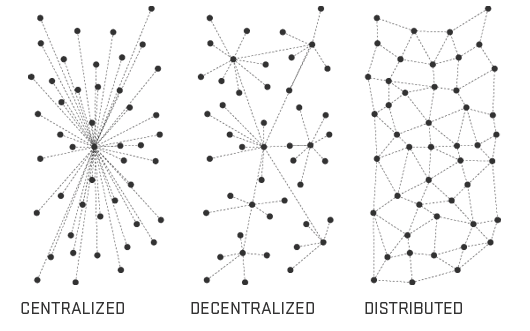
Here are three network layouts:
First we have a centralized network. One hub server and then every
client is a spoke connected to that center core. The most efficient
way to organize an “everyone-must-see-everything” protocol, but
vulnerable to disasters like meteor strikes, nuclear explosions,
billionaire takeovers, or earthquakes.
Then we have a decentralized network. Several hubs connected to each
other, mirroring each other. Usenet worked like that. The hubs need to
be just as beefy as the ones in a centralized network. This has some
advantages like redundancy and robustnesss, and it’s more politically
appealing to the anarchists that built the internet. (Not sure why
since there’s still two tiers and a mod group that rules everything
for everyone.) It can be wasteful. It can handle
everyone-must-see-everything protocols. It can also really shine when
everyone doesn’t need to see everything, like IRC which is super
efficient. IRC is a brilliant protocol design that, like a mailing
list, only sends the messages to a server that that server needs.
Finally we have a distributed network. No hubs. It looks more like a
mesh where every machine is connected to only a handful of “nearby”
machines. This type of network is an absolute disaster for the
everyone-must-see-everything scenario! Redundant to the point of
wastefulness. That’s a future we must fight tooth and nail! And that’s
exactly where the relay-centered version of ActivityPub was headed,
and that’s what would be “needed” for hashtags-as-groups-and-discovery
to “work”.
Here’s where we the grassroots federalized ancom degrowth community
need to check ourselves before we wreck ourselves because even though
energy and e-waste is underpriced, a capitalist for-profit silo
company would never in a million years set up a system like this
because it’s too wasteful ever for them, while we’re liable to do so
since each instance op only sees their own costs, not the cost for
the network as a whole. The megacorps are OK with centralization
because for them, the power consolidation in the first two network
types is a positive, while for us it’s a huge negative so we’re drawn
to the third type, so we need to be really careful and really
responsible here.
But as bad as this layout is for everyone-must-see-everything, it’s
really awesome for protocols where everyone doesn’t need to see
everything. It’s economical, robust, cozy. ActivityPub (without the
relentless mirroring) is a good fit here. I can follow a handful of
users and be connected to their instances and only their posts are
sent to my instance, I don’t mirror the entire server. It’s actually
pretty awesome! It’s good for moderation too because I only need to
moderate my “neighborhood”. Yeah, a “neighborhood” is the perfect
analogy for this; neighborhoods that can and overlap but are still
small and managed. A system set up like that can remain smol and cozy
even as it invites everyone on Earth. It’s great. ActivityPub is
awesome.
I like toot as a good complement to other ActivityPub clients. It’s
friendly for scripting.
I can’t really use the TUI version (maybe there’s some issue with my
shell) but I use the CLI interface all the time.
One way I use it is in Emacs shell-mode. I hacked in some Lisp so I
can favorite, reblog and even reply right from there; I move the
cursor to the body of the post and then hit the key bound to one of
these interactive functions. (If I wanna do even more fancy
stuff I still can, just typing it in the command line as usual, or for
some things I still schlep out another client.)
Except that where I wrote “toot post -r” here, in the version I’ve got
bound it’s instead a wrapper around written in zshbrev that tries to
guess language (currently doing a really bad job at it since
for some reason many emojis trigger false positives making it guess
that some English language posts are Swedish) and that offers
to post links to linkhut.
One limitation is that it doesn’t pre-populate the reply with
@usernames; that’s a work in progress. I currently just manually paste
them in. Today I added the feature that it preserves the spoiler text
a.k.a. subject line, and a similar route, parsing status --json,
could be the ticket for getting the user names in there. One SMOP over
the line, sweet Jesus.
Update
Yeah, finding the usernames was possible:
toot-get-usernames () {
	toot status --json $1 | jq -r '..|select(.acct?).acct' |
		mawk '!s[$0]++' | sed 's;^;@;'
}
I’ve been against the explore tab all along but what really broke my
heart is how it looks more or less the same across the several different
Mastodon instances I looked at.
For me, I feel like the mechanism of social media to emphasize a handful of
a-thousand-likes big viral posts over your own friends is dehumanizing.
Fedi already has mechanisms in it like boosts/reblogs that can cause
that. People will boost some posts causing them to spread further.
“Explore” takes something that’s not great and cranks up the bad
parts at the expense of the good parts. It’s like cranking up the
contrast on a picture that already has too much contrast, turning “bass
boost” on a song that’s already poorly mixed, exacerbating the problem.
Pouring gasoline on a fire or dousing a flooded building with more water.
With reblogging/boosting, at least you’re seeing stuff curated by
people you’ve selected. That’s where the original meaning of “going
viral” came from; things people spread between each other, send to
each other voluntarily. There are some pros and some cons to that, but
it’s a bad idea to amplify that effect artificially.
A silver lining of “Explore” could’ve been that it might break through
echo chambers. You’d be seeing a reflection of mainstream culture instead
of just your own li’l bubble and that might be a good thing. But
technically that still doesn’t work since due to the way Fedi is set up,
Explore is still filtered through the normal instance blocks etc. (Which
is a good thing because there is a lot of nazi bullshit instances out
there. But then the “Explore as a reflection of mainstream culture” is
technically not feasible since they won’t see those posts anyway.)
One reason I’ve been enjoying Fedi is that it breaks down this
monolithic, monocultural, “everyone sees the same super top ten
sponsored megaposts” bull that corporate faux “social” media has broken
down into. Just like real life, every li’l ant sees the ants next to it
and have fun with them in a Dunbar-number sane way.
I don’t like how YouTube, Twitter, BSky push mega-stars and creates
parasocial relationships and fandoms over friendships. Audience over company.
Here is a timeline I do not want to head down. One of the worst parts
of the post-September internet are these huge celebs. Instead of “Here
is the mailing list for Werewolf: the Apocalypse, let’s talk together”
it’s “Hello adoring fans here are my favorite brands of the day”.
I’m into participatory culture, and this is not that.
This is what Instagram, Twitter, BSky and Threads are set up to be,
and YouTube too. “Viral” successes. Do not want.😰
Hashtags are bad because the technical details behind how they are
currently implemented reward big instances and punish small
instances. Those problems are then reflected in an even more
exaggerated way on the “explore” tab.
I get the impression that some of the core Masto devs secretly wish
they owned Twitter and that all forms of federation is just a
concession to appease us FOSS seals.
The internet I grew up with was one where you found friends and communities
through common interests and then you talked to those people and they
talked to you. Community. Not billboards. Twitter is “one IRC channel
for the entire planet” and that appealed to a lot of bigmouths and
blowhards and people are trying to recreate that with things like BSky
and Nostr and Masto’s “Explore” tab. But that’s never what I wanted.
I wanna quit watching YouTube entirely but one thing that I’ve used for
the past few years is an extension that turns off all recommendations.
The only way I can find videos is by searching for them specifically or
following links. So if I wanna watch a review of a particular synth, I
can, but I won’t then get flooded with “up next: Jordan Peterson
explains why he who knows nothing about climate change should be the
only person people listen to about climate change” and that kinda bull.
Internet as a library where we can seek out things or get
recommendations from the people who are actually in our lives and close
to us. Internet as a party where you can talk to the people at your own
table instead of being drowned out by the screaming from the big stage.
Participatory culture.
2024-05-07T09:23:32+02:00Idiomdrottningsandra.snan@idiomdrottning.orghttps://idiomdrottning.org/books-vs-internet<div xmlns="http://www.w3.org/1999/xhtml"><a href="https://idiomdrottning.org/books-vs-internet">Books vs Internet</a></div>
Books come across as if they were so high-and-mighty and
thought-through but they’re less robust than a well-worn, palimpsested
wiki page or even a solid, hashed-out Usenet thread.
They’re more like sermons than conversations, being talked at than talked with.
In linguistics school one teacher said to us that “written language is
just a technology”. It’s one particular finger pointing to the moon
but it’s nothing to get hung about. If videos or voice messages really
were a better way for people to record and convey and teach and
understand things then it would be fine if it, over centuries, pushed
out the written word.
But for a book lover like me, books aren’t the be-all-end-all nor do
they have to be. They’re just a stepping stone away from the internet
out into the real world, the real living off-line, off-page world.
Books are a kind of nicotine patch to still get to read without
having to read online stuff.
And I dunno all the reasons why the internet is so bad but it is. The
algo-driven social medias are for sure bad, we know that much. The
snippets pushing viral randos ahead of your own friends and fam.
But even more conversational versions like small closed groups and
one-to-one conversations over encrypted protocols can be a breeding
ground for nazis and facho propaganda and create echo chambers
exacerbating and radicalizing people. The infocalypse is already upon
us and the brownshirts have gained more ground that I ever would’ve
feared.
Even when the internet is at its best it can be more than a
small-town girl like me can handle. One thousand voices at the same
time. What makes one person happy leads to a heartbreaking diss from
someone else.
Don’t get me wrong. I don’t think the future without internet is the
way to go. The tyrant regimes are trying to shut down internet because
it’s a threat to them. But that can be true at the same time that the
internet the way it currently exists is something that I can’t
healthily handle, that I’m a li’l bit too crazy for.
We’ve been trying our best to build a new course-corrected internet
with fixed email (e2e), retro webpages (gemini) and healthier socials
(fedi). But it’s soulcrushing when that then gets torn up and spat
upon by Masto trying to reintroduce algo hell with their “explore” tab
and drive everyone to huge instances with broken hashtags.
Or maybe it’s not about the network at all. Maybe it’s literally as
dumb as it being the shiny. LCD screen tech. It sounds dumb and
incredible and “r/PhonesAreBad” so it’s with some hesitation I’m
looking at study after study coming in saying that reading
comprehension and retention is way lower on screen than in books, for
adults as well as for kids. Even with (if I understand it correctly)
the same texts. Maybe e-ink will give the world its brain back? Just
in time for us to be the calmest, most focused zen minds on the
cinder.
I can call this jx on an URL or Fedi account name, get out some
JSON, copy and paste the URLs from there into new calls to jx and so
on in order to browse around what’s going on. Because most of the time
the web view of Fedi pages are pretty incomprehensible to me. People
are sometimes better at API design than UI design.
So you call it like this:
jx @account@instance
And in that JSON you’ll find more URLs and when you wanna look at them, you call jx on those URLs too:
jx https://more.urls/that/you/found
acct2url is only called as a helper and if the input is already an
URL, it just passes it through. jq is only used for pretty-printing
and you can swap it out for your other fave JSON converter or parser,
or tack on a pager like |less -e after.
Authenticated fetch interferes with this probably, I dunno. This stuff
is pretty hard to understand even for a stable genius like me. Sad!
I’ve been using it to find posts from a.gup.pe or from PeerTube. They
can be a li’l tricky to interact with otherwise if you don’t follow.
Or at least I couldn’t find the object URLs.
I’m really enamored with the idea of one account for all things
ActivityPub whether it be photos, texts, videos, topic threads, book
reviews etc. Mainly that’s an aesthetic hangup, there’s certainly a
lot of drawbacks to this approach. I like it because it feels a li’l
more like email and a li’l less than web silos.
Standalone script version
If you don’t like sourcing things in, you can put this in a file and call it as a shell script:
2024-04-10T13:13:13+02:00Idiomdrottningsandra.snan@idiomdrottning.orghttps://idiomdrottning.org/bubbles-allowlists<div xmlns="http://www.w3.org/1999/xhtml"><a href="https://idiomdrottning.org/bubbles-allowlists">Bubbles and allowlists</a></div>
My experience with the big names in community moderation on the
fediverse has been that while they don’t always get it right,
they’re right often enough to be useful.
Pooling moderation efforts together is a good idea.
My take on a lot of their moderation calls is that it makes sense for
their instance and I agree with the call for their instance. For
example an instance with many users of a vulnerable group would
usually need to have a lower threshold for instance-blocking than an
instance with fewer users to protect since the fewer users you
yourself have, the better you can respond to attacks on them.
I’d prefer a whitelist instance, anyway, and if I ever do get around
to setting up my own instance that’s how I plan on running it.
I’m not into that, and that is one of the biggest qualms I have
against Threads (it’s not the only problem with
Threads!). I mean, I can see some usecases for it for very
specialized instances so don’t take this as a generally applicable
kibosh, but when I have the typical instance in mind, thinking of it
being allowlist based makes me 😱. To me that kinda breaks the whole
appeal of federation in the first place and it punishes small
instances and affords a trend towards fewer and bigger instances, and
I don’t want that.
But destroy “The Whole Known Network”
Mastodon had this idea of a tab of “The Whole Known Network” or “The
Federated Timeline”. I hate that idea. You’re widely republishing and
advertising all kinds of weird stuff without vetting it. Not into it.
They even have a specific level of block that’s milder than a normal
block called “silencing” which means posts don’t show up on that
“federated timeline”. Even just “silencing” instances is considered
controversial. (That level of free speech entitlement is a li’l
absurd even to me. 🤷🏻♀️)
Silencing is different from blocking in that you can still follow
people and you can still see replies from them, replies from them
still show up in your threads.
I hate this “federated timeline”. I went through absurd lengths trying
to remove it from my li’l instance with some mad hacks; the hacks
didn’t work very wells and the hacks also caused other bugs so when
Akkoma finally introduced a supported way of removing that tab, that
was a huge sigh of relief from me and I instantly applied it.
It’s like I’ve “silenced” the entire Fediverse. Good riddance.
Bubble timeline
Akkoma also has a bubble timeline which is like an allowlisted
“federated timeline”. You pick a couple of charming instances and you
have a timeline of known posts from them. You can have both a bubble
timeline and a normal federated timeline, or neither, or just one of
them, and I went with just the bubble timeline. I like it, even though
on my instance the bubble timeline is pretty useless since it still
only shows posts it knows about, and I don’t follow very many people
and neither do my friends on my instance. That’s sad and maybe I
should subscribe to some sorta relay but on the other hand I don’t
wanna break my dinky li’l VPS.
So I feel like I get the best of both worlds: allowlisting in what
posts my instance promotes but normal blocklisting for people who need
to actually reply and get in touch.
2024-04-08T08:30:47+02:00Idiomdrottningsandra.snan@idiomdrottning.orghttps://idiomdrottning.org/dogpile<div xmlns="http://www.w3.org/1999/xhtml"><a href="https://idiomdrottning.org/dogpile">An avalanche of dogs</a></div>
Being critical of someone in person or in a small group is a difficult
time for everyone involved but it’s part of normal life.
But when I’m being critical of someone publically, especially
in a many-to-many medium like online, what happens is that I get a
figurative “megaphone” probably better known as “ten thousand faceless
clowns who claim to be on my ‘side’ but who are much meaner and
harrassier and have way worse arguments will ‘join in’ or will have
already joined in even before I say anything”. A tidal wave of hot
takes drowning out attempts at nuanced criticisms and small
course-corrections.
It’s easy to get fooled into thinking that “my particular personal
take is reasonable, nuanced, restrained, logical, correct, emotional,
insightful, informative, personal”, and all of that might be true. I
know and I can honestly tell myself that I don’t want an avalanche of
stones to be thrown, just one li’l reasonable and commensurate pebble.
But that’s what everyone else in the stone-throwing mob is also
kidding themselves. Each of their own li’l rocks on their own is
“well, we’ve got to be able to criticize wrong things and stand up for
what’s good and right” but the internet has made that not possible
anymore. We’re not raindrops anymore, we’re a tsunami. We’re not
snowflakes, we’re an avalanche.
I’m not saying criticism isn’t a necessary and a good thing. It is.
Normally. But the way the global convo is set up makes it impossible.
We’ve taken something that’s normally necessary and vital and
important, and made it impossible. That’s a problem.
Humanity needs to figure out a new way to deal with this, with each
other. The global village is getting to feel both cramped and lonely
at the same time.
I’m just naturally such a negative person but I need to learn to really hold
back online instead of dishing out the well-deserved spoonfuls I’ve got so
plenty of in my bitter li’l heart.
But criticism is also important. The fact that it’s no longer possible
is a huge problem. Sometimes people do need to come correct. So this
is a tricky conundrum that people need to solve together. Me and my
own personal li’l policy won’t change things.
Going too far in favor of callouts we get angry, life-wrecking mobs,
but I don’t wanna silence victims either. Are there other ways we can
organize how our entire conversation is set up? This is also why I’m
not into Twitter, or into how Reddit was set up before they invented
separate subreddits: “one chatroom per planet” is a model that wrecks
humanity’s brains a li’l bit.
Here is a li’l tutorial for how to use groups from Mastodon:
Follow method
Easy method is to just the groups as if they were normal users. For
example @bookstodon@a.gup.pe or @dnd@lemmy.world or
@pbta@ttrpg.network. Finding the right groups is… Not easy.
There are many groups and often more than one alternative for a given
topic. Suggestions welcome for this part of the tutorial!
That’ll give you a ton of posts about that topic and then you can tag
the group name in your replies os everyone in the group will see your
replies, or untag the group if discussions get deep and boring for
other people.
You can also start new threads by mentioning the group. I don’t think
you even need to be following a group in order to participate. Easy
peasy.
Participating without following
Now this is way more difficult and nerdy so if you’re just starting
out, stick with the follow method above, and read no further!
I don’t like to get overwhelmed by a ton of posts so I don’t like to
be directly subscribed to the groups.
You can reply to posts without following them by going to the search
box on your instance and pasting in the true, real, original,
originating URL for a post. But it’s gotta be the original.
Like, if you’re browsing Mastodon web and you go to Alice’s instance,
let’s say it’s called vegetables.example, and you see Bob replying
to her, but Bob is posting from gardens.example, he doesn’t have an
account on vegetables, he has an account on gardens. That means
pasting in the link to his reply as it’s shown on vegetables is no
good. You need to go all the way to his own webpage gardens and find
his reply there. How to find this original is different on every site.
🤦🏻♀️ Some make it easy with a li’l “Fedi link”, others don’t have an
easy way to find it at all.
This is one of the main challenges Fedi faces. You see a post online
and you can reply to it but figuring out how to get that post into
your own instance so you can reply or reblog or like is not very easy.
“Threadiverse” group servers like Mbin, Kbin, PieFed and Lemmy have
web views of their groups so I can sometimes figure out what’s going
on from there, and find the posts from there.
Guppe
Gup.pe doesn’t have those kinds of web views for its groups as far as
I know. If you want to find Bookstodon posts, the idea is that you
follow @bookstodon@a.gup.pe and then you’ll see new posts and that’s
the intended way. But there is a hack!
If you have the Unix command line and wget and jq, this’ll print a
list of URLs to recent posts!
There are other Fedi apps that are set up to more easily work with
groups so if you love groups then you might wanna check them out! For
example Mbin or Lemmy. I don’t have that much experience using those
apps directly since I use Akkoma which is similar to Mastodon when it
comes to groups.
On some Fediverse platforms you can use a subject line as a kind of “content warning” so people can optionally open the posts, sort of like a subject line in an email. I sometimes do that, although I’ve gotten a li’l more cautious against overusing them because they can sometimes be counterproductive to their main aim of being considerate to readers.
Why CW
I found myself using them for three reasons, or four since the third, main reason has two sub-reasons.
Context
Just like any subject line or file name sometimes a context can make a
post much easier to understand. If I’m gonna post something that’s
only built for Emacs Lisp hackers, that’s gonna be better for everyone
if the subject says “Emacs” so people don’t go trying to pop the hood
of their Selectric looking for an Edwardian Manifestation of All
Colonial Sins.
I still do this all the time.
Distancing
It was also subconciously a way for me to show that I’m surely above the bad thing I’m talking about. If I write “mh-“ or “ableism” or “racism” or what it might be, I show how aware and illuminated I surely am about the bad thing. A pretty selfish reason and I don’t do this so much (except sometimes a li’l self-deprecatingly) anymore.
I’m not saying other people do that, it was just something I found myself doing.
Now on to the big reason, which is respect for readers when the topics are sensitive.
This main reason comes in two parts, a lesser (compliance) & a greater (actually warning for the content).
The benefits of compliance
I understand how a lack of CWs can in-and-of-itself bring a sense of
loss-of-control that’s frustrating to trauma survivors; that the CW
itself isn’t the consolation. The consolation is the compliance with
the “please CW your post” request. This sounds shallow or dumb but I
honestly do think it’s an OK argument for using CWs.
I switched out my link-posting app so that I could more easily put CWs
and some of the CWs I use are primarily for this reason. That was a
few days worth of hacking. Worth it to help you folks who need this.
But I only wanna do put CWs when it doesn’t interfere with the main
reason for content warnings, which is:
Actual psychology
Content warnings and it’s predecessor, trigger warnings, often get
flak from annoying people who are opposed to caring. They have the
mistaken impression that we wanna shield our li’l snowflake selves
entirely from the thing even though the reason for a CW or TW can
sometimes just be the textual equivalent of “OK, sit down, and take a
deep breath before I tell you what happened”, giving people chance to
steel themselves and collect themselves and choose a time and space
before they open the post, or (rarely, but sometimes) whether they
even open the post at all.
This is the most considerate and best reason but what I noticed was that it often had the opposite effect. Especially for text.
It’s one thing to put a scary video or image in a virtual “envelope”
and not immediately blasting it, but the problem with using a text header as protection against a text post is that the header is itself also text. Logging into Fedi and seeing page after page of
disturbing headlines taken out of context is pretty rough.
I’m gonna use a metaphor of the post being like a room, and the header
being a sign on the door.
If we start with the premise that text really can hurt, and I think we
all know that it can, so let’s say that the headline in-and-of itself
feels like a stab (metaphorically speaking). A stab
that is lessened by the warm feeling of “oh, someone cares about me,
is polite and respectful and want the best for me” but a stab
none-the-less. To see headline after headline of “racism”, “sexual
violence” and so on pretty quickly becomes a heart-burdening mess.
Going back to the metaphor: walking down a corridor and getting
stabbed by door after door does not feel good.
When the stabbing doors are there to protect us from getting completely
mauled by dangerous tigers, then it’s worth it. Readers who truly
can’t handle the tiger inside can see the door, get stabbed by the
door, refrain from opening, and try to patch themselves up to the best
of their ability, and walk on by. If that’s what happens I think the
content warning was worth it.
But if what’s behind the door is a lesser scratch, the stab from the
door is not worth it. Not even if what’s behind the door is a deep cut
it’s worth it because then you’ll get stabbed twice; one from the post
itself (the text post itself has the additional advantage of
being able to use nuance and build things up in a context; the
opposite of a “jump scare”, instead of the unexpected door-stab it’s
an understandable, reality-based, and validated pain), in
addition to the stab from the headline itself, in all its rawness and
suddenness.
I don’t wanna completely give up these kinds of headlines. As I said,
if it’s the worst clawtiger in the world behind the door, of course a
warning makes sense. (Another idea might be to not even make
the post, if it’s truly that brutal.) But what I’m thinking is
that it takes a lot for the headline to be worth it.
Otherwise it’s as if every room has a clawtiger and we’re building up
a fear and a worldview that’s even more gruesome than the world
actually is, which is plenty gruesome already, thanks.
I still wanna use them! But I’m cutting down on some of the most
“gratuitious” ones. Studies are coming in now saying they generally seem to do more harm than good, create anxiety rather than console it, worsen rather than improve. I think what’s going wrong in some of those studies are when people are “overusing” CWs, I think there is a lagom amount that hits the sweet spot. (As I tried to explain with my text here about “stabs” vs “clawtigers” but maybe I’m just making things even more confused.)
All that is also why I do favor CWs with cryptic abbreviations or that are otherwise on the euphemistic treadmill. They don’t have the benefit of context so how can the “stab” otherwise be “lessened”?
There’s another counter argument to CWs also but it’s an argument that I feel is a li’l bit weaker and not as well-meaning, it’s when you wanna write something political, like “Now it’s time to vote against fossil fuels” or similar. Then it’s pretty bad if people are missing that message because of a CW. This argument isn’t the strongest beacuse on Fedi, non-CW’d things don’t get boosted as much.
There’s also small affordances and annoyances here and there like
clicking to open and such but that’s just peanuts compared to the
importance of people’s well-being.
Now, what’s not good is some of the examples of knee-jerk pro-CW gatekeeping I’ve seen where people have been posting about their own personal political struggles and political work and gotten scolded & shushed because they didn’t put a “uspol CW”.
All of this is much less important now with current versions of
Mastodon and Akkoma where people can “auto-CW” other people’s posts
based on text in the entry. Like how I have “Advent of Code” filtered
out, and posts autohidden, whether or not the post actually has a CW.
• I know some people block me for thinking like this. (And of course people can block whomever they want; I block 40000 men and women every day.) Some even wanna defederate my entire instance.
But don’t worry. I’m not gonna revel in anti-CW:ing. I’m not gonna post a bunch of un-CW’d shock and gore just to be annoying. I’ll still use CW, but more sparingly is the idea.
For example, let’s say I mention a cat in a post. I’m not gonna then also put warning warning cat cat on top of that. That’s just adding injury to injury and more harm than good even for catphobic peeps. But if there’s a lot of cat in the post, or an unusually scary or detailed cat description, that’s when a CW might be warranted. That CW is gonna be harmful to all catphobes that log in and get subjected to it, but it’s protecting them from something even worse, the post itself. (And another option is, of course, to not even make the post. That’s always an option to consider when thinking about what CW to use.)
A specific example
Warning: This example gets real. I stuck to “catphobia”, a pretty unusual phobia, in my examples above, in order to cause harm to the least amount of people, but here we’re about to talk about something real and dark that’s upsetting to me and to most other people.
I’ve been reading Jewish Currents for the past few years. Apparently half the staff quit after
Oct 7, or I misunderstood their editorial where they implied that. I
can understand why. That’s a hard thing to grapple with.
I’ve been posting a lot of their articles on Fedi, and I linked to this comic.
I didn’t use a CW, and the text of my post was:
This situation is so messed up. More than most people have the capability to psychologically handle without making it worse. Great comic:
Followed by the URL.
I can understand why people wouldn’t wanna boost it in if if their followers have a lot of people who have a very pro-CW culture. That’s understandable.
If the text of my post itself would’ve had sensitive stuff I would’ve
put a CW (at least “ispol”) but I reasoned that the loaded topic was
on the other side of the link, and I tried to give people some
content-specific awareness, such as how messed up the situation was
and that it was difficult to handle.
Someone kind suggested this as a CW for my post:
CW: compassionate analysis of Israel-Palestine-genocide-related
confrontations in NYC
Wow, that’s half a dozen things that are in and of themselves triggering. That CW would’ve needed its own couple of CWs. CWs are also text.
Judgements about the quality of the analysis
The worst crime humanity does against itself, genocide. More than 30000 had died then (75000 now).
Confrontations
What that CW elides is also an issue:
The hostages, many of whom have died or subjected to sexual assault
Reference to a brutal name-and-shame campaign of people who for whatever reason wants to take down posters
A comic that also names the poster artists and quotes them unflatteringly
I did think the comic was good and nuanced. I dunno. I’ve never been
to NYC. I didn’t wanna put too much of my own takes on this. A lot of
peeps give me flak online
for being so confident and arrogant but I’m sometimes more scared of
being slagged as a fence-sitter or a both-sides-do-it–er. Truth is, I
come across as confident because I like writing in teach-and-learn
mode. I write about stuff I think I’ve figured out or that I’ve been
taught, sometimes hard-earnedly. And when I don’t have any more
insight or info about a conflict that’s been well-reported on, I can’t
do much more than pass links. I wanna write about the one-state
solution another time, that’s a whole bag of bags, but that’s
political philosophy, which is my jam, not reporting, which I don’t
know how to properly do.
When I don’t have additional info or insight on a situation, I don’t
wanna just make things up, that’d devalue all the things I do have
something to add.
2024-03-08T21:47:18+01:00Idiomdrottningsandra.snan@idiomdrottning.orghttps://idiomdrottning.org/groups-vs-tags<div xmlns="http://www.w3.org/1999/xhtml"><a href="https://idiomdrottning.org/groups-vs-tags">Groups vs Tags</a></div>
there might be separate groups about the same thing
Think mailing lists or subreddits or web forums like phpBB, Vanilla, or Discourse.
Or “Discords” and “Slacks” and IRC channels for that matter.
A tag is:
spontaneous
wide-reaching
easy to add to any post
more easily affords crossposting
“viral”
as temporary or permanent or necessary
moderation depends on you blocking specific users
This is how “Tumblr” and “Twitter” communities worked. And I think
TikTok? I’m realizing as I’m writing this how little I know about the
silo so-me sites, like I don’t even know how Facebook and Insta
work.
Maybe we do need a way to make tags work. A lot of people seem to be
drawn more to that way of organizing. The two styles also appeals to
different kinds of people, it seems. Groups are a li’l more
left-brained, orderly, symbolic. That’s great, but we also need the
kind of people who are more drawn to tags.
I’m sticking to my guns that we shouldn’t be using hashtags on
Fedi but maybe we need to come up with a FEP or
something that makes something that feels to hashtags work?
“Spontaneous decentralized groups.” And that has the same interface
i.e. you just write #foo and that’s all you’ve got to do.
As per ushe, Mastodon has been driving ahead with stuff that doesn’t
really work as if it worked (like that awful “Discover”
tab) and have been pushing hashtags. Hashtags work (partially) on
huge instances and hashtags work with instances that are redundantly &
unscalably mirroring all the stuff from all other instances.
But maybe there’s a better way? One that under-the-hood uses actors
and inboxes in some sorta magical I dunno way?
Wow, today I learned that Guppe actually has this! Tag any group name
@a.gup.pe and the group is created and from then on exists.
2024-03-08T08:55:44+01:00Idiomdrottningsandra.snan@idiomdrottning.orghttps://idiomdrottning.org/re-mastodon-is-fun-and-easy<div xmlns="http://www.w3.org/1999/xhtml"><a href="https://idiomdrottning.org/re-mastodon-is-fun-and-easy">Re: Mastodon Is Easy and Fun Except When It Isn’t</a></div>
The most common—but usually not the only—response, cited as a primary or secondary reason in about 75 replies—had to do with feeling unwelcome, being scolded, and getting lectured.
I’m not happy that Fedi is this way. There was an “anti-September” frenzy last summer when people were scared that CWs were gonna go away etc.
I am partially culpable for this since I sometimes scold people for no alt text.
I wish this could change (in a healthy way, ofc—there are plenty of ways a change could go south).
For me, it was that Mastodon seemed to actively discourage discoverability. One of the things I loved most about Twitter was the way it could throw things in front of me that I never would have even thought to go look for on my own.
Right. I love this part of Mastodon. I think it’s the main reason I’m even on here. I don’t get a constant flow of things to discover.
The new Explore tab that Mastodon has introduced is especially toxic since it’s the same on every instance (that has that enabled).
Algorithms are bad for two reasons:
The addictive flow of moremoremore. I don’t get that on here and I think that’s great. I can go read books or catch up on Campaign 3 or something.
The curation. Remember that post that went around a while ago about how in science fiction, there’s a huge gap between the well-known, best-selling authors vs the second tier. Being among the “second-best” selling authors means basically no-one reads you. Same thing happens on social where some posts go absolutely viral. It’s lagom that posts do that on their own, that they do it via boosting/reblogging. We don’t need a page that takes the most amplified posts and amplifies them even further.
However. I do have some fondness for groups and web forums. Once groups work a li’l better, that’s gonna be able to replace hashtags in a good way and be a good replacement for subreddits, tumblr tags, phpBB sites and so on. FEP-1b12.
The next big cluster includes group #3, too confusing/too much work getting started, group #5, felt siloed/federation worked badly, and group #7, instance selection was too hard/intimidating.
OMG yes. This is a mess. The technical issues are bigger than the social ones.
Problem one is whether it works: Posts gets dropped, go missing, never go through, don’t show up. I want it to get much flakier.
Problem two is how it works. I’m browsing the web & Safari and I find a fun li’l post on someone’s Masto or Pixelfed. I know how to boost, like, even reply to it and I’ve created a Shortcut (or Bookmarklet) to do so. And figuring that stuff out was not easy.
Until the “Fedi links” proposal becomes real, we need an UI that makes it absolovinglutely crystal that A. “here you can find the permalink to that post”, and B. “here is where, in your frontend or app, you paste in that permalink URL to find the post”.
A, sometimes called “original post”, is a complete labyrinthine experience worse than GDPR and different on every instance, and
B. looks like a “search” box and you need to somehow have been told that that’s for importing posts.
(And I understand that anytime there’s a technical issue on line that’s partially on me because it’s my job to go fix every god damn thing and send patches in order to be a good FOSS citizen but my li’l backlog on that is just growing & growing.)
People in this category talked about a seriousness that precluded shitposting or goofiness, and a perceived pressure to stay on topic and be earnest at all times.
Here’s another category where Fedi as it is right now is a pretty good fit for me 💁🏻♀️
But once we get groups going people can find their meme groups so they can esspost and goof to their hearts contents there.
And I don’t think the Health First school has come to terms with the fact that in an non-authoritarian society, you can’t make people choose networks that feel like eating their vegetables over the ones that feel like candy stores
So it’s not a win for me that every man, woman and child is on Masto or Fedi. But the goal I have is that it’ll work well as open infrastructure not controlled by for-profit interests or deliberate darkpatterns like using addiction psychologists to make your app more addictive. I love email and RSS and if Fedi can become something that’s as reliable of a backbone as those things, that’s a win, that’s a huge win.
I’m getting less and less convinced by the non-authoritarian society’s ability to deal with climate change (not that the authoritarian society does any better—greetings from Soviet’s fossil&steel economy) but as I’ve said before, the ancom direct action, federation toolbox, for all its inability to deal with climate change, is pretty good at making your own individual life a li’l better with things like worker coops, unions, and labelling for addressing labor issues and with things like rough consensus and running code to get a useful non-toxic smolnet for you & me. It doesn’t solve the problem for everyone but it solves it for us.
(That said, our broken climate is a consequence of our broken economics which is a consequence of our broken political system which is a consequence of our broken media, especially social media. So the fact that Meta and Twitter and Google håller på with their siloing and their fever-pitching algorithms is ultimately a problem for the entire planet. But on a more direct, short-term level I do not want the Fediverse to become what Twitter was.)
I’m not implying that her post & analysis & conclusions were not good. They were! 👍🏻