<?xml version="1.0" encoding="UTF-8"?>
<?xml-stylesheet type="text/css" href="https://idiomdrottning.org/feed.css"?>
<feed xmlns="http://www.w3.org/2005/Atom">
  <title>Idiomdrottning</title>
  <subtitle type="xhtml">
    <div xmlns="http://www.w3.org/1999/xhtml">
      <ol><li><a href="/blog">/blog</a></li>
      <li><a href="/blog/en">/blog/en</a></li>
      <li><a href="/blog/gtd">/blog/gtd</a></li>
      <li>/blog/gtd/en</li>
</ol>
    </div>
  </subtitle>
  <link rel="self" href="https://idiomdrottning.org/blog/gtd/en"/>
  <updated>2026-04-11T16:59:42+02:00</updated>
  <id>https://idiomdrottning.org/blog/gtd/en</id>
  <entry>
    <link rel="self" href="https://idiomdrottning.org/calls"/>
    <id>https://idiomdrottning.org/calls</id>
    <title type="xhtml"><div xmlns="http://www.w3.org/1999/xhtml"><a href="https://idiomdrottning.org/calls">@Calls</a></div></title>
    <content type="xhtml">
      <div xmlns="http://www.w3.org/1999/xhtml">
	      <div>
        

<p>Probably the worst part of original GTD is having a list of calls. That just doesn’t parallelize nor serialize well since nowadays each call is a multi-hour affair if it’s a hold/wait system, or if it’s a “we’ll call you back sometime later today” it’s not great to have multiple such incoming calls hanging over you either.</p>

<p>Even the literal 43 folders (which doesn’t make sense to reproduce digitally over just a normal reminder that just gives yoi the file you want on the day you want it) at least historically made sense as something useful for those dealing with a lot of paperwork, but phonelines and waiting has been real for my entire life.</p>

        </div>
      </div>
    </content>
    <updated>2026-03-27T08:58:25+01:00</updated>
    <link href="https://idiomdrottning.org/calls"/>
    <author>
      <name>Idiomdrottning</name>
      <email>sandra.snan@idiomdrottning.org</email>
    </author>
    </entry>
  <entry>
    <link rel="self" href="https://idiomdrottning.org/shirking"/>
    <id>https://idiomdrottning.org/shirking</id>
    <title type="xhtml"><div xmlns="http://www.w3.org/1999/xhtml"><a href="https://idiomdrottning.org/shirking">Shirking: Unplugged in Stockholm</a></div></title>
    <content type="xhtml">
      <div xmlns="http://www.w3.org/1999/xhtml">
	      <div>
        

<p>As I continue my self-racking of heart and mind to figure out why I hate smartphones and internet and screens so much, here’s one more reason I came up with and this one is not pretty. Kind of wish that I had stayed in the self-deluded dark and not figured this one out:</p>

<p>Once upon a time, a subconscious part of my own twisted mind must’ve realized that if it’s not possible for me to do something, that’s the best excuse for not having to do it. “Oh, I can’t go and check and fix and do all that for you now, I don’t have internet here.” “Oh, I didn’t see your email, I wasn’t at home.”</p>

<p>I can’t do that right now because I had to walk away from the tools.</p>

<p>I finally managed to track down this unknown impulse by thinking long and hard about just exactly <em>why</em>, as I’m trying out mods for Light Phone III, it’s so important for me to not be able to, for example, open browser or F-Droid or Termux on that thing. Like, I found myself uninstalling AntennaPod because of how it has an “open website” widget on podcasts that lets me, from there, access the open web. Other apps where I’m like “oh no from the help page or even log in screen I can break out into the open web so okay goodbye this app was good but I <strong>need</strong> to stay disconnected”. I had to ask myself why this mattered so much to me that I’m going through ridiculous hoops for it.<small> And it’s two reasons. The biggest is that I just don’t want to spend all nights and all mornings online. It’s nice to do podcasts or audiobooks late at night as long as I then have to physically leave bed in the morning and get a tablet if I wanna go online, because I’ve found again and again that if I don’t, I’ll miss breakfast, I’ll miss the entire day. Or if I can go online in the middle of the night, I’ll wake up and do that. That’s right, the even bigger reason than my laziness is my lack of impulse control. Hmm, this essay is making me doubt my own awesomeness.</small></p>

<p>Secondary reason is the aforementioned shirking. Being offline as a way to get out of work. Apparently I have this hangup that “If I <em>can</em> do it, I’m gonna keep finding myself in situations where I <em>ought</em> to do it”. My conscious mind, my values, really do want to help and say yes, to the extent that <a href="/two-wolves" title="The Two Wolves">my subconscious wants to protect myself</a> by putting up these barriers. I’m not the type of person that can just easily say “no I don’t wanna” or “I’ll get to that later, I’m doing something else now” or “I’m gonna put it on airplane mode for a few hours”. But my other brain noped out for me, ahead of time, by making sure I don’t have internet in my pocket and making sure that online is something I can and do walk away from.</p>

<p>Now, to pull back from the self-deprecation for three seconds and try to figure out how this kind of antisocial shirking-through-disconnection sometimes actually can be the responsible choice.</p>

<p>It might be the case that I can do stuff more efficiently and faster by using batching and a more appropriate and capable device like a bigger screen and a real keyboard. If I can reply to ten emails spread out over the day in a way that adds up to forty-five minutes total or even more due to context switching and mindset and resources and thumb-typing vs touch-typing, that’s an overall loss if I otherwise could’ve replied to them all in one half-an-hour window.</p>

<p>The batching can also foster a more responsible selection of duties making sure society <a href="/efficiency" title="The ruthless efficiency of spoons">gets the most out of my limited spoons</a>. If more requests come in than I can handle, batching them can help me get enough of an overview to select the most worthwhile ones.<small> (Uh, that’s not to say that I’m good at it yet and if I’ve missed some of y’all’s messages that’s more likely due to a mistake on my part than a deliberate deselection.)</small></p>

<p>Even if it can’t, the shirking might be a vital rest and recuperation and acknowledgment of limited bandwidth.</p>

<p>This is also interbraided with the other reasons for going offline, like my frustration with the mental ice age of <a href="/appified" title="Against the Appified Society">the corporate-owned, appified society</a>. Maybe <a href="/unplug-weirdo" title="Being an unplug weirdo to not be a FOSS weirdo">I can’t explain why</a> I <a href="/franklin" title="Franklin Street Statement on Freedom and Network Services">don’t want to go on Facebook</a> but if I physically <em>can’t</em> because I don’t have a smartphone with me, I don’t have to worry as much about the other person trying to convince me or bully me. Nope, sorry, I just literally can’t.</p>


        </div>
      </div>
    </content>
    <updated>2025-11-25T13:34:05+01:00</updated>
    <link href="https://idiomdrottning.org/shirking"/>
    <author>
      <name>Idiomdrottning</name>
      <email>sandra.snan@idiomdrottning.org</email>
    </author>
    </entry>
  <entry>
    <link rel="self" href="https://idiomdrottning.org/boredom"/>
    <id>https://idiomdrottning.org/boredom</id>
    <title type="xhtml"><div xmlns="http://www.w3.org/1999/xhtml"><a href="https://idiomdrottning.org/boredom">Boredom and existentialism</a></div></title>
    <content type="xhtml">
      <div xmlns="http://www.w3.org/1999/xhtml">
	      <div>
        

<p>I heard fourth hand with citations long forgotten that too much boredom can be dangerous, cause depression etc<small> (and some sprawlbrained people like me are extra sensitive to that)</small> but too little boredom is also unhealthy and is much more common.</p>

<p>So I’ve started practicing boredom a bit more. When I first <a href="/dumbphone-experience" title="The Dumbphone Experience">started dumbphone</a> I had a long-running, then–still-going meditation practice, and while at first I was listening to radio and music on the dumbphone, the headphone jack quickly broke leaving me bored when walking around which was horrible at first, then nice and I got used to walking without <a href="/headphones" title="My headphones, they save my life">the headphone soma</a>, then it led to me just walking less until I figured out how to hook up an old 2DS game console to play podcasts and gradually I got bored less often and when the contagion first hit my meditation practice also ended and then two years into that I got really sick.</p>

<p>And then two years after that, two years ago now, I got re-obsessed with the whole phone-hating thing, I’m hyperfixated on it, all that I eat and sleep and breathe is hatred of smartphones and of the modern web, and I am gradually getting into retro aesthetics even when it’s <a href="/antique-phone-experience" title="The Antique Phone Experience">mostly larping</a> and the for-show component is at least as important as the for-real part of it.</p>

<p>I got away from glowyglowy screens in favor of e-ink and RLCD and aural interfaces (radio and podcasts) and <a href="/books-vs-internet" title="Books vs Internet">paper books</a> both for writing and reading. Thinking all of that was my proverbial nicotine patch away from constant online and that actually facing the horrible silence would be the next step. And, it eventually was. It took me a while to get there but I’m dipping my toe in it now.</p>

<p>Not all the time and I’m not forcing myself too much. It’s more like (figuratively speaking) exercising, nudging myself a liiittle bit and then it feels nice. Maybe I’ll have headphones off on the way there and put them on on the way home or vice versa.</p>

<p>Being bored here in Stockholm<small> (where I’ve lived for almost twenty years)</small> feels like traveling. That’s a missed reference these days because these days traveling is the same as home. Your “For You”–page looks the same away as it does at home. But for me, putting away the book and headphones evoked a sense memory of travel, of more fully noticing the air, lamps, cobblestones, trees, trash fluttering in the wind, rain on the window.</p>

<p>Ironic given that Stockholm, specifically, I first started visiting only <em>after</em> I’ve gotten hooked on headphones. I’d always put on the <em>Way Beyond Blue</em> album on the repeat-all mode when I was here so if I want to evoke a feeling of traveling to Stockholm specifically, embracing the headphone life to the tunes of sweet Catatonia would be the ticket for that. But that’s not what I meant. Just that sitting at the deli counter with headphones off made me more aware of the world is all.</p>

<p>Being bored is scary, and for good reason: the brain wants to have fun, fun things makes it easier to learn and be happy and connect. But physical exercise is similarly scary-for-a-good-reason; instinctively I don’t want to give up precious, hard-won  energy on unnecessary, unplayful, <a href="/two-wolves" title="The Two Wolves">duty-bound</a> movement. Conclusion: right now, as in the past few weeks, I’ve finally re-discovered the joys of boredom, along with the pains and dreads of it and how holding on through that pain is sometimes rewarded with how alive everything is and other times is just why-am-I-even-doing-this?</p>

<p>The existential dilemma of boredom is <a href="https://www.youtube.com/watch?v=SxPZF_LWJaU" title="You'll Have Time - YouTube">wasting time vs tasting time</a>. At the end of all things, what will deserve the most regret? The mystic, the ascetic might think “Dang it! I should’ve embraced my curiosity, my desire to explore, I should’ve scrolled down for more videos, I should’ve let my brain cyber up and go discover and get recommended more and more and more stuff online.” And the screen junkie might think “Why did I waste it on this compulsion, this digital sugar, this junk, why did I never ever look up from this pervasive trash can I had my head stuck in all this time?”</p>

<p>Knowing whether boredom is good or bad becomes a pretty important question. I really wish I had the answer to that because that’s <a href="https://en.wikipedia.org/wiki/Jacob_wrestling_with_the_angel" title="Jacob wrestling with the angel - Wikipedia">an angel</a> I’m in a particularly nasty no-holds-barred cage fight with.</p>

<p>Until I figure out an answer for this, here’s a temporary answer, a cop-out, a Gordian solulu sidestepping that question:</p>

<p>Let’s say for the sake of argument that the experience-rich life is the better option over the staring-at-the-wall shikantaza yawnfest. Buddha don’t at me because that’s not where I’m gonna land, this is gonna be rhetorics, it’s the null hypo that we’re postulating and putting a pin in.<small> Like in a sudoku, we’re just saying <em>if</em> this is an eight, would that cause contradictions elsewere? We’re not painting in the eight with ink just yet.</small></p>

<p>Now, the next question becomes what <em>kind</em> of experiences we’d want to fill that experience-rich life with. <a href="/gtd-basics" title="GTD basics">Actually doing stuff?</a> Helping other people? Doing meaningful things? Not drowning in procrastinating and self-hatred and compulsive behavior? Okay, so step two then is thinking “we postulated how awesome and truly great the TikTok-drowned life is compared to the paint-dry life of <a href="/sitting" title="Sitting">just sitting</a>. But it’s only the <em>second</em> best compared to all the stuff I wish I could be doing <em>instead</em>.” With me so far?</p>

<p>Then step there becomes: okay, okay, what if <em>some</em> amount of deliberate boredom is what’s gonna help you get away from that second best thing into the best thing? If the anti-boredom compulsion is what’s exacerbating procrastination and leaving us unable to get going on the things that really would matter to us, and overcoming the fear of boredom is what’s gonna unlock creativity, problem-solving, even regain a tiny bit of executive function? If that is true—and I don’t have the answer to that yet—then boredom is not wasting it. If that is true, boredom becomes win-win:</p>

<p>In the one branch of the dilemma where boredom is awesome and boredom means savoring life-as-it-is, here and now, boredom is already the winning ticket, and in the opposing branch of the dilemma where fun and busyness and jamjamjam is the ideal, boredom is still a stepping stone right into the best <em>version</em> of that richer life that helps us sift signal from noise.</p>

<p>Please don’t conflate that with that myth of how supposedly Warren Buffett at one point said “make a list of your 25 most important things, now circle your five most important ones. Done? Put the remaining twenty on an absolutely-do-not-do list.” That is fake, that doesn’t work, I’ve tried it, he never said that, I wouldn’t wanna emulate him anyway. Here, I’m not saying “step away from the 20 other appealing things in order to somehow magically receive focus and motivation and energy for the 5 best things”; instead, I’m saying that perhaps stepping <em>towards</em> some amount of boredom might give you the tools to better work with the more important things.</p>

<p>To what extent all this philosophy applies more to mainstream-headed folks and is a complete mismatch to sprawlbrains like us, that’s an unsolved question for me. It could be that this boring structure was made specifically for us and is vital lifeblood for us scatterheads whereas the plainjanes don’t need it as much, or it could be the other way around where I’m barking up the wrong tree altogether and I should try to find a more fun and entertaining toolbox to get through the day. I’m gonna keep exploring this path for a little while longer. It’s early days yet for me. And heaven knows I’m grasping at straws at this point. 😭</p>


        </div>
      </div>
    </content>
    <updated>2025-11-14T12:26:55+01:00</updated>
    <link href="https://idiomdrottning.org/boredom"/>
    <author>
      <name>Idiomdrottning</name>
      <email>sandra.snan@idiomdrottning.org</email>
    </author>
    </entry>
  <entry>
    <link rel="self" href="https://idiomdrottning.org/gtd-inbox-begone"/>
    <id>https://idiomdrottning.org/gtd-inbox-begone</id>
    <title type="xhtml"><div xmlns="http://www.w3.org/1999/xhtml"><a href="https://idiomdrottning.org/gtd-inbox-begone">Inbox, begone!</a></div></title>
    <content type="xhtml">
      <div xmlns="http://www.w3.org/1999/xhtml">
	      <div>
        

<p>Okay so 99% of GTD advice is about how to “process” your inbox, and
that’s awesome, even my own <a href="/gtd-basics" title="GTD basics">basic version</a> starts by making an inbox
list and sorting it into steps and goals.</p>

<p>And getting good at GTD means getting good at sorting the inbox out.</p>

<p>But it’s never going to be completely “free”. It’s always going to be
one decision after another and that’s going to be mentally exhausting and
totally dreaded.</p>

<p>I’ve de-emphasized weekly reviews in <a href="/gtd" title="All my GTD posts">my posts</a> because the review is
usually what trips people up. But the point of the review is to make
sure your lists are current and that every project has a next step (or
is done… or officially abandoned). That’s something you’re gonna have
to do eventually and hard enough even if you don’t have a massive
inbox waiting for you every week.</p>

<p>That’s why my advice is going to be to use your inbox as little as
possible! Put as few things as possible in there! I might’ve said
before that the bad habit to bypass the capture step and instead write
things directly onto project list and next actions list has the
drawback that it can lead to letting too much things into your life
and leading to overwhelm and that warning still holds so you need to
A. be super vigilant about what you write in there when you add it,
and B. be ready to give up on projects and remove them. But if you
promise you can do that, the “bad” habit is a heck of a lot less “bad”
than letting a bunch of unmade decisions pile up in a huge inbox.</p>

<p>Tossing stuff into your inbox is an amazing tool when you’re
overwhelmed so doing it “as little as possible” does not mean “never”.
It’s like magic to me that the scribbled note at a party or quick memo
when I was super busy, that I can salvage that and turn that into a
life-saving stitch in time to save nine once I finally get around to
processing that inbox. Jamming stuff into the inbox tbd later is a
necessity as a quicksave that lets you fully focus on your work, your
art, the people around you. But doing it too much creates “decision
debt”, it’s like the GTD equivalent of skipping sleep.</p>

<p>This is heresy in the GTD world because the entire point is to get
good at inbox sorting and at the daily review. “Don’t fear the inbox.”
And yes, thanks to practicing GTD, I have gotten so much better at it.
But it’s never gonna become easy breezy. Mind like water still takes
time and effort. For some tasks, there’s value in batching things and
doing a bunch of them at once once you’re in that particular flow. For
some people who aren’t as decision fatiguable as I am, inbox review
might be one of those task, and an end-of-day sweep of an inbox
they’ve tossed vague junk into all day might be the most efficient and
best use of their time. But for me it’s having to move a mountain all
at once. I’d rather try my best to keep the inbox as empty as possible
before it stacks up, knowing that sometimes life happens and the inbox
piling up is going to be a good thing, a caretaker of all the yan,
tan, and tethera of your life while you’re under the ice.</p>

<p>Having to sort through a huge inbox is an inescapable part of GTD, I’m
not denying that. When you first bootstrap GTD, when you’re returning
to it after having fallen off, or when your life circumstances
drastically change and turn everything upside down. I could try to
sell you some other productivity method that didn’t do that <a href="/supposedly-simpler-than-gtd" title="Supposedly simpler than GTD">but I honestly don’t think that would make your life any simpler or better</a>.
Reviewing the inbox is core to GTD. I’m just saying I’m trying to do
it as little as possible and “bypassing” the inbox when I can; as long
as I’m making conscious and deliberate decisions about what goes on
my lists.</p>


        </div>
      </div>
    </content>
    <updated>2025-04-19T17:19:30+02:00</updated>
    <link href="https://idiomdrottning.org/gtd-inbox-begone"/>
    <author>
      <name>Idiomdrottning</name>
      <email>sandra.snan@idiomdrottning.org</email>
    </author>
    </entry>
  <entry>
    <link rel="self" href="https://idiomdrottning.org/calendaring"/>
    <id>https://idiomdrottning.org/calendaring</id>
    <title type="xhtml"><div xmlns="http://www.w3.org/1999/xhtml"><a href="https://idiomdrottning.org/calendaring">When calendar was a verb</a></div></title>
    <content type="xhtml">
      <div xmlns="http://www.w3.org/1999/xhtml">
	      <div>
        

<p>I’ve found that when my calendar is cumbersome to use, I tend to instead make todo items like “remember to calendar that dentist appointment on may sixth”, i.e. a note to self that I’d have to put that in there, and sometimes I’d even procrastinate so much on doing that that I got double booked and messed up.</p>

<p>These past two years when I’ve been using a paper calendar always with me, I haven’t had to do that anymore and at first I didn’t even notice that improvement because it was so natural. Then as I’m considering going back to digital, I’m like “hold on—maybe not. Remember having to tell yourself to calendar things?”. It’s a whole class of tedious and awful todo items that are now just <em>gone</em> because with the paper calendar I just enter them directly and immediately. It’s one big source of stress that no longer exists. I hope that was a problem unique to me, to have “calendaring” as a verb be a chore, a consequence of the way I had set up my system.</p>

<p>So when I first got into GTD in 2006, the first year I had a stack of A7 index cards and a super tiny book with weekly spreads that the entire book was smaller than the stack of index cards so I used rubber bands to keep it together. The GTD stuff was on index cards, “hard landscape” was in the tiny tiny weekly planner. Worked great.</p>

<p>Then, for 2007, 2008, and 2009, I had an A5 size book with one week down the left hand and a gridded/lined page for todo items on the right. 07 and 08 I used Moleskine, 09 I used Muji. I’d keep my <a href="/contexts" title="Contexts and sequencing">context lists</a> separated in sections where I’d be like “uh I’ll probably have more at home sections this week so I’ll make that section a little bigger”. Each week I’d rewrite the context lists, migrate over unfinished things from last week. I’d keep the project list in the back. I didn’t have internet at home during this era. On my work desktop, I had one of the context lists in a gnome app. I had one GTD system that encompassed both home and work, it was just that that one “@work” list lived in the desktop todo item list. If I wanted to add something to that list when I was away from the desktop I’d make a note in my paper book to do that, which was fine because that almost never happened. And projects, including work projects, lived in the back of the paper book. It was just really efficient being able to see at a glance up there what I needed to do, and <em>not</em> being able to see it when I was away from work was also great. Worked great.</p>

<p>An X in the box meant wontfix, a checkmark meant done, and a slash meant migrated away, usually just to the next page but could mean to a specific date or to someone else in which case my “waiting for” list was in the back.</p>

<p>These first four years of GTD were so awesome. The A7 size book with index cards and the A5 size books with rewriting-all-the-context-lists-every-week, both really good systems.</p>

<p>Then in 2010 I made a mistake. I got that same Muji calendar that had worked so well in 2009 but I decided to go with A6 size instead of A5. But no index cards. I was thinking, I’m back in school, work is over, I don’t have that many todo items, it’s just “do school stuff”. And what ended up happening was that I just weren’t using the paper book for anything.</p>

<p>So I gradually frogboiled myself into a digital system.</p>

<p>Also <a href="/now" title="Now">my life became really empty</a> around this time <a href="/appified" title="Against the Appified Society">because everyone else was on Facebook</a> which I <a href="/vendor-lock-in" title="Vendor Lock-in">refused to join</a>.</p>

<p>And by “digital system” I mean a complete mess based on a flat text file where the stuff I wanted to do next was <a href="/dot-and-do" title="Dot &amp; Do">marked by dots</a>, a tangle of cron jobs for appointments, and org for projects but not using full on org mode for todo items<small> (which I’ve tried and hate because <a href="/gtd-basics" title="GTD basics">it conflates goals and concrete action too much</a>)</small>.</p>

<p>This was a system that grew piecemeal like the Rube Goldberg from hell from 2010 through 2021.</p>

<p>It was really quick and efficient… as long as I was at the desktop. I only had a desktop, no laptop, so whenever I had to schedule things when I was at like my physiotherapist’s office I’d have to… guess? I dunno what I was thinking. I was carrying around a paper notebook, one that I kinda still like because I found out a way to combine a sketchbook with nice white blank pages to sketch on with unbleached, super-low-quality lined note pages that I could guilt-free scribble on to journal or write errands list or use as inbox to enter into my desktop system when I got home.</p>

<p>I <a href="/dumbphone-experience" title="The Dumbphone Experience">had a smartphone between 2009 and 2017</a> but I never migrated my GTD system to it. I’d occasionally set a single appointment as an extra alarm<small> (most dumbphones can do that too)</small> but that was for special occasions; the phone calendar was never the “single point of truth”. For a while I tried a really <a href="/sot-kalender" title="Söt kalender">minimalist yearly spread</a> where I could check if a time was booked and I could easily keep this in my paper notebook but not as easily keep it synced up manually.</p>

<p>Late 2021 to late 2023, I used Apple Reminders and Notes on iPad. That was dumb because I got <a href="/vendor-lock-in" title="Vendor Lock-in">vendor locked-in</a>, not because of <a href="/network-externalities" title="Network externalities">network effect</a><small> (I didn’t use shared calendars or shared todo lists)</small> but because the app was just so dang good. Except a proprietary app can never really be good because it locks you into a platform and now since I’m thinking of switching to RLCD or e-ink, one of the things I know I’ll really miss is those apps.</p>

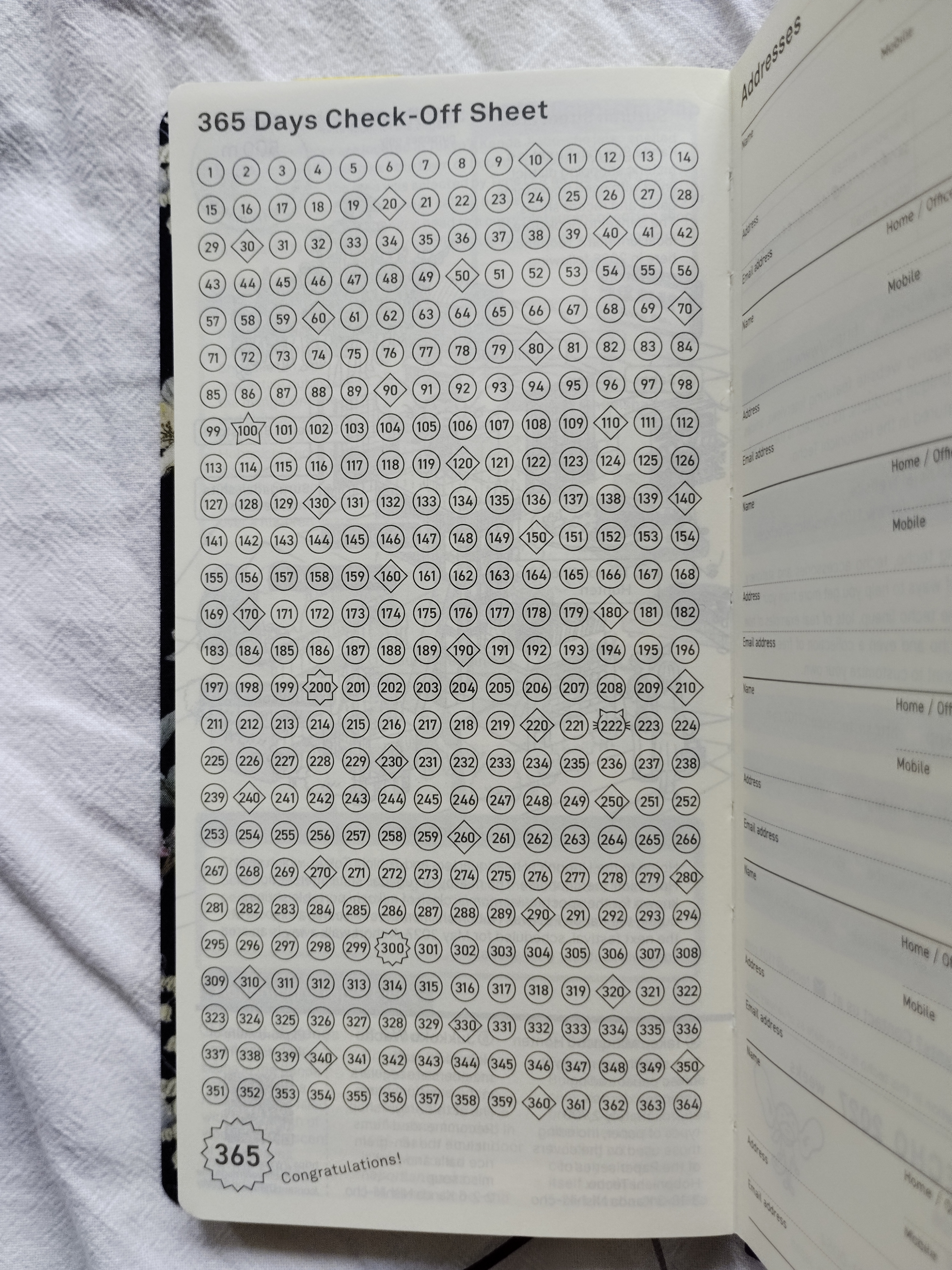
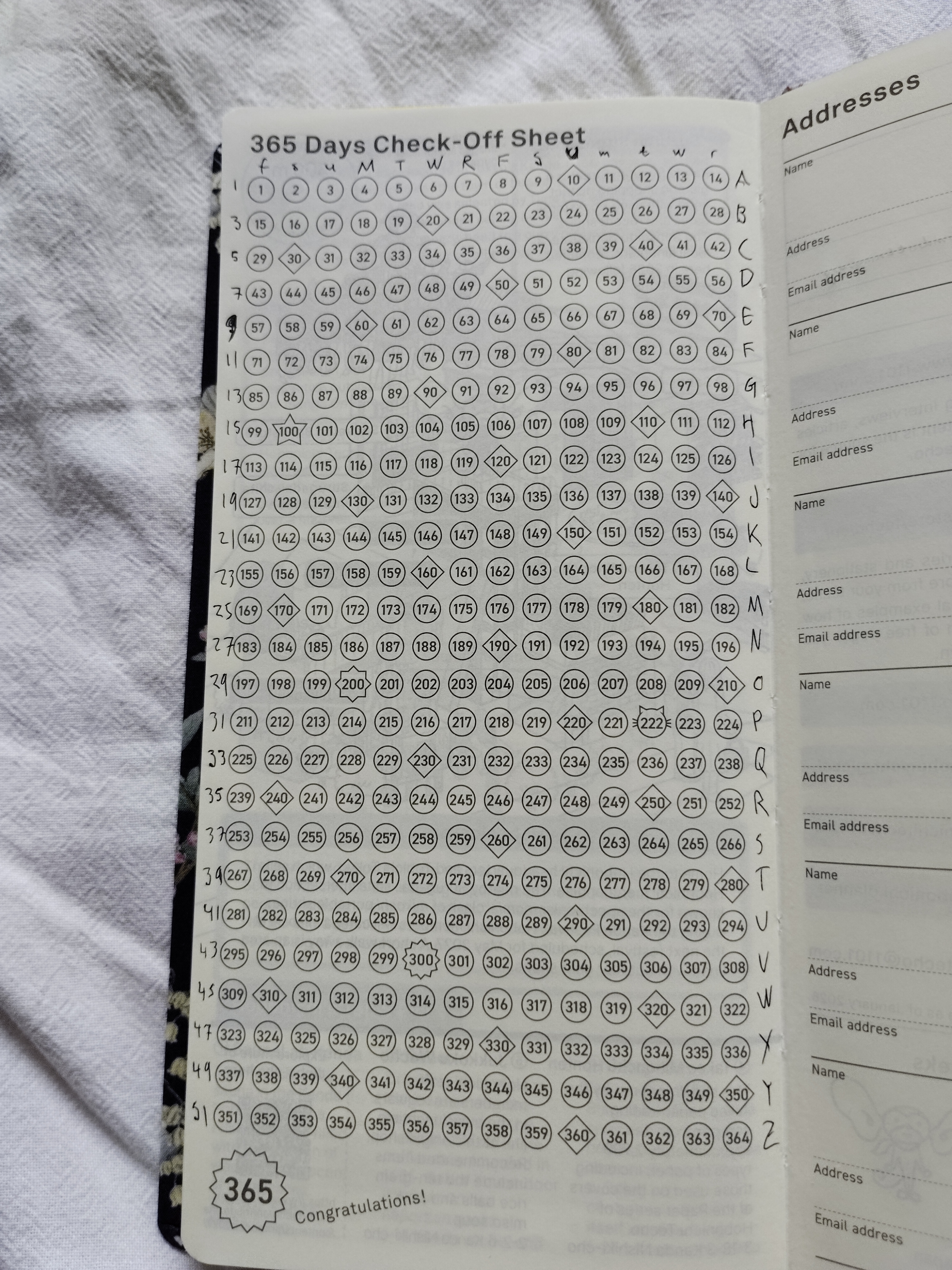
<p>But not really because I switched to paper in October 2023! I used a traditional bujo setup with future log for those last three months, thinking that was going to be good for a temporary solution and not having to buy a three-month calendar, because then I got my Hobonichi Techo Weeks paper calendar which I used for 2024 and a new one for 2025. It has the same “week down the left page, free page on the right” that I loved 2007 through 2009, but instead of rewriting the context items I let the list run across a few weeks, and migrate or X out things that have fallen behind. A box in the top right corne r means “this is the oldest page with empty boxes”, and checking it means “no undone things on this page <em>or on any older page</em>. Instead of dividing the page into contexts, I use the life-changing magic of indentation. No steps in means do on InkPalm, one step in means do at home, two steps in means do on iPad, four steps in means errands. Grocery list in the front and <a href="/gtd-in-a-connected-world" title="GTD in a connected world">“talk to friends” lists</a> in the back.</p>

<p>I remember being a li’l frustrated how the Muji calendar had both a yearly spread, twelve monthly spreads, and 52 weekly spreads. In a digital calendar, that is awesome, but in a paper calendar that’d mean manually copying things from those to each other to get full use of them. So here’s my thinking on that now. The weekly spread is the Single Point of Truth. That’s where things need to go and need to be right. I redundantly and manually copy things to the yearly spread in the front because having the yearly spread is amazing for two reasons: it’s good to have an overview for planning and for longer trips and for knowing when my friends are on longer trips, and it’s good to have a look back over the year on which days were lonely or on which days I hung out with friends &amp; fam. So it’s useful but I still don’t want to get in a position where some things from the yearly got missed and not copied to the weekly <em>and</em> vice versa. <em>Only</em> vice versa, where things that are in the weekly got missed and aren’t in the yearly, that’s less bad because then I still have a single point of truth I can rely on. I also journal and plan there. I have extra note pages in case the journal for a day runs long, I’ll just write a page reference to it. Circled number means “see note page with that number”, squared number means see a calendar spread on that week.</p>

<p>I do use the monthly spreads too, but for mean planing, meal recording, excercises and stuff. And, okay, yeah, some months this is blank because I’m not great at that stuff.</p>

<p>This system has been working great… For January, February, and March of 2025. Not so much 2024. I was experimenting with the idea that “write the 25 things you want to do, now the bottom 20 out of those 25, move that to an ‘absolutely do not do’ list because they distract you from your true goals” and that was a disaster. I’ll write an essay just about that someday once I’ve thought more about it. I still haven’t figured everything out.♥︎ I 2025 has been more traditional GTD and has been better so far.</p>

<p>So for 2026, I’m thinking I might want to go partially digital again! That sounds dumb given how it’s only March 2025 and how I just gushed on how great the paper calendar has been working.</p>

<p>And it really has been great. First of all, it’s a <em>portable</em> system. I don’t have to schlep the entire desktop or iPad, I just have it all in my paper notebook—and I was usually carrying a paper notebook anyway, so I’m not even carrying more stuff. The benefit of having a reliable calendar with me when I’m actually meeting real people whether it’s in a medical context or friends, that’s just awesome. Second, knowing what I want to do today without having to reach for the iPad is also great. It makes it so that I can decide “Okay, I want to do these three things on the iPad and then put it away” and actually having a fighting chance of that sometimes happening that way and me not getting sucked in! Third, no vendor lock-in, and fourth, it’s just cute. It’s an adorable flower book.</p>

<p>But it’s also pretty expensive with the shipping so I might want to go to another brand like a “fauxbonichi” or something local or just back to the bujo future log system which I can do in any notebook.</p>

<p>So here’s my idea:</p>

<p>Only the “<a href="/hard-landscape" title="GTD vs timeboxing">hard landscape</a>” of appointments is digital. Todo items, projects, context lists, even planning and journalling, that’s all in a paper notebook<small> (and I can use any old paper notebook which is great because I found a huge stash of adorable old blank notebooks in a storage area the other day when I was looking for a replacement headphone cable)</small>. And with structure; maybe I’ll something like a bujo except with the future log digital. When I carried a paper notebook 2010 through 2023, that was a completely free space of scribbles and junk which was great to just get thoughts out of my head. Here, I’ll try get the best of both worlds with some more permanent pages like my reading list and agenda lists and some more scribbly areas, all date stamped. I dunno.</p>

<p>And I’ll only want to do this if… that Light Phone III finally ships and is good, <strong>and</strong> if I can figure out a way to have a calendar server so I can sync its calendar bidirectionally with a nice gorgeous tablet calendar app. That way I could do my calendaring with a nice and good UI at home but still have access to it when I’m out and about and only have the phone. I’ve been all paper, and I’ve been all digital, and I’ve even briefly tried digital but with a paper calendar, but not the most obvious configuration which is paper but with a digital calendar.</p>

<p>Why? Okay, so there are two advantages. One, while I’ve schlepped around some sort of paper notebook since 2006 in one form or another and I love doing that, it’d be kind of nice to not <em>have</em> to do that. I could go down to the café or board game night and just have the phone in my pocket and not bring my whole purse. The phone would have everything so I’d run no risk of double-booking, and if I entered things in there it’d show up in the home calendar and vice versa.<small> (Alhough where would I keep tissues, keys, weapons, spare headphones, lip balm and a copy of Shirley Jackson’s <cite>Dark Tales</cite> if I don’t bring my purse?)</small> Second, I could get into the world of sharing calendars with friends &amp; fam! Digitally!</p>

<p>That’s been my thinking for the past month or so but then I remembered the already-almost-completely-forgotten chore of calendaring; when calendar was a verb, and that thought kept gnawing and boiling in me for a few days until this essay that you’re reading now came out. Just to, I dunno, surface my thoughts. And I can update here once I’ve done more thinking because I still haven’t made up my mind. Once that dang phone does arrive I can start experimenting with, I dunno, <a href="https://radicale.org" title="Radicale">Radicale</a> or something and see if I can make something work. There’s no rush because I’m committed to my current paper system throughout 2025<small> (although early fall is when it’d be time to order a new paper calendar for 2026 if I want to stick with my current setup)</small>.</p>

<p>There’s also, and this is super tempting, there are paper calendars with microscopic printing and a camera in the pen that makes it so that as you write in ink in the calendar, it can block that same time in your online calendar automatically. It can only do it on an hourly granularity and it’s not bidirectional, i.e. things that are entered in the digital calendar (perhaps from the phone) is not automatically entered in the paper calendar. So going this route, I’d definitively need to move things from inbox to calendar once I’m at home or in a place where I’ve brought that paper calendar. What’s good is, the paper calendar isn’t magic (it just has micro printing), the pen is. So you don’t have to buy new electronics every year as long as you keep that pen. I’d still get half of the two benefits: I could share my calendar with others (but not the other way around) and I could bring a read-only copy of it with me with my phone (but still have to enter things into it at home). Both of those halved benefits still sound amazing compared to what I was dealing with with my dumb desktop text file system from 2010 to 2021 but they also sound like kind of step back from my current Hobonichi Techo Weeks paper calendar (since it is smaller and I can just bring it in its entirety more easily than these microprinted ones). Still tempted just for how cool the idea is and for how it cuts down on screentime compared to a tablet calendar app which is what I’m leaning towards because it just makes more sense. Again, holding off until I can play around with Radicale or similar apps later this summer, once (or if) that Light Phone III arrives.</p>


        </div>
      </div>
    </content>
    <updated>2025-03-26T11:13:06+01:00</updated>
    <link href="https://idiomdrottning.org/calendaring"/>
    <author>
      <name>Idiomdrottning</name>
      <email>sandra.snan@idiomdrottning.org</email>
    </author>
    </entry>
  <entry>
    <link rel="self" href="https://idiomdrottning.org/hard-landscape"/>
    <id>https://idiomdrottning.org/hard-landscape</id>
    <title type="xhtml"><div xmlns="http://www.w3.org/1999/xhtml"><a href="https://idiomdrottning.org/hard-landscape">GTD vs timeboxing</a></div></title>
    <content type="xhtml">
      <div xmlns="http://www.w3.org/1999/xhtml">
	      <div>
        

<p>GTD draws a hard line between calendar items and todo items, saying to keep calendar items few and sharp and don’t miss them, and leave lots and lots of unscheduled time to work off your lists.</p>

<h2 id="calendar-items">Calendar items</h2>

<p>… are things that <em>has</em> to be on a specific time, usually something that someone else relies on, like an appointment, or like in our building where we need to schedule laundry machines.</p>

<h2 id="list-items">List items</h2>

<p>… are things that you want to do as soon as possible. GTD likes to sort them into <a href="/contexts" title="Contexts and sequencing">contexts</a> so you can get all your grocery stuff done at the grocery store, for example. But remember here that there are also checklists, where you can put things like a daily or weekly routine. Don’t knock checklists, dumb as they seem. If it’s good enough for airplane pilots it’s good enough for you. For some projects, you might even have a project list with more steps than just the <a href="/gtd-basics" title="GTD basics">very next step</a>.</p>

<h2 id="timeboxing">Timeboxing</h2>

<p>Now, there’s nothing wrong with actually scheduling some time to work on your lists, or even to work on <em>specific</em> things from your lists; GTD just asks you to make that a separate thing from your other calendar items. One of the benefits of GTD is how it’s more fluid and flexible and post-modern and if every single thing I’d have to do in a day was as rigid and immovable and urgent as a dentist appointment, I would die.</p>

<p>That said, early on I really was helped by having set alarms that would remind me to “work on my lists”. I didn’t even box in specific projects, just “work on list stuff”, and that made all the difference in the world. GTD has five steps and fifth step is actually <strong>doing the things</strong>, there’s just no getting around that, and if you don’t remember to actually do the things the whole system is gonna be useless and that’s where an “hey, do list stuff” li’l reminder can help especially early on. Or specific list stuff if you so prefer.</p>


        </div>
      </div>
    </content>
    <updated>2025-03-26T10:42:12+01:00</updated>
    <link href="https://idiomdrottning.org/hard-landscape"/>
    <author>
      <name>Idiomdrottning</name>
      <email>sandra.snan@idiomdrottning.org</email>
    </author>
    </entry>
  <entry>
    <link rel="self" href="https://idiomdrottning.org/two-wolves"/>
    <id>https://idiomdrottning.org/two-wolves</id>
    <title type="xhtml"><div xmlns="http://www.w3.org/1999/xhtml"><a href="https://idiomdrottning.org/two-wolves">The Two Wolves</a></div></title>
    <content type="xhtml">
      <div xmlns="http://www.w3.org/1999/xhtml">
	      <div>
        

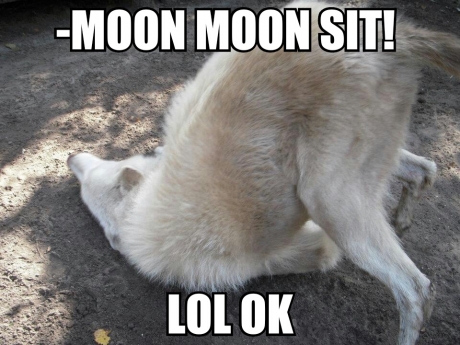
<p>Inside of me there are two wolves. One is called “I ought to” and the
other is called “I don’t wanna”.</p>

<p><img src="/moon-moon.jpg" alt="Kinda like this photo meme of an unruly wolf." /></p>

<p>Sometimes it’s “I ought to” running the internal monologue, the
“school speakers in my brain” so to speak, and verbalizes things that
I ought to do and gets frustrated and surprised that they do not get
done.</p>

<p>Other times it’s “I don’t wanna” that’s set out to rest and calm the
heck down but can’t because there’s a gnawing guilt.</p>

<p>So it’s not that one is always “the conscious” and the other is always
“the subconscious”. That can change.<small> (I know calling it
“sub”-conscious has fallen out of vogue in psychology but I wanna
bring it back, I do think it’s a great name for it, bubbling juuuust
under the surface, you can barely feel it out.)</small> But they’re
both in control; they equally affect what I actually <em>do</em>.</p>

<p>Belatedly discovering this phenomenon in the mid 00s was a huge step
forward for me. It was something I wish I had understood much
earlier.<small> (The first 25 years I lived on this planet I had
severe procrastination issues. That’s why I write so much about
that.)</small></p>

<p>At first, I didn’t understand that they could switch places. I thought
“I” <em>was</em> “I ought to”, and that I was wrestling with the laziest
angel of all time. But even that level of awareness of the other wolf
was a good step forward.</p>

<p>I couldn’t “hear” it yet but I could try to deduce from how it
influenced my actions and inactions what it really wanted and try to
comprommise with it, or be clear to it, or just validate it.</p>

<p>In that era, a powerful technique when it was really hard to do
something and I just didn’t know why I’m procrasting so much was to
sit down and let wash over me the thought of how much of a hecking
schlep the task is going to be, really fully feel how much I don’t
wanna do it. A lot of the time, after doing that, I’ll feel myself
rise from the chair and go do it.</p>

<p>That was “I don’t wanna” feeling fully heard and validated, and
wordlessly being like “Damn, sis! That was all you had to say! I was
worried you weren’t hearing me and that you weren’t taking into
consideration my warning that this was going to be a huge pain in the
neck!”</p>

<p>I came to see “I don’t wanna” less as an impish monkey on my back and
more like a cute monchhichi I needed to take care of, make sure it was
heard, acknowledged, taken into consideration. “I” still was “I ought
to”, or so it seemed, but I tried hard to not overextend myself, to
get rest in, to add food and sleep to the mix in with “I ought to”’s
desire to hack the world and write The Great Pan-Galactic Novel.</p>

<p>Mid ’10s, I found out about how psychologist and roshi Marsha Linehan
uses two Euler circles for what I’m calling two “wolves” here; and for
actions and inactions that the two can agree on, things that are in
the intersection of her two “circles”, she calls that the “wise mind”.</p>

<p>By then I had just about figured out how it’s not always the
procrastinating, inactive side that’s lurking under the surface. That
the two wolves can and do switch who’s on the mic. To no avail because
what we tell ourselves
what we’ll do <a href="https://angryflower.com/296.html" title="Bob the Angry Flower - The Time Looker-Forward Tube">isn’t always what we will do</a>.</p>

<p>And that “I” am not the two wolves. Or I am both of them and more. Or
there is no clear atomic delination between what’s one person and the
next in this cloud of microbiotics and signal substances and neuron
fire. Eww, that got trippy.</p>

<p>Back to the practical tips. One technique I’ve discovered only a few
months ago has been to offer some choices. “OK,” the wolf-on-the-mic
will tell the other. “Option one: you can lie here and if so put a
sleep mask on because it’s bright. Fall asleep or don’t, I don’t care
which. Or, option two, go up and make oatmeal. Either of the two
options are fine by me. It’s fully your choice and I’m happy either
way. Video games can wait because I’m tired and I’m hungry.”</p>

<h2 id="ps">PS</h2>

<p>I don’t usually think of them as wolves, it’s more like “I don’t
wanna” is some kinda frog monkey and “I ought to” is a stern teacher,
but I thought that the wolven imagery might be more readily understood
because of <a href="https://en.wikipedia.org/wiki/Two_Wolves" title="Two Wolves - Wikipedia">this meme</a>.</p>

<p>I like that it makes them more similar to each other than different.
That makes the picture clearer.</p>

<p>That meme story is telling you to feed one and starve the other.
That’s not me. I’m with Linehan, either wolf can give you some pretty
bad and destructive ideas. Listen to your heart <a href="/unreasonable" title="Unreasonable">fully</a>.</p>


        </div>
      </div>
    </content>
    <updated>2025-03-18T08:41:31+01:00</updated>
    <link href="https://idiomdrottning.org/two-wolves"/>
    <author>
      <name>Idiomdrottning</name>
      <email>sandra.snan@idiomdrottning.org</email>
    </author>
    </entry>
  <entry>
    <link rel="self" href="https://idiomdrottning.org/do-before"/>
    <id>https://idiomdrottning.org/do-before</id>
    <title type="xhtml"><div xmlns="http://www.w3.org/1999/xhtml"><a href="https://idiomdrottning.org/do-before">What do I want to do before that?</a></div></title>
    <content type="xhtml">
      <div xmlns="http://www.w3.org/1999/xhtml">
	      <div>
        

<p>One of my favorite habits is to, first thing, when I know what I want
to do today, like today I wanted to stay in bed and watch
<cite>Inuyasha</cite>, it’s to grab my planner and think “Okay, what
do I want to do before that?” If nothing, great! I’ll enjoy the show
so much more. This makes such a huge difference to the quality of my
day.</p>

<p>And if something, that’s also good! It’s a great catch knowing that I
won’t have forgotten them or had them gnaw on me. Like today, I had
projects that were even more worthwhile to work on so I was so
grateful to my past self for having written them up<small> (and I was
also cursing my past self for writing some of them so illegibly that I
have no idea what it’s supposed to say)</small>.</p>

<p>Of course, what I want to do might get a lot of its value from the end
goal of that task rather the task itself. <a href="/paycheck" title="Employers hate extrinsic motivation">If that weren’t the case</a> a
lot of people might never want to go to work in the morning. A lot of
jobs are fun but not a lot of jobs are more fun than watching cartoons.</p>

<p>Now, as always, when deciding what to do, do not neglect the value of
rest. Point of GTD is not to kill us with overwork, it’s to be a
bookmark of everything we’re not doing so we can more fully do what we
are doing; which might be resting.</p>

<p>I’ve found this especially good when working on longer projects like a novel. First thing everyday being like “okay, today I want to work on the novel” and then <em>only</em> doing the <em>most</em> urgent and important stuff before writing has worked really well. I, uh, might need a nudge every morning to remember that I do have that big project. Like a post-it on the mirror or a note by my bed.</p>


        </div>
      </div>
    </content>
    <updated>2025-03-17T11:11:00+01:00</updated>
    <link href="https://idiomdrottning.org/do-before"/>
    <author>
      <name>Idiomdrottning</name>
      <email>sandra.snan@idiomdrottning.org</email>
    </author>
    </entry>
  <entry>
    <link rel="self" href="https://idiomdrottning.org/paycheck"/>
    <id>https://idiomdrottning.org/paycheck</id>
    <title type="xhtml"><div xmlns="http://www.w3.org/1999/xhtml"><a href="https://idiomdrottning.org/paycheck">Employers hate extrinsic motivation</a></div></title>
    <content type="xhtml">
      <div xmlns="http://www.w3.org/1999/xhtml">
	      <div>
        

<p>One of the most important parts of productivity is finding your
motivation, getting crystal clear about <em>why</em> you’re doing things. In
this brief crack of light between two eternities of darkness<small> (probably
better known as our existence)</small> we might not get around to doing all
that we want so it’s a good idea to know which things we <em>most</em> want
to do, and knowing the why is pretty clutch for sorting that out.</p>

<p>So when it comes to work for hire, the “for hire” part is not to be
skipped over. Knowing that the job pays for a roof over my head, a bed
to sleep in, food to eat, that can fire me up to apply my full
creativity and wit if it’s a problem-solving job, or care and
attention if it’s a more tedious type of job.</p>

<p>I.e. actually thinking “the reason for this job is the paycheck” can
be pretty important in order to do the job right and to care about the
tasks that are part of the job. Especially with a <a href="/gtd" title="GTD essay collection">GTD</a> mindset of how
your passion for a goal can and ideally should transfer to the steps
you take in pursuit of that goal no matter how off-putting and awful
those steps would’ve been without that context.</p>

<p>But these days, saying “the reason for this job is the paycheck” has
become taboo in the ears of the employers. It’s a quick way to get
easily kicked out of a job interview. They want to be able to pretend
that you think the job in and of itself is fun and good, that the
embarrassing-for-all-parties bother of the paycheck is a mere
inconvenience that should be abolished as soon as we all could get
around to it.</p>

<p>And there <em>are</em> tasks like that. Projects where what you’re doing is
intrinsically valuable for yourself or for the help it brings others.
There’s no shortage of them, either. The world is a broken place and
there are so many ways we could help build it up, repair it, or make
it better.</p>

<p>Like doing volunteer work whether that’s in a formal context or just
hacking on free software projects out of your own proverbial garage.
Trouble is, 9999999% of those things don’t pay.</p>

<p>Maro once said that a dream job is a job that 1. You love doing, 2.
You’re good at, 3. People pay you for.</p>

<p>I’d add a paragraph zero: something that’s a net active good for
society or for myself. It’s a sad state of the world that a lot of
jobs do not qualify for that zeroeth paragraph. So many jobs are
either all bad, or do more harm than good. Like advertising, as one of
many examples. On the train yesterday my eyes were bleeding from the
dozens of ads plastered all over the cart. I’m not saying ads don’t
have <em>any</em> informative advantages but the disadvantages heavily
outweight any good. A world where there aren’t any ads in public
spaces might seem like a dream but it would be so restful. And give
people space to stare at their phones or whatever since that’s
something they seem to truly enjoy doing.<small> Or, more likely, they’re
looking at the phones since it’s so punishing to look up and get
blasted by ugly ads.</small></p>

<p>I know for a fact that I’d have no shortage at all of ways to fill my
days when I don’t have a job. I’m not just talking about the
post-boredom society we live in where we’re the most entertained
generation in history, I’m talking about actual fun or good things.</p>

<p>What we do needs to be meaningful.</p>

<p>If your job can be paragraph zero but not paragraph three, uh, that is
to say: if it can be intrinsically valuable but not give me three
square meals, that’s fine but it’s competing with all those other
things we could be spending our time on that might be even <em>more</em>
intrinsically valuable.</p>

<p>And if your job, like so many other jobs here, doesn’t even have
intrinsic value, if it’s just spam or lies or widening the wealth gap
or burninating the countryside, then ditch the fantasy of
your employees pretending that the extrinsic
motivator<small> (a.k.a. salary)</small> doesn’t matter to them.</p>

<p>Employers, the only reason you might sway us from days of war and
nights of love is to the extent you offer a cost-effective way to get
healthcare, food, and shelter, especially in this cruel <a href="/arbetslinjen" title="How forced labor became the “liberal” agenda">arbetslinjen</a>
world,<small> (and by cost-effective I mean cost in the time and toil
extracted from us in return for those extrinsic rewards)</small>.</p>

<p>If you can’t even do that you might as well close up shop.</p>


        </div>
      </div>
    </content>
    <updated>2025-03-17T11:08:52+01:00</updated>
    <link href="https://idiomdrottning.org/paycheck"/>
    <author>
      <name>Idiomdrottning</name>
      <email>sandra.snan@idiomdrottning.org</email>
    </author>
    </entry>
  <entry>
    <link rel="self" href="https://idiomdrottning.org/lock-screen-design"/>
    <id>https://idiomdrottning.org/lock-screen-design</id>
    <title type="xhtml"><div xmlns="http://www.w3.org/1999/xhtml"><a href="https://idiomdrottning.org/lock-screen-design">Designing the perfect lock screen and notifications system</a></div></title>
    <content type="xhtml">
      <div xmlns="http://www.w3.org/1999/xhtml">
	      <div>
        

<p>Uh-oh.</p>

<p><a href="https://support.thelightphone.com/hc/en-us/articles/360031122051-Notification-Settings-Ringtones-Sounds" title="Light Phone notification settings">This does not seem good</a>.</p>

<p>No scheduling, no easy toggling, no time outs (like “don’t disturb for the next N minutes”), no allowlist for specific numbers to punch through, no “if they call twice let them through”.</p>

<p>The two options for “new activity icon” are a bigger problem. You see, the problem for us caught in the “check-check-check” mentality is that the activity icon is like a slot machine, crack-a-pack, treasure chest, gambling, choosing a scratch ticket over bread, dopamine injection! “Ooh do I have a li’l hug waiting for me if I unlock?”, that’s what the asterisk says. That damage would be minimized if the lock screen gave just a little bit mit more info about what’s going on instead of all activities (no matter how trivial or disappointing) showing the same li’l light-up Christmas star.</p>

<p>And turning <em>off</em> that alluring lootboxy li’l asterisk is a thousand times worse because then the entire phone becomes a constant, never-ending slot machine. I can’t know whether or not I have anything without going through that li’l addictive “unlocking” ritual. Unrapping the pack, flipping the ante, scratching the ticket, pulling the slot machine lever… and unlocking the phone. Those extra hoops ironically is what makes it <em>more</em> addictive.</p>

<p>Hark, y’all: once upon a time there was an unusually cruel animal experiment. One group of the li’l critters got unlimited amount of food. Anytime they wanted food, they could just go and get it. No risk of ever running out, just a constant cornucopia of li’l treats. The other group, they got a contraption that they could engage with that randomly, sometimes, if you’re lucky, it gave you food.</p>

<p>That first group with easy-access food? They thrived and lived healthy and cozy lives. Post-scarcity for the win. No anxiety about where the next hug’s gonna gome from once you know there is love.</p>

<p>That second group with the gambling contraption? They got hooked. Hooked with a capital every single letter: H O O K E D. They eanded up eating way <em>more</em> than the group that had infinity food. And they died and it was pretty awful.</p>

<p>Now, everyone’s different and that’s great but I know that I’m super susceptible to these li’l dopamine habits. That’s just my personality (and/or it’s a messed up prefrontal cortex causing executive dysfunction but uh, let’s go with the personality story instead, I like that better). I get into all these li’l mostly-unconscious habits and behaviors and obsessions.</p>

<p>Now, there’s a lot of talk about dark patterns and how the tech companies hire psychologists that are literally trying to make this stuff even <em>more</em> addictive. As insane as that rumor sounds and as broken a human needs to be to sign up for that task, I stills have every reason to believe it’s true.<small> (Market capitalism has a couple of flaws, it turns out.)</small></p>

<p>But here’s the thing. Even without deliberately trying, these “dark patterns” arise. Because design is difficult. Endless scroll was designed because someone thought it was convenient and less of a chore. Likes and stars were invented because people were sick of the “I agree, well said!” posts that plagued Usenet in the Eternal September era. It wasn’t made to hook us and mess with us, but since, uh, mistakes were made, that’s what ended up happening.</p>

<p>Our best hope is to iterate, to notice these behaviors and try to fix them with better design. Designing for convenience has backfired and created addiction. But so has designing with deliberate hoops and obstacles.</p>

<h2 id="more-is-less">More is less</h2>

<p>Scheduling can be part of the solution. Like, growing up, we read the paper every morning. We were “addicted” to that habit but it was an addiction that couldn’t really grow. If we wanted more paper, we still had to wait until next morning.</p>

<p>We want less stress, right? Sometimes more design can lead to a simpler life.</p>

<p>Tempo, a proprietary<small> (boo and hiss! Long live FOSS)</small> email app that I never personally used but I saw videos, had some really good ideas there. You’d have an allowlist of friends and fam who got to reach you right away, and other email you got to see in scheduled batches, and the main screen was a todo list, not an inbox.<small> Yeah, sometimes sites will be like “we’ll send you a verification code over email that’s valid for the next thirty seconds” or your boss will call asking for some sorta special turnaround, so Tempo did have a “let me please peek at my future email even though it’s not time for the schedule” feature, and it did have plenty of “are you sure? hold the button for so-and-so-many seconds” hoops in place really meant to safeguard you that could easily become an addictive scratch ticket, but the main safeguard was that since there was scheduling, you could tell yourself “Okay, I really really wanna peek but I’m gonna wait until the schedule comes around with one hundred million angels singing.” and that, in combination with the allowlist that gets let through right away, might at least alleviate that itch. </small></p>

<p>Tempo is an example of “more” design, since instead of just a simple “here is box, mail come here, Hulk smash”, it was more elaborate with different tabs, different categories of mail, but that setup would hopefully lead to a state of “less”, to fewer bad habits for you. “Hey”, another proprietary app<small> (with additional baggage on top of that, apparently, but that’s a story I don’t wanna go dig out of <code>/dev/null</code>)</small> similarly has a more elaborate workflow with stacks and separate inboxes and a multi-reply-view, that’s all ultimately meant to hae you spend less time in email, not more.</p>

<h2 id="not-that-email-is-always-bad">Not that email is always bad</h2>

<p>Two decades ago, Merlin did an <a href="http://www.43folders.com/2006/11/28/productive-talk-comp" title="Productive Talk Compilation: 8-episode podcast with GTD's David Allen">interview with David Allen</a> that I really loved.</p>

<p>It has many gems, but one thing I’ve been thinking about lately is when Merlin starts talking about some of this stuff like scheduling, batching etc to try to curb the checkmania, Allen pushes back a little, saying that for some occupations, the entire point of the job is to be on top of things costantly. Two of his examples are a “missile silo” and an OB/GYN as the two examples.</p>

<p>But Merlin and Allen quickly agree that if that’s not your job, it’s not your job. If your job is to actually think or actually do things (or actually <a href="https://mnmlist.com/brew/" title="I am not a brewer">not do things</a>, as the case may be), having  a couple of tiers of we get info can be a good thing. Not every message need to get to us right away.</p>

<p>But the more we can trust that the ones we <em>do</em> need will get to ous in time, the easier we can put the less urgent stuff out of mind.</p>

<h2 id="update">Update</h2>

<p>One mitigating factor in this specific situation is that it can only be calls or texts. So it’s a less random “slot machine” that’s hopefully more practical. I’d still prefer it if it said “three missed calls, four texts”. Not enough to leak data to someone else looking at your phone, but takes some steps for making it be less like a mystery gacha pull for you to decrease the gambling factor.</p>

<p>Also all I have to go on here is my own experience with this addiction. I’m not discounting that better studies could teach us even more about how to design this.</p>

        </div>
      </div>
    </content>
    <updated>2025-02-20T22:46:29+01:00</updated>
    <link href="https://idiomdrottning.org/lock-screen-design"/>
    <author>
      <name>Idiomdrottning</name>
      <email>sandra.snan@idiomdrottning.org</email>
    </author>
    </entry>
  <entry>
    <link rel="self" href="https://idiomdrottning.org/knowledge-navigator"/>
    <id>https://idiomdrottning.org/knowledge-navigator</id>
    <title type="xhtml"><div xmlns="http://www.w3.org/1999/xhtml"><a href="https://idiomdrottning.org/knowledge-navigator">The Dystopian Hellscape of Apple’s 1987 Knowledge Navigator Concept Video</a></div></title>
    <content type="xhtml">
      <div xmlns="http://www.w3.org/1999/xhtml">
	      <div>
        

<p>So in 1987, <a href="https://www.youtube.com/watch?v=umJsITGzXd0" title="Apple Knowledge Navigator Video (1987) — YouTube">Apple made a concept video</a>.</p>

<p>In the video, a guy—an academic—saunters into work, boots up his iPad, and starts talking to an AI.</p>

<p>He has a ton of message notifications.</p>

<p>He also gets a few appointments and is expected to remember them himself. The appointments are pretty big deals but they’re completely last minute shocks to him, like having to prepare a lecture that he’s supposed to have in a few hours or getting a cake for a family gathering.</p>

<p>For his actual work, the lecture, he throws something together in three seconds with the LLM and mooches off a friend, asks her to come do the lecture. Actual thinking: nadita. I’m not denying that an LLM like he has could help him come up with some great insights and ideas, <a href="/ml" title="Machine Learning—good and bad arguments against">that’s not one of the problems with LLMs</a>, they can be great<small> (and the “What was his name, Fleming something” and the LLM understanding that certainly rings true to a lot of us)</small>. But that’s not what he’s doing. He’s just pasting some maps together…</p>

<p>And he’s tasked to do the remembering part while the LLM does the thinking.</p>

<p>He does spare a few seconds to make light of the “nice” climate change
driven desertification and completely glosses over the human toll.
He’s got <a href="/cinder" title="Most blank on the cinder">the cushiest tenure on the cinder</a>, apparently. Power he
uses to try to place all of climate change blame on the same global
south it’s ravaging.</p>

<p>And all the while he’s trying to think about this lecture he’s getting
new messages, new calls, and he’s just as bad himself, having sent a
“<a href="https://nohello.net/" title="no hello">“please call me” (without even saying why)</a>” message to his
fish-with-a-bicycle colleague. Or rather, having asked the bot
to do that.</p>

<p>All of this because his own scheduling has utterly collapsed. He’s scrambling with last-minute cake cop-outs and giving phoned-in lectures<small> (both figurative and literally)</small>.</p>

<p>It’s like he is the secretary, and failing at it, while the robot is
the professor. And the robot is the son, too, since it’s the robot who
gets to talk to the guy’s mom for him. Human connection delegated to
AI. A mom who’s only calling to remind him to get the cake that the
robot has already reminded him about twice and that he’s gonna forget anyway.</p>

<p>So constant digital interruptions, colliding double-booked
appointments, no awareness of last-minute deadlines, phoned in
lectures, and using tech to isolate rather than to connect. All in a
world driven to the brink by fires and drought. I’ll say one thing for
1987 Apple: they did make a cyberpunk video that’s more of a warning
than a utopia.</p>

<p>A warning I bet many of us wish we would’ve heeded.</p>

<p>The one piece of tech I wish I could send back to the grim darkness of
the far future where there is only slop, to the
2010-as-viewed-from-1987? That’d be the life-changing magic of <a href="/gtd-overview" title="GTD overview">GTD</a>:</p>

<ul>
  <li>A lighter calendar with only the hard landscape</li>
  <li><a href="/notes">Notes where action is sifted from reference</a></li>
  <li>The piece of mind to work on what’s most important, uninterrupted</li>
  <li>The tools to bookmark that work so he could have room for the human touch</li>
  <li>Messages and conversations dealt with one-by-one</li>
</ul>

<p>And best of all:</p>

<p>A clear idea of what to do sorted by where to do it, driven by the
projects and areas and values that really matter instead of what’s
just latest and loudest.</p>

<p>This wonderful technology is a system that can use fancy apps or
 just <a href="/gtd-basics" title="GTD basics">scraps of paper</a>. Either way, that’d free him to use his science-fiction wonder computer to do some real work instead of
 drowning him in noise.</p>


        </div>
      </div>
    </content>
    <updated>2025-02-16T23:49:06+01:00</updated>
    <link href="https://idiomdrottning.org/knowledge-navigator"/>
    <author>
      <name>Idiomdrottning</name>
      <email>sandra.snan@idiomdrottning.org</email>
    </author>
    </entry>
  <entry>
    <link rel="self" href="https://idiomdrottning.org/tried"/>
    <id>https://idiomdrottning.org/tried</id>
    <title type="xhtml"><div xmlns="http://www.w3.org/1999/xhtml"><a href="https://idiomdrottning.org/tried">Enh, I tried…</a></div></title>
    <content type="xhtml">
      <div xmlns="http://www.w3.org/1999/xhtml">
	      <div>
        

<p>I’m experimenting with “sitting down with the project for a few hours and if I really can’t crack it, I’ll cross it off the list”. Accepting failure as a possible outcome. That sounds sad and desperate but it’s just been such a relief. It’s a safety valve. It’s a reverse reward. If I <em>don’t</em> do it, I get rewarded by not having to do it.</p>

<p>When I first started <a href="/gtd-basics" title="GTD basics">doing GTD</a>, one thing I tried to get good at right away was noping out. The whole “I’ve really wanted to do this for a long time but now that I see everything I want to do, this one thing doesn’t seem worth it comparatively or I don’t even know how to begin doing it, so let’s just not”.</p>

<p>This new “try, then maybe fail” is a new thing, a kind of middle ground between noping out right away vs buckling down and throwing all my effort and resources and desperation at something.</p>

<p>And so far, it has surprised me because so far none of the “tries” have failed. I did manage to do it even though I didn’t think I could. So it’s still an experiment. I dunno how I’ll feel once I start racking up the L’s and the swamp has eaten all my X-wings.</p>

<p>So far it feels pretty good. Since it’s a middle ground, it’s hard to know when to apply this “try technique” compared to just really committing for real on something or to just nope out without wasting any more time on it. It’s been a motivational aid, like “Ugh, this thing has been on the lists for weeks, I’ll never get to it because it’s such a Totally Dreaded thing that I don’t even know where to begin with” and then I’m like “Okay, I’m gonna buckle down and <strong>try</strong>” and that helps me get going.</p>

<p>It helps with prospective or inchoative aspects of procrastination (dreading getting started), because in order to really give it an honest try, I do have to sit down and figure out the actual first steps (which is the part of GTD that the-people-who-don’t-need-GTD always scoff at, the fact that we-who-do-need-GTD need to actually take a breath and spend some time cognitively <em>figuring out</em> how to start doing something and what the actual first steps are).</p>

<p>It also helps with the perfective aspects of procrastination (dreading having to do the final touches), since I’m not as committed to seeing it through.</p>

<p>I just finished a project I was 99% sure I’d want to give up on. I just decided to give it one really solid try first.</p>

<p>(It was hacking a zigbee light switch to instead control music [I don’t even have any “smart” lights], a project I first started last spring, but then shelved because the websocket ports were world-accessible.</p>

<p>That wasn’t procrastination, that was just a good old noping out.</p>

<p>Then unrelatedly I switched routers a few months later, making the project possible again. It still wasn’t procrastination until I realized that I could do it and put it back on the list.</p>

<p>And there it stayed for several months. That was procrastination.</p>

<p>And I didn’t wanna do it because I didn’t think i was gonna be able to do it. I remembered last time trying it eight months ago, it was just flashing lights and crashing loops.</p>

<p>But that “maybe I can’t do it”, I realized I could reframe that as an out instead of as a reason to not try, something that had worked for smaller scale projects last week. And then I still procrastinated one more half-an-hour (by writing the first half of this essay) and then I finally managed to do it.</p>

<p>Conclusion: do, or do not. Or try.</p>

        </div>
      </div>
    </content>
    <updated>2025-02-02T14:50:11+01:00</updated>
    <link href="https://idiomdrottning.org/tried"/>
    <author>
      <name>Idiomdrottning</name>
      <email>sandra.snan@idiomdrottning.org</email>
    </author>
    </entry>
  <entry>
    <link rel="self" href="https://idiomdrottning.org/contexts"/>
    <id>https://idiomdrottning.org/contexts</id>
    <title type="xhtml"><div xmlns="http://www.w3.org/1999/xhtml"><a href="https://idiomdrottning.org/contexts">Contexts and sequencing</a></div></title>
    <content type="xhtml">
      <div xmlns="http://www.w3.org/1999/xhtml">
	      <div>
        

<p>When GTD was first published one of the new ideas was to sort your “next actions” list into contexts like “Calls”, “Do at home”, “Errands”, “Do at desk” and so on.</p>

<p>This was great for two reasons. One: it’s more efficient to do something in one trip than in two, and that reduces overhead. Two: that’s also psychologically a motivator! It’s satisfying to “I might as well do this as long as I’m doing that”, that just feels good and unclumsy and elegant. And while it sometimes feels like it’s not worth making the schlep to do one thing, it might start to feel really worth it once you have a couple of things to do there to tip you over the top.<small> (Although that’s a double-edged sword once a context gets full of so many daunted and dreaded things that you don’t even want to go there in the first place because then you’d have to do the totally dreaded thing.)</small></p>

<p>For many people, “contexts” have fallen of the wayside in modern GTD since they have the world in their pockets at all times so what’s the use? It doesn’t really add any efficiency for them, just more fiddliness with the system. And some of the contexts, like “Calls”, have become pretty dumb since I can’t really make multiple calls at once in this era of “please hold” and “we’ll call you back so keep your phone ready”.</p>

<p>But that’s throwing out the motivation baby with the convenience bathwater. The whole “I’m doing this while I’m here so I might as well do that” factor really did help me a lot.</p>

<p>Another benefit of contexts is … Okay, one of the problems my sprawlbrain has with navigating the world is what game nerds call “Sequencing”<small> (from card games where it subtly but crucially matters in what order your draw your cards or cast your spells)</small>; a non-game example is if you’re gonna clean the floor and dust off the tables, it’s better to do the tables first in case you spill some table dust on the floor. Having just a context-specific subset of actions to consider makes it easier to do them in a good order.</p>

<p>Another ginormous benefit of sorting my actions list by contexts is how that subtly nudges me to consider what the actual practical next step is. That’s something normal people maybe can’t relate to but us sprawbrained weirdos definitively can: the core issue of what psych eggheads call “executive function” is separating “end goals” from “next steps”.</p>

<p>Before GTD: “‘Clean apartment’, yeah that would be nice, I’ll get to that any day now.”<br />
After GTD: “Okay, so having a clean apartment is my end goal so I’ll put that on the projects list; the first step can be scrubbing my sink so I’ll get the baking soda out.”</p>

<p>This is something that the people-who-don’t-need-GTD can do automatically. They can get by with just a todo list because their brain automatically and instantly recognizes what’s the next step for their goals. Especially for chores they’ve done many times.<small> (They might be out of luck if something unusual comes up that they don’t know how to deal with, where GTD has a more general problem-solving approach that can handle even unusual things.)</small> “Automatisation”, this is called in the psych world.</p>

<p>Now, it’s easy to get carried away with too much “I’m gonna do this so I might as well do that” and take on too much work. That’s one of <a href="/gtd-bad-paths" title="GTD bad paths">the pitfalls of GTD</a>, you get too efficient so you do too much and then you die. The solution is to keep guard of what you put on your list in the first place.</p>


        </div>
      </div>
    </content>
    <updated>2025-01-29T11:13:41+01:00</updated>
    <link href="https://idiomdrottning.org/contexts"/>
    <author>
      <name>Idiomdrottning</name>
      <email>sandra.snan@idiomdrottning.org</email>
    </author>
    </entry>
  <entry>
    <link rel="self" href="https://idiomdrottning.org/habits"/>
    <id>https://idiomdrottning.org/habits</id>
    <title type="xhtml"><div xmlns="http://www.w3.org/1999/xhtml"><a href="https://idiomdrottning.org/habits">Habit Hooks</a></div></title>
    <content type="xhtml">
      <div xmlns="http://www.w3.org/1999/xhtml">
	      <div>
        

<p>Okay, warning for the hopeless leading the hopeless here because I am really really really bad at picking up new habits, buuuut I think I stumbled onto something!</p>

<p>Add the new habit in <em>before</em> something else you’re already doing. Like, “before I eat I should get my vitamins.”</p>

<p>Many years ago I read in a book that a key technique for picking up new habits is to tie them be triggered by something else you’re doing. Like, every time I’ve laminated the stasis which I always do, I should then distim the doshes after which is the new habit I’m trying to pick up.</p>

<p>And that’s worked okay. Way better than nothing, than just hoping the new habit would start automatically. Not as good as like, making notes or alarms for the first few months then gradually taper those alarms away until you don’t need them anymore. And those techniques also can combine and work together.</p>

<p>But my new idea is that habits that are <em>before</em>, rather than after, the pre-existing thing work even better. Now, that’s not always possible<small> (as much as I wish I could come up with a way to do dishes before dinner)</small> but when it is, it’s great! Because the thing after is something that’s already firmly entrenched so I’m not going to forget it. It’s like how it’s much easier to memorize a poem or song by learning the final phrases first and then building it up from the end.xs</p>

        </div>
      </div>
    </content>
    <updated>2024-10-17T22:26:48+02:00</updated>
    <link href="https://idiomdrottning.org/habits"/>
    <author>
      <name>Idiomdrottning</name>
      <email>sandra.snan@idiomdrottning.org</email>
    </author>
    </entry>
  <entry>
    <link rel="self" href="https://idiomdrottning.org/svt-mot-internet"/>
    <id>https://idiomdrottning.org/svt-mot-internet</id>
    <title type="xhtml"><div xmlns="http://www.w3.org/1999/xhtml"><a href="https://idiomdrottning.org/svt-mot-internet">SVT mot internet</a></div></title>
    <content type="xhtml">
      <div xmlns="http://www.w3.org/1999/xhtml">
	      <div>
        

<p><a href="https://www.svtplay.se/video/jkAWko4/veckans-snackisar/dags-att-logga-ut-smartphonen-ar-en-enarmad-bandit">SVT tar upp internetberoendefrågan och digital minimalism</a>.</p>

<p>Dom håller sig till grunderna, typ “jag har en knapptelefon ute men
internet hemma”, “det är upp till individen att ta eget ansvar” osv.
Och jag hatar <a href="/debate" title="Debate">debatt som format</a>.</p>

<p>Att inte kunna fokusera på grund av dopaminrusherna från våra
teknikprylar är ett stort problem. Håller med om det. Även om jag fick
intrycket att internetnedtrapparen hade tagit några av sina
formuleringar, t.ex. <a href="/savoring-and-wandering" title="Savoring &amp; Wandering">om att låta tanken vandra</a>, från Johann Haris
halvsussa bok <cite>Stolen Focus</cite>.</p>

<p>Som många av er vet är jag själv ofta rätt opepp på internet. Jag <a href="/dumbphone-experience" title="The Dumbphone Experience">har
också en dumbphone</a><small> (och under något drygt år på slutet av 00-talet
hade jag inte internet hemma heller, bara på jobbet)</small> men hemma har jag
ju min tablet som jag har jättesvårt att slita mig från. Fast det är
nog inte bara internet som är beroendeframkallande där för jag kan
sitta i timmar med en bokapp eller en serietidningsapp.</p>

<p>Böcker är ju <a href="/books-vs-internet" title="Books vs Internet">inte heller</a> något “naturligt”. Dom har bara funnits i
några hundra år. Att sitta och hyperfoka på nån Proust känns inte som
nåt som djuren och växterna skulle göra ex vis. Det är också ett sätt
att drömma sig bort precis som internet.</p>

<p>Det är lätt att känna “men vad fan varför har jag så sjukt mkt
skärmtid” samtidigt som vi inte har samma hatrelation till andra
moderna vardagsverktyg som vår säng eller vårt kylskåp. Jag använder
min säng varje dag, flera timmar per dygn sover jag i den. Är jag då
“sängberoende”?</p>

<p>Men det finns två stora skillnader:</p>

<p>För det första är dom ofria <a href="/appified" title="Against the Appified Society">apparna</a> som Facebook och Insta och X
företagsägd, <a href="/franklin" title="Franklin Street Statement on Freedom and Network Services">odemokratisk infrastruktur</a>. Sängen och kylskåpet har inga
<a href="/network-externalities" title="Network externalities">nätverksexternaliteter</a>. Jag vill inte lägga mitt liv i nåt som
Zuckerberg och Musk äger. Jag har aldrig haft konto på dom där
nätverken eller plattformarna. Det här var en jättestor lucka i
teveprogrammet, det blev mer “ja det kan ju kännas lite jobbigt att
det är svårt att slita sig ibland ist för att gå ut i skogen och
chilla men det är ju ens eget ansvar eller så ska samhället ta ett
större ansvar”, vilket iofs var bra att dom tog upp men det stora
felet med samhället är ju att <a href="/history" title="The quaint wealth gaps of history">vi ägs av techmiljonärerna</a>.</p>

<p>För det andra, och det här tog programmet åtminstonde upp, så är många
av dom här apparna beroendeframkallande. Ofta avsiktligt designade så,
att dom har psykologer vars jobb det är att få oss så mycket på kroken
som möjligt. Men det behövs inte alltid mycket design. Vi hade en wiki
förut och det blev bara att vi satt hela dagarna och laddade om recent
changes. Eller hur IRC åt upp mina telefonräkningar på 90-talet till
helt absurda mängder. Inga av dom apparna var gjorda för att vara
beroendeframkallande men dom var det. Vi människor är sociala varelser
och att få social kontakt, eller inbillad social kontakt av
låtsaskompisarna du följer fast dom inte har en aning om vilka du
själv är, är en stor drivkraft.</p>

<p>Det finns ett klassiskt experiment med djur, råttor eller möss eller
vad det nu var, där den ena gruppen dom fick hur mycket mat dom bara
ville. Var dom hungriga var det bara att ta. Dom klarade sig fint. Den
andra gruppen, dom hade en knapp som hade en random chans att ibland
ge dom mat. Det var en gambling fast det kostade inget, bara tryck på
knappen så kanske du får ingenting eller så kanske får du mat. Dom
gamblande mössen blev jättetjocka och dog. Dom var jämt på den där
knappen och tryckte och dom åt så sjukt mkt mer. Det är så dopaminet
funkar. Det är vårt system för att klara oss i en osäker vild miljö
där vi måste ta tillvara på vad vi får; det systemet är rätt så dåligt
när vi är i en miljö det inte är gjort för. Det blir lätt att vi
kollarkollarkollarkollar tills vi blir helt stirriga. Och glöm att
försöka foka på nåt typ skogspromenad eller bok. Det är så frestande
att kollakollakolla om vi har fått en ny digital kram<small> (eller
fått nåt nytt att bli sur på)</small>. Folk tar till och med fram
mobilerna på bio!</p>

<p>Det var en tråd på Fedi för nåt år sen där nån användardesigner som
jobbat på nåt av dom stora ofria nätverken försökte säga att
kureringsalgoritmer var bra för dom gjorde appen lättare att använda
och fick folk att hitta fler intressanta trådar och spendera mer tid
på den. Men att vi måste spendera mer tid är ju inte en bra grej! Det
är koko! <a href="/time-flies" title="Existing, fast and slow">Hellre en tum av tid än en fot av juveler!</a></p>


        </div>
      </div>
    </content>
    <updated>2024-10-02T12:02:37+02:00</updated>
    <link href="https://idiomdrottning.org/svt-mot-internet"/>
    <author>
      <name>Idiomdrottning</name>
      <email>sandra.snan@idiomdrottning.org</email>
    </author>
    </entry>
  <entry>
    <link rel="self" href="https://idiomdrottning.org/unfree-will"/>
    <id>https://idiomdrottning.org/unfree-will</id>
    <title type="xhtml"><div xmlns="http://www.w3.org/1999/xhtml"><a href="https://idiomdrottning.org/unfree-will">Wielding the Unfree Will</a></div></title>
    <content type="xhtml">
      <div xmlns="http://www.w3.org/1999/xhtml">
	      <div>
        

<p><a href="/free-will" title="Free Will">Whether</a> or <a href="/best-world" title="Help! We're stuck in the best of all possible worlds!">not</a> we have a free will is something I’ve älted in the
past but maybe the easiest explanation to understand is this:</p>

<p>We have a will. Free or not.<br />
We must make decisions. Free or not.<br />
Decisions is one of the main interfaces we have.<br />
Breaking out of ruts and making decisions is hard enough. It requires effort.</p>

<p>Especially if you’re like me whose executive function is <a href="/efficiency" title="The ruthless efficiency of spoons">completely
fried</a> from all the gazing into the existential abyss.</p>


        </div>
      </div>
    </content>
    <updated>2024-08-21T09:06:12+02:00</updated>
    <link href="https://idiomdrottning.org/unfree-will"/>
    <author>
      <name>Idiomdrottning</name>
      <email>sandra.snan@idiomdrottning.org</email>
    </author>
    </entry>
  <entry>
    <link rel="self" href="https://idiomdrottning.org/doing-the-work"/>
    <id>https://idiomdrottning.org/doing-the-work</id>
    <title type="xhtml"><div xmlns="http://www.w3.org/1999/xhtml"><a href="https://idiomdrottning.org/doing-the-work">Doing the work</a></div></title>
    <content type="xhtml">
      <div xmlns="http://www.w3.org/1999/xhtml">
	      <div>
        

<p>I’ve been struggling lately. I
made strides against online addiction only to get <a href="/books-vs-internet" title="Books vs Internet">addicted to books
instead</a>. I don’t wanna work on the record (I’m making music) because
it’s <a href="/the-art-fear" title="The Art Fear">embarrassing and scary</a>. It’s daunting to do a multi-day
project. It’s not tedious exactly; at first I thought that was the
problem but the tasks are varied enough or could be made varied
enough. It’s just daunting, and looking at the long long road ahead is
somehow exhausting.</p>

<p>I procrastinated seven weeks before getting started for real<small> (I
had some misguided idea about what the first steps were gonna
be)</small> and even now when the ball is rolling I sometimes go over
a week before touching this project. I’m trying different things to
get unstuck but then life keeps happening, too. Other appointments,
other commitments, and just hangups and mental blocks. There’s always
new struggles in the war of art.</p>

<p>If you know how to make an actionable todo list, you’re already in a way better place than I was before I found
<a href="/gtd-basics" title="GTD basics">GTD</a>. It’s hard to overstate how much of a wreck I was before GTD.
Other people whom I’ve ranted and raved about GTD get disappointed
because they weren’t as broken as I was so the difference isn’t as big.</p>

<p>GTD helps me work; it helps me plan out a bigger project than just a
single song, to work on the songs in parallel.</p>

<p>When I was a kid most of my friends were into video games but one time
we couldn’t play for an entire weekend because my friend’s dad was
working through Rygar and he had left the game console on and the
game on pause as he was working his way through, using the continue
feature. This was before every game could save.</p>

<p>But with GTD, I can save my progress on this project, so GTD helps me
to not-work, too. To rest, to meet friends, to cook, to read, to
sleep. Yes, it does take quite a while to “get back into it”<small>
(and that time is <a href="/subjective-time" title="Subjective time">longer than I’m consciously aware of</a>)</small> so I
don’t want my sessions to be too short and too interruptable, but
without this ability to “save” the work there would be no work; I made
songs before I had GTD but only ones where I could go from idea to mix
in one day<small> (or when I had another more organized friend as a
producer)</small>.</p>

<p>My issues are also compounded lately for how I’m trying to <em>not</em>
do other things, to have a way narrower project list and life focus.
When I first started working on GTD I initially was fairly focused and
managed to do longer projects but as the years went by and as our
lives became more digital I started spinning more and more and more
and more and more plates. Sure, the occasional longer project did get
finished but mostly it was shorter quicker stuff. I was living the
<a href="/sofa" title="Choosing SOFA">SOFA</a> life, involuntarily. Since last fall, I’ve been working on a
new approach where I try hard to <em>not</em> do things that aren’t on the
list and that’s hard to get used to.</p>


        </div>
      </div>
    </content>
    <updated>2024-07-27T09:43:23+02:00</updated>
    <link href="https://idiomdrottning.org/doing-the-work"/>
    <author>
      <name>Idiomdrottning</name>
      <email>sandra.snan@idiomdrottning.org</email>
    </author>
    </entry>
  <entry>
    <link rel="self" href="https://idiomdrottning.org/proving-a-negative"/>
    <id>https://idiomdrottning.org/proving-a-negative</id>
    <title type="xhtml"><div xmlns="http://www.w3.org/1999/xhtml"><a href="https://idiomdrottning.org/proving-a-negative">Proving a negative</a></div></title>
    <content type="xhtml">
      <div xmlns="http://www.w3.org/1999/xhtml">
	      <div>
        

<p>One of my wishes stretching back many years now is a “reverse timer”.</p>

<p>A normal timer is great at setting a maximum amount of time I spend on
something. Let’s say I wanna eat cookies and read smutty comics but I
don’t wanna carried away because I also wanna do the dishes later.
Setting a timer or an alarm, especially placing it far away so I have
to leave my chair to go turn it off, is a great way to accomplish
that. I use it all the time, it’s wonderful.</p>

<p>But I what I would need at least as often is setting a <em>minimum</em>
amount of time to spend, like working. With the comics &amp; cookies, it’s
fine if I end it early because I get more motivated to do something
else, but that’s the opposite of what I want when I’m in a little room
and I’m working on something good. There, it’s fine if I work a li’l
longer than I planned; what I want is a minimum, not a maximum. Or I
could set both if I really needed; if the “reverse time keeper”
invention existed, I could set that to 20 minutes minimum and combine it
with a traditional timer at one hour or whatever I needed.</p>

<p>I know that this doesn’t exist, can’t exist. But I have such a hard
time convincing myself about that. I have sympathy for all those
suckers who tried to make a perpetuum mobile or square the circle. I
feel the same way about this.</p>

<p>Yeah, yeah, I’ve gotten close. For some tasks, having an audio
accompaniment like a specific record or podcast would work. “I need to
work as long as I’m on the first episode” or whatever. It’s <a href="/subjective-time" title="Subjective time">rare that
I can do good work with audio on</a> so what I use most often
is a sand timer. I can glance at it and if the sand’s still moving,
I’ve got to keep working. If I forget about time and keep working more
than the minimum, it doesn’t rudely 🍅 interrupt my flow. I think this
is also one of the reasons why <a href="https://en.wikipedia.org/wiki/Body_doubling" title="Body doubling - Wikipedia">body doubling</a> so well. An alarm
clock can’t tell if I’m about to leave my workdesk early but another
person can.</p>

<p>It’s hard to logically disprove (at least to my own overly
daydream-prone satisfaction) that this invention could exist just like
it’s hard to disprove other negatives. Human knowledge will always
have some gaps I guess, unless logic can improve beyond Celarent and
Barbara.</p>


        </div>
      </div>
    </content>
    <updated>2024-07-02T16:19:34+02:00</updated>
    <link href="https://idiomdrottning.org/proving-a-negative"/>
    <author>
      <name>Idiomdrottning</name>
      <email>sandra.snan@idiomdrottning.org</email>
    </author>
    </entry>
  <entry>
    <link rel="self" href="https://idiomdrottning.org/thinking"/>
    <id>https://idiomdrottning.org/thinking</id>
    <title type="xhtml"><div xmlns="http://www.w3.org/1999/xhtml"><a href="https://idiomdrottning.org/thinking">Thinking is not enough</a></div></title>
    <content type="xhtml">
      <div xmlns="http://www.w3.org/1999/xhtml">
	      <div>
        

<p>I never got around to reading <cite><a href="https://en.wikipedia.org/wiki/Thinking,_Fast_and_Slow" title="Thinking, Fast and Slow - Wikipedia">Thinking, Fast and Slow</a></cite>
back in the day although I was kinda fooled by the book cover to
thinking that this must be a profound, thought-through work.</p>

<p>Never judge a book by its cover, I keep forgetting, and in this case
an elegant cover wrapped a not-so-interesting book. Replication crisis
aside, its system 1 and system 2, I’m not saying they’re a useless
model but I’d still categorize both of those systems as similar to
each other.</p>

<p>Both are the li’l monologue narrator in your head going “OK, two plus
two is four. Seventeen times twenty four is, uh, well, hmm, seven
times times six is one-oh-two, and that times four is four-oh-eight”.</p>

<p>I’m more interested in thoughts vs, uh, let’s call ‘em “emotions”.
There’s also feelings and sensations and all kinds of stuff. The parts
of our heads that “the li’l narrator” doesn’t always know to consult
or examine.</p>

<p>Not saying it’s only <a href="/brain-lateralization" title="One “left”, one “right”—brain edition">two halves</a>; maybe <a href="/sitting" title="Sitting">there’s three</a>. Teresa of
Ávila spoke of seven rooms and Timothy Leary had the eight circuits.
It’s a whole tangle of yarn in there, thousands of threads. Every
attempt to sort them is just a model.</p>

<p>Pretty much everyone—especially those who think this <em>doesn’t</em> apply
to them—has this tendency to start by feeling something and then
afterwards finding arguments in favor of that, kidding ourselves into
thinking that <a href="/unreasonable" title="Unreasonable">we reasoned our way there</a> in the first place, that the
horse was properly in front of the cart and the dog was wagging the
tail.</p>

<p>This has been on my mind a lot lately; both of my previous essays
today touched on this; <a href="/exploitation" title="Exploitation">first how liberals can be so biased in favor
of market capitalism</a> that they think its flaws are good actually
<a href="/free-market-embarrassment" title="The free market is an embarrassment">even when it very much isn’t</a>. Second, in <a href="/ai-punditry" title="AI punditry">an essay about AI
punditry</a>, I was tossin a li’l jab at the all-change-is-bad crowd,
without being clear enough that that includes me, too.
That’s absolutely a bias I have, that change and new things can be
exhausting and that, when I’m being self-reflective, I find myself
having twisted my reasoning to “logically” try justify resistance to
change that’s more based on exhaustion or fear.</p>

<p>Many of us might’ve had someone in our lives who was sensitive to low
blood sugar, who’d get more easily angry or otherwise be more quick to
find fault if what was really going on is that they hungry. Perhaps
some of y’all have known someone who initially wasn’t aware of this
correlation, even to the point of refusing to believe it at first, and
how much easier it was to be with them once they developed that
awareness. Or like a li’l kid who’s too tired to realize that they’re
tired, that’s another example.</p>

<p>So I guess most grown-up people do know that reason isn’t always
reliable and that feelings sometimes have a bigger picture than what
we’re consciously aware of.</p>

<p>But that’s not how the discourse goes. Maybe it’s that in nerd spaces
there’s a li’l bit of over-belief in rationality and the reasoning
mind, an over-trust in “the li’l narrator”, but “nerd spaces” doesn’t
just rule computing; it’s all kinds of academia, economics, business,
law, and politics.</p>

<p><a href="/sitting" title="Sitting">Becoming more aware</a> exactly <a href="/free-will" title="Free Will">how we decide things</a> isn’t done in a
flash. It’s a life-long process. But becoming aware <em>that</em> there are
more things in heaven and earth than are dreamt of in your philosophy,
that’s step one.</p>

<p>Becoming aware of your feelings doesn’t mean becoming ruled by them.
It’s the opposite; the less aware you are of them the more they’ll
wreck you without you knowing what’s going on. They’re not always
right, and making decisions should involve both thinking <em>and</em>
feeling. But they’re not always wrong and if you dont’t know they’re
there, you’ll mess yourself up. I keep needing to re-learn this lesson
again and again and again.</p>

<p>I’ll guess I’ll have to start by <a href="/gtd-basics" title="GTD basics">making a list</a>.</p>


        </div>
      </div>
    </content>
    <updated>2024-06-26T14:25:57+02:00</updated>
    <link href="https://idiomdrottning.org/thinking"/>
    <author>
      <name>Idiomdrottning</name>
      <email>sandra.snan@idiomdrottning.org</email>
    </author>
    </entry>
  <entry>
    <link rel="self" href="https://idiomdrottning.org/gtd-in-a-connected-world"/>
    <id>https://idiomdrottning.org/gtd-in-a-connected-world</id>
    <title type="xhtml"><div xmlns="http://www.w3.org/1999/xhtml"><a href="https://idiomdrottning.org/gtd-in-a-connected-world">GTD in a connected world</a></div></title>
    <content type="xhtml">
      <div xmlns="http://www.w3.org/1999/xhtml">
	      <div>
        

<p>GTD asks us to “capture”, which means to write down stuff or use audio
recordings or whatever.</p>

<p>Sometimes it feels like writing down “Email Alice and Bob about how
such-and-such” would take longer time than just writing &amp; sending that
actual email, if you have a good comfy modern email app, especially if
you’re capturing with some level of detail what the email is about.</p>

<p>In the modern era, that’s true for more things than email; there are
plenty of other things we do that work similarly.</p>

<p>GTD has <a href="/2min" title="The two-minute rule in GTD">the two-minute rule</a> to prevent this; when things would be
quicker to just do, you just do them instead of forcing them through the system.</p>

<p>But when almost <em>everything</em> falls under that “two minute” umbrella,
you lose out on one of the main benefits of GTD in the first place,
which is to live a more directed and intentional life where the stuff
we do is the stuff we want to do the <em>most</em> right now.</p>

<p>This is a problem for GTD in 2024.</p>

<p>One GTD idea that has fallen by the wayside was to have “agenda
lists”, you’d keep an “Alice” list with stuff you wanted to talk to
Alice about the next time you see her, and a “Bob” list and so on.
These days, it’s hard to argue for having such “agenda lists” when you
have your computer in your pocket so you can always send things to
them right away instead of waiting for a chance to see them. Writing
the thing down on the list takes almost as much time as just writing
it down in a message to them.</p>

<p>But it’s not a worthless idea. Some people we still do have in our IRL
lives<small> (although because of the pandemic I went 15 months not
seeing anyone IRL—yeah, I went a li’l crazy)</small> and I’ve been
experimenting with using agenda lists again. The idea is that sure, if
it’s someone who lives on the other side of the planet, I should
message them instead, but if it’s someone I wanna see IRL soon, I’m
better off making a note so I can talk to them about it IRL than
messaging them.</p>

<p>The drawback is that I can tend to become a li’l forgotten, a little
bit out-of-sight-out-of-mind, but that’s why we have the “waiting for”
list.</p>

<p>I’ve been trying to be more <a href="/dumbphone-experience" title="The Dumbphone Experience">asynchronous</a> lately and the setup I’m
currently on does introduce more overhead and inefficiencies. I’ve
still got more things I can <a href="/ed-and-make" title="ed config.h &amp;&amp; make install">sand down</a> but it’ll probably
fundamentally still be a li’l less efficient than to just do it
directly. The reason I’m doing it is to get more intentional and more
selective. That my takes will be cooler and more though-through and
<a href="/urgency" title="Towards a sweet spot of urgency">less urgent</a>. But I have limited spoons and if this does end up too
efficient, <a href="/efficiency" title="The ruthless efficiency of spoons">I’m not sure I can afford doing it this way</a>.</p>

<p>There’s a li’l bit of hope though. Even as I’m introducing these
inefficiencies, I’m making my overall routine more efficient in other
ways that I hope can make up for it. There’s less context switching
and <a href="/often-vs-once" title="“Little and often” vs “only once”">more batching</a>. I can plug in my keyboard and bang out a bunch of
stuff in one sitting that’d otherwise trickle out across several days
without getting anything else done. And I can do other things without
the same amount of inner turmoil and distraction, if I can internalize
that to everything there is a season. Time will tell if I can make up
for it completely (or even more, so that I’ll net gain time) or if I
can at least make up for it somewhat, enough that the directedness and
intentionality makes it worth keeping up.</p>

<p>I’ve also found that things can be discussed more thoroughly and quickly in a conversiation than in a series of texts. The flipside is when you need to look back and reference what was said.</p>

<h2 id="follow-up">Follow-up</h2>

<p>This “batching” is looking good so far! I’m still experimenting but
I’ll return here to share what I’ve found! So far I’m spending way
less time on social media. That doesn’t necessarily equate to getting
more things done since <a href="/books-vs-internet" title="Books vs Internet">there are books</a> and I’ve been connecting
with old friends. It’s an evolving journey! 🤷🏻‍♀️</p>

<h2 id="more-follow-up">More follow-up</h2>

<p>I can’t believe it’s only been three months. I’ve seen a radical
transformation already. No more <a href="/doomscrolling" title="The Doom That Came to Scrolling">doomscrolling</a>; back to a more restful
approach to media.</p>

<h2 id="another-perspective-that-i-didnt-wanna-make-a-separate-page-for">Another perspective (that I didn’t wanna make a separate page for)</h2>

<p>It is a fact that it takes longer to get a notepad and a pen and write
down “look up how many teeth a giraffe has” and then later get out
that that notepad and pen and decipher your handwriting and then get
out your magical don’t-panic–marked panic-inducing pocket Guide and
look it up via the information superhighway “cyber space” than it
takes to just skip the writing-it-down part and go directly into the
“cyber space” and look up your emergency giraffe-fact right away.</p>

<p>Or it would be a fact if there weren’t any rabbit holes online.
Because going online and then on your way to and from the
<code>alt.fan.giraffes</code> Usenet archive, that might make that method take
longer.</p>

<p>So one way to justify the joy of writing things down first (even
though the real reason is that it’s fun to write things down) would be
if we could leverage that written-down–list to get into enough fewer
rabbit holes (perhaps because the giraffe BBS is just one stop on a
more-or-less pre-planned itinerary) and/or use the sheer overwhelming
length of the list to motivate us to perhaps cross out some things
from that list entirely via the life-changing magic of WONTFIX and
sifting and choosing which of our gazillion things on the list we
really do want to check. That’d be one way to an efficient and fun
life.</p>

<p>Another would be if we developed an iron will such that going online
for the giraffe trivia really truly only took as little time as it
does, completely rabbit-hole free. This one seems pretty difficult; it
happens again and again (including yesterday) where I’m with someone
and they’re like “okay I just wanna look up that one fact we just
discussed” and then they end up checking nine or ten other things
because they get <strong><em>sucked in</em></strong> because online is a hellvortex.</p>

<p>A third approach would be to trust in our own intuitive, curious,
pleasure-seeking, info-seeking, instinct-powered heads and hearts and
stopped seeing the rabbit holes as bad things and just lived more
according to whim and stopped fighting it and reveled in the treasury
of the connected world. That actually sounds pretty great but I’m
gonna say no on that because that curious playful trust was co-opted,
hijacked, exploited by bad-faith actors like Meta and X and Google and
Bytedance who poured razorblades and toxic glue into the ballpit and
now playful exploration means getting forcefed constant junk.</p>

<p>Ergo: lists FTW. Capture → process → do like saint Allen intended.</p>

<p>Also then you can do it with a proper keyboard and a proper screen and
a propper cuppa. That might make going through that
facts-to-lookup-list faster too, I dunno.</p>

        </div>
      </div>
    </content>
    <updated>2024-06-21T11:29:13+02:00</updated>
    <link href="https://idiomdrottning.org/gtd-in-a-connected-world"/>
    <author>
      <name>Idiomdrottning</name>
      <email>sandra.snan@idiomdrottning.org</email>
    </author>
    </entry>
</feed>